
By Carbon to Sea Initiative
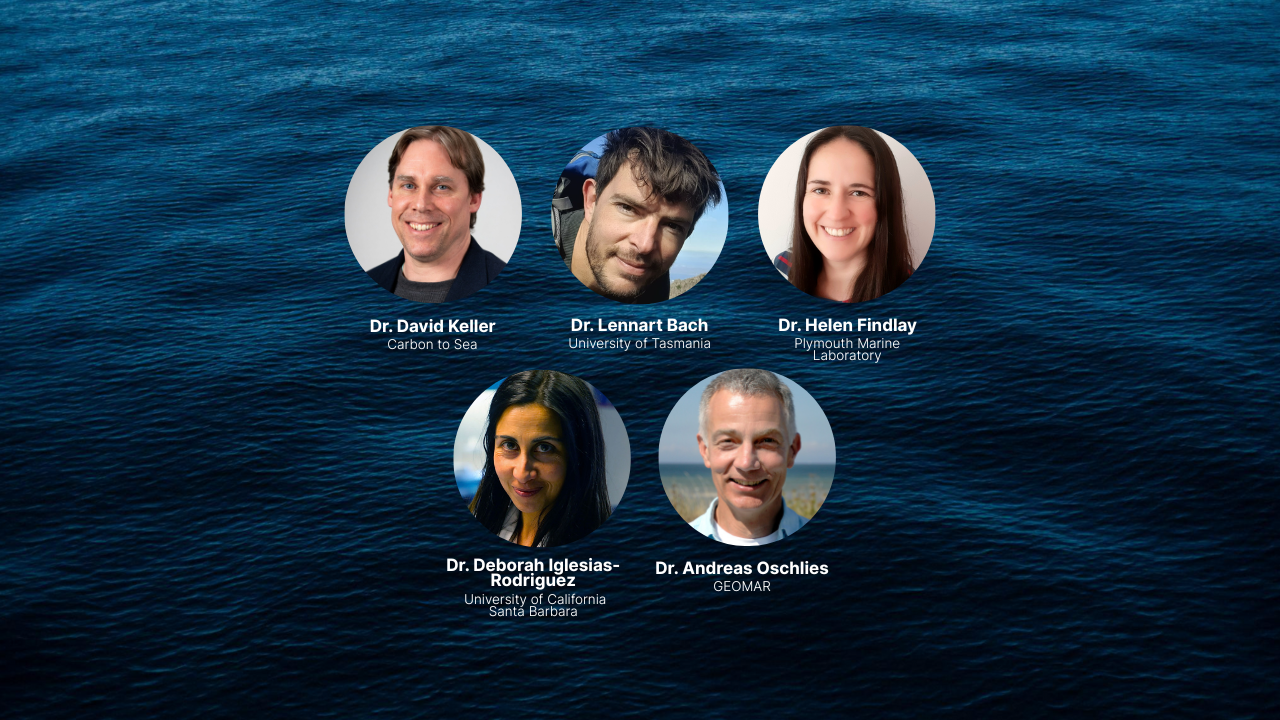
On December 4th, Carbon to Sea hosted a webinar on “Understanding Latest Environmental Safety Research and Ocean Health Monitoring for OAE.” The event was moderated by Carbon to Sea’s Director of Research and Technology, Dr. David Keller, and featured four expert speakers who discussed emerging research developments from the ocean alkalinity enhancement (OAE) field.
Dr. Helen Findlay, a Biological Oceanographer from Plymouth Marine Laboratory and Honorary Professor at the University of Exeter, presented the Environmental Impact Monitoring Framework — a guide for evaluating the environmental impacts of OAE across its different pathways. By extending existing codes of conduct for ocean-based CDR, the framework is designed to promote safety, transparency, and accountability that will support ongoing and future research efforts. Dr. Findlay highlighted the framework’s “phased and gated” approach, which walks through the different considerations for responsibly scaling-up or stopping projects. This is designed as a tool that stakeholders at every level, from research teams to regulators, can use to assess and mitigate the environmental impact of OAE field research projects.
Then, Dr. Debora Iglesias-Rodriguez, a Professor of Biological Oceanography at the University of California Santa Barbara and author of the 2022 US National Academies report, “A Research Strategy for Ocean-based Carbon Dioxide Removal and Sequestration”, presented findings from lab experiments examining how OAE may affect marine ecosystems. Her work centers on a core question: does deployment of alkalinity meaningfully alter organisms’ physiological performance, taxon selection, and community composition? To answer this, Dr. Iglesias-Rodriguez and her team have been conducting rigorous lab and mesocosm trials that establish important observations under tightly controlled conditions. However, these experiments cannot account for crucial factors like seasonal and oceanographic variability that occur in real-ocean conditions. Moving to field trials — for example, leveraging efforts of long-term oceanographic time series — is a necessary next step for her research to truly understand the impact of OAE deployments on marine ecosystems. This information is key to designing adaptive (when and where to deploy) and responsible OAE deployments.
Next, Dr. Lennart Bach, Associate Professor in Marine Phytoplankton Physiological Ecology at the University of Tasmania, outlined the current state of knowledge on OAE’s environmental effects. He drew the conclusion that, based on existing research, the environmental effects of the intentional alkalinity perturbation appears to be benign and consistent with natural ocean variability — at the diluted levels expected from deployment. However, there are still important and unanswered questions that need to be answered. Dr. Bach’s own research focuses on OAE’s intentional alkalinity perturbation which sequesters CO2, but also on the various unintentional “collateral perturbations” that come alongside the different OAE implementation pathways. Scientists have a good understanding of how added alkalinity affects carbonate chemistry as it relates to environmental impacts, but there is more to understand about potential unintended perturbations with trace metals or nutrients present in different alkaline feedstocks.
Lastly, Dr. Andreas Oschlies, Head of the Biogeochemical Modelling research unit at GEOMAR and co-chair of Germany’s CDRmare research mission, spoke about the guide of best practices for OAE research — an open-access resource developed to bring greater consistency and coordination to the fast-growing field. The guide includes standardized protocols for experiments, modeling, data reporting, and monitoring, research, and verification (MRV), allowing research to be more comparable across projects. Dr. Oschlies also shared results from Germany’s CDRmare program, which brings together nearly 140 scientists to study important questions about ocean-based CDR pathways. So far, results based on lab and mesocosm studies have indicated small, manageable environmental impacts of OAE, but there are impacts that need further examination in field trial settings, including potential impacts of delayed phytoplankton blooms and potential carbon storage leaks caused by marine calcifiers and sediments.
Thank you to all of our speakers and attendees for joining us. As mentioned during the panel, there are several current or upcoming opportunities to shape this discussion:
- The Environmental Impact Monitoring Framework has recently completed a period of public review and comment.
- The ICES Journal of Marine Science is accepting submissions for a special issue on marine CDR and its interactions with ecosystems, fisheries, and aquaculture through February 13, 2026.
- Dr. Bach’s team will be releasing new data from the OAE Pelagic Impact Intercomparison Project (PIIP) which was conducted in 16 countries. Keep an eye out for this forthcoming research.
You can watch the full webinar recording at the following link.