
By Carbon to Sea Initiative
Carbon to Sea initiative’s first Joint Learning Opportunity, launched in partnership with COVE and Planetary, supported research and field-building for ocean alkalinity enhancement (OAE) projects in Canada. The Ulnooweg Development Group led an initiative with Lennox Island to foster community involvement in learning about OAE projects and shellfish farming enhancements, with a focus on integrating traditional Indigenous knowledge with modern technological approaches.
We previously highlighted the work of joint learning opportunity recipients Dr. Julie LaRoche (HERE), Dr. Chris Algar (HERE), and Sequoia Scientific (HERE), as well as the OAE research being led by the Woods Hole Oceanographic Institution’s Dr. Adam Subhas (HERE).
What were the goals of the joint learning opportunity and how was it underscored by the perspective of Mi’kmaq First Nations?
The intent of this collaborative project was to raise awareness in Lennox Island about climate change impacts, explore how OAE could help mitigate these changes, and understand its potential benefits for shellfish aquaculture, which is important to residents both economically and culturally. Through engagement sessions and workshops, community members were invited to learn more about OAE projects, and discuss how our traditional First Nations knowledge and lived experiences can be combined with modern technologies and tactics for climate mitigation.
Mi’kmaq perspectives were foundational to designing our community engagement efforts. Throughout the project, we relied heavily on the unique generational perspectives of the Aboriginal Women’s Association of PEI (AWAPEI), the PEI Office of the Regional Chief (PEIORC), Elders, fishers, shellfish farmers, and residents on the local ecosystems and viewpoints. The Lennox Island community prioritizes an interconnectedness between the ocean, the environment, and people, which helped us understand how to explain OAE within a larger framework of environmental, social, and cultural harmony.
How was your progress tracked throughout the research process and what was learned from each benchmark?
We used four milestones to track progress and make sure we were building a holistic understanding of local perspectives while identifying the best ways to raise awareness.
The first milestone involved using surveys and community engagement sessions to understand existing perceptions of climate change and its impacts on Lennox Island. We developed the survey with community partners like AWAPEI, PEIORC, Elders, and local fishers to ensure cultural practices, values, and mechanisms were respected. From this, we were able to learn that residents were aware of climate change and its impacts and that there is a general interest in OAE as a potential strategy for mitigation, but concerns around how the science works.
To address those concerns, the second milestone used portable labs and tanks to perform demonstrations of OAE techniques and their effects on the water and shellfish health. These hands-on activities with demonstrations by Dr. Will Burt from Planetary helped communicate the wide-ranging impacts of carbon pollution on ocean life and how OAE relies on the ocean’s natural carbon removal process to mitigate those impacts.
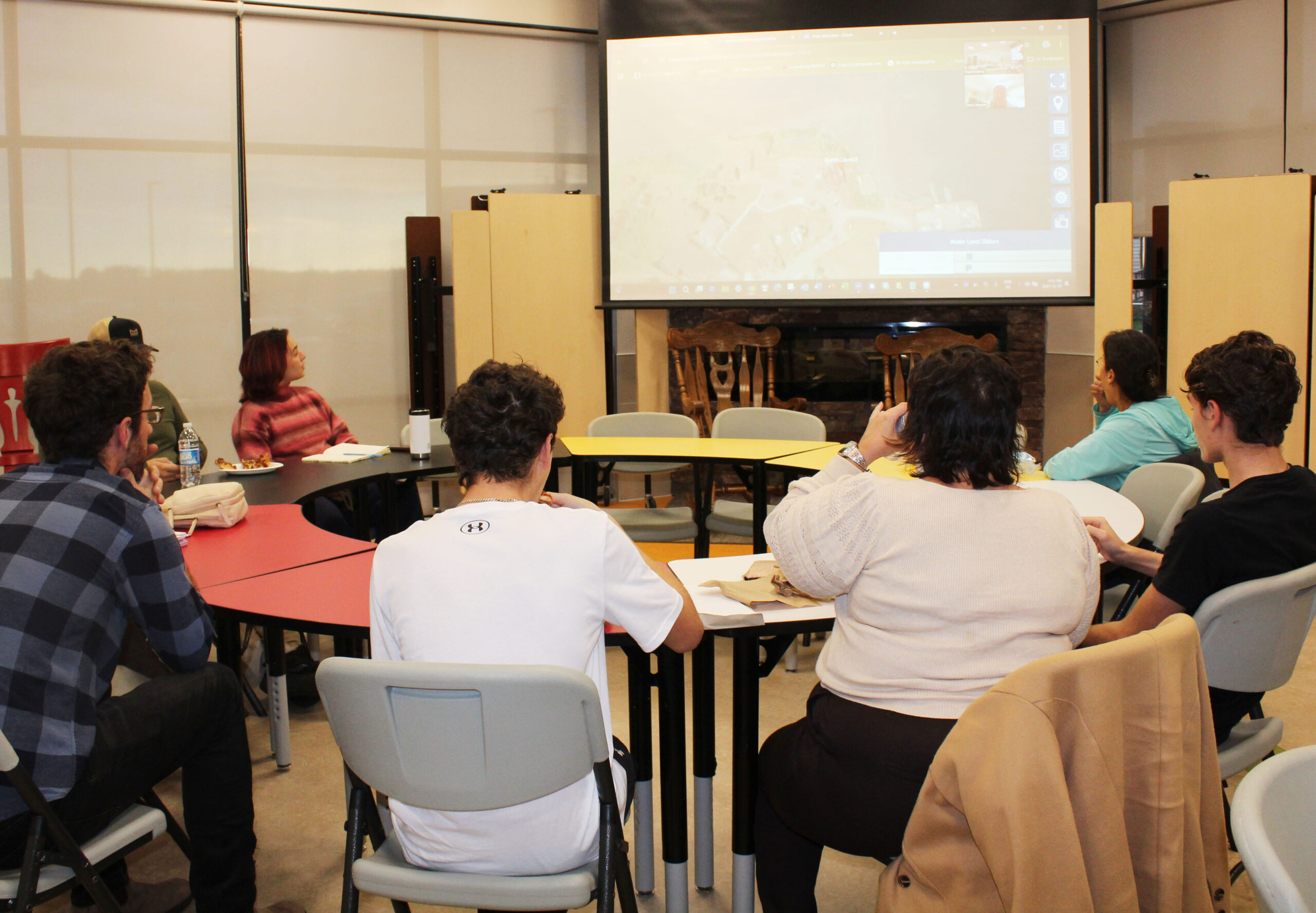
The third milestone was our educational outreach. Working with Lennox Island communities, we used storytelling to link the impacts of climate change and the potential benefits of OAE with First Nations knowledge and practices. We created physical and online resources in English, French, and Mi’kmaw for community seminars and school events. At two of the three events, we also offered one-on-one interviews to understand the participants’ thoughts and concerns about OAE and climate change.
The final milestone was the project report we submitted to Carbon to Sea, which incorporated the recommendations from Lennox Island community members and project partners to hopefully inform future community engagement efforts with First Nations Tribes.
What do you hope comes from the awareness this project built?
We hope this project leads to deeper and more intentional engagement with First Nations communities on important climate research. We weren’t just giving members of Lennox Island First Nation scientific definitions of climate change and OAE, but engaging in collaborative dialogue about how climate change is already impacting their lives and livelihoods, possibilities for mitigation and adaptation, and where OAE might be able to play a role. Our hope is that OAE researchers in Canada will continue to build on this relationship with the PEIORC and other partners, to continue hosting additional engagement and educational sessions, finding opportunities to get the next generation of Mi’kmaq involved, and looking for opportunities for further collaboration with First Nations communities within and beyond the Bedford Basin.
To me, this project demonstrated the importance of climate solutions that involve both modern science and mechanisms (like OAE) with First Nations knowledge about our rivers, oceans, and environments. First Nations leaders and communities are essential partners in developing and eventually deploying any potential climate strategy.