By Anna Madlener
Carbon to Sea’s MRV Blog: This is the third installment in Carbon to Sea’s MRV blog series. I’m Anna Madlener, Senior Manager for MRV at Carbon to Sea. Check out previous posts on open-system CDR and our independent review of the first OAE credits issued in June 2025.
In this post, we introduce the Interactive MRV Database: a structured and interactive look at the current practice of MRV in five of the world’s first OAE field projects.
Overview
Ocean alkalinity enhancement (OAE) is an open-system carbon dioxide removal (CDR) approach, meaning the process of CDR happens slowly over space and time. The very features that make it compelling also make it challenging to monitor and attribute. As well, the approach to monitoring may change depending on your OAE method, the purpose of your research, and whether you are an academic researcher or private company.
In the absence of a shared regulatory standard, there remains ambiguity around what monitoring for OAE entails, how much progress has been made, and how closely perceptions align with actual field practice. Yet despite this divergence, there is relevant activity and progress in the field. In 2025, Carbon to Sea conducted a structured MRV landscape analysis, combining a desktop review of public documentation with 37 expert interviews across academia, the private sector, MRV providers, buyers, and funders. Coming out of this analysis, Carbon to Sea sought to document activities in an effort to benchmark a starting point against which we can track improvements in MRV quality, confidence, and, in future waves, cost.
A database to document practice and prioritization
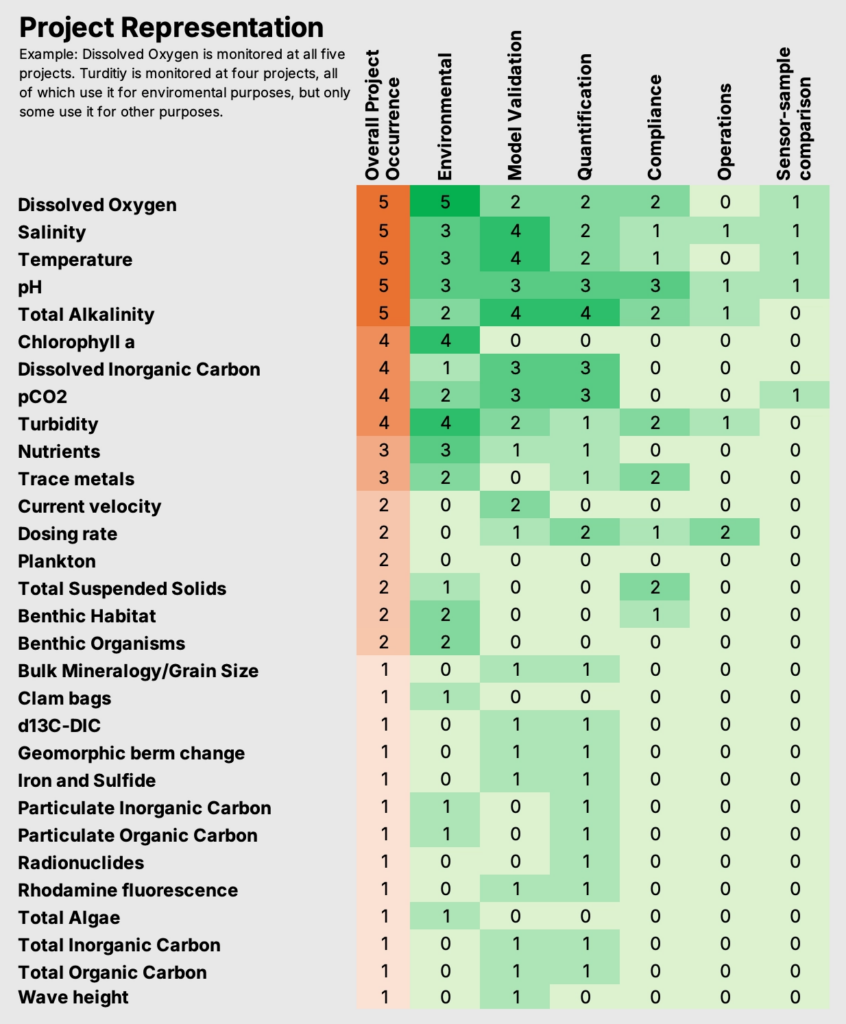
With gracious contributions from project leaders of LOC-NESS, Vesta, Ebb Carbon, Planetary, and the University of Rhode Island, the Interactive MRV Database offers the most detailed look available at OAE field measurements today. Across hundreds of measurements, the database tracks the parameter, location, collection method or sensor, and purpose of the measurements.
The Interactive MRV Database consolidates this information into a unified structure and presents an insightful meta-analysis of 250+ measurements indexed across the world’s first five major OAE field projects. With this database, we offer a structured documentation of how monitoring is being practiced and prioritized across five projects.
What this database does not do: Because the scope and nature of the research is varied, the purpose of the database is not to compare the projects in absolute terms, assess the adequacy of any project’s MRV, or validate carbon removal estimates. Rather, it looks for emerging themes and areas of alignment in order to surface insight and opportunity. This database does not analyze baseline monitoring, but focuses specifically on measurement of OAE (though there can be overlap).
Using the database
The Interactive MRV Database is a practical starting point for understanding what OAE monitoring looks like in the water today. It lets you quickly explore how five field projects are approaching MRV — what they measure, why they measure it, where sampling happens, and which platforms and sensors they rely on — without having to piece together plans across documents. The easiest way to use it is to follow the section headings that match your question (e.g., What is measured? or Where are measurements taken?), then use the interactive charts to see patterns and click into individual project cards for brief context on how each approach is implemented.
Next steps
We view this interactive database as a living tool, planned to be updated approximately once a year as new projects launch and practices evolve. Beyond updates, we encourage projects to submit information for consideration and inclusion. We aim to better understand and document emerging practices — especially around measurement strategies, sensor development, and the use of this dataset to benchmark and improve MRV.
Applications to the second installment of Carbon to Sea’s Research Fellowship are currently open until March 10. We are looking for one fellow to work on the expansion of this database. Please see details on how to apply here.
Do you have questions or feedback about this database, future iterations of it, or would like to add new projects or revise existing ones? If so, please email feedback@carbontosea.org to get in touch.