
By Carbon to Sea Initiative
Yesterday, Carbon to Sea hosted the “Examining MRV Practices Across Five OAE Projects” webinar featuring leading scientists from the five projects included in our recently published Interactive MRV Database. The virtual event focused on introducing the database and its features, as well as each project’s monitoring approach, rationale, trade-offs, challenges, and future plans.
Watch a recording of the webinar below, or on YouTube.
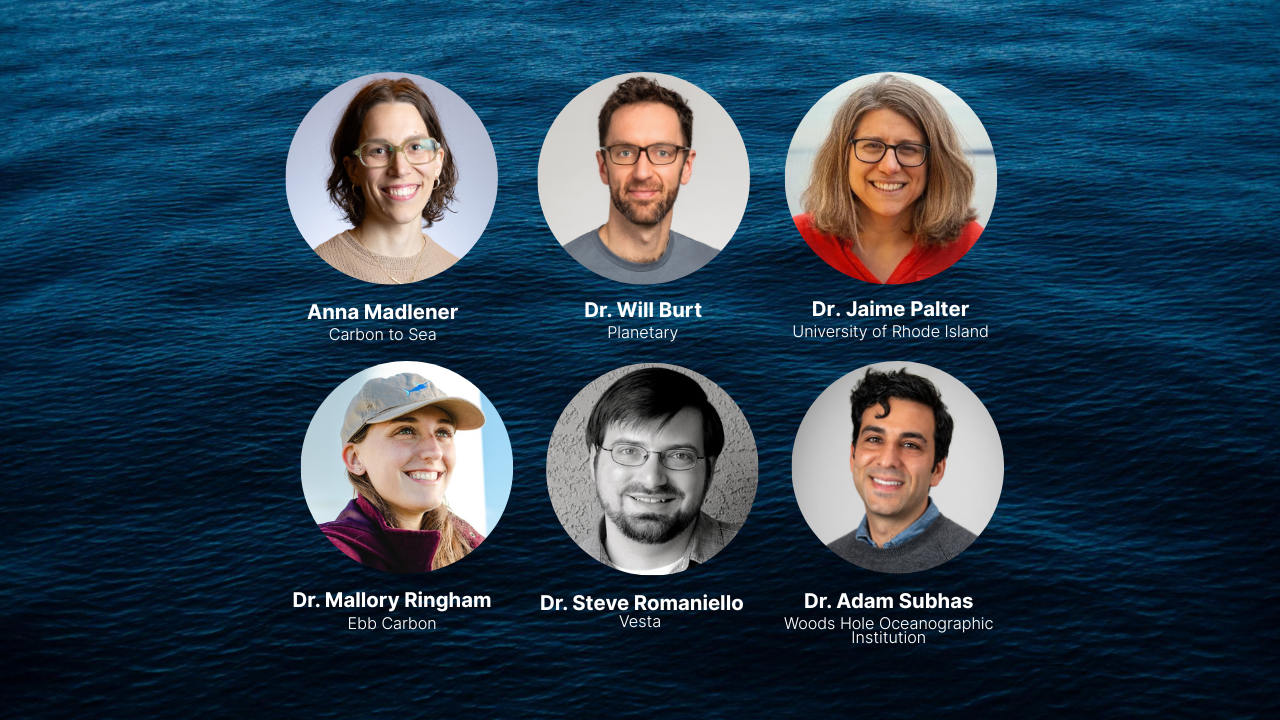
The discussion was moderated by Anna Madlener, Senior Manager for MRV at the Carbon to Sea Initiative, and featured leading scientists from five ocean alkalinity (OAE) projects, including:
- Dr. Will Burt, VP of Science and Product at Planetary, a startup company that has been testing OAE from a coastal outfall using a mineral slurry feedstock in Halifax, Nova Scotia.
- Dr. Jaime Palter, Associate Professor of Oceanography at the University of Rhode Island, and co-Principal Investigator of a NOAA-NOPP-funded project studying the alkaline runoff into the Winnapaug Salt Pond, Rhode Island, from a golf course where limestone is routinely added.
- Dr. Mallory Ringham, Head of Ocean Science at Ebb Carbon, a startup company that has conducted a pilot experiment in Port Angeles, Washington, testing an electrochemical OAE approach in coastal waters.
- Dr. Steve Romaniello, Director of Geochemistry at Vesta, a startup company that has been conducting a pilot experiment in Duck, North Carolina, testing a coastal enhanced weathering approach by placing natural olivine rock on coastal seabeds. This project’s monitoring is conducted by the non-profit organization Hourglass Climate.
- Dr. Adam Subhas, Associate Scientist at the Woods Hole Oceanographic Institution and the project lead for LOC-NESS, an academic research effort that tested ship-based OAE by releasing sodium hydroxide over the course of one day in an open-ocean setting off the Gulf of Maine.
The Interactive MRV Database is designed to be a living tool that will be updated approximately once a year as new projects launch and practices evolve. Beyond updates, we encourage projects to submit information for consideration and inclusion. We aim to better understand and document emerging practices, especially around measurement strategies, sensor development, and the use of this dataset to benchmark and improve MRV.
If you have questions or feedback about the Interactive MRV Database, would like to add projects to the database, or would like to revise existing projects in the database, please email feedback@carbontosea.org.