

OAE Environmental Impact Monitoring Framework
The Ocean Alkalinity Enhancement (OAE) Environmental Impact Monitoring Framework provides essential guidance for researchers, regulators, funders, industry stakeholders, and the public on how to evaluate the environmental impacts of OAE approaches during field research.
Developed in partnership between PML Applications and the Carbon to Sea Initiative, this framework extends existing codes of conduct for marine carbon dioxide removal (mCDR) researchers. As mCDR and OAE research projects begin to move from the lab to field trials — an essential step to rigorously evaluate how these approaches work in real-world conditions — this framework defines specific environmental monitoring needs and considerations for OAE field trials. This document aims to promote human and environmental safety, transparency, and accountability across the fast-growing oCDR community.
The framework is structured around a phased and gated approach, allowing OAE projects to scale up gradually, as knowledge grows and potential risks are mitigated. It draws from established environmental standards, government regulations, lessons from past field trials, and community best practices.
If you would like a printed copy of the OAE Environmental Impact Monitoring Framework, please fill out this form. We will cover the cost of printing and shipping for the first 50 respondents. Please submit your request by October 1, 2026.
Table of Contents
- Table of Contents
- Document History
- View and Download PDF
- About
- Figures and Tables
- Part I: Environmental Impact Monitoring Framework
- 1. Executive Summary
- 2. Purpose and Guiding Principles
- 3. Background on Ocean Alkalinity Enhancement (OAE)
- 3.1 Monitoring Environmental Impacts of Biogeochemical Changes
- 3.1.1 Enumerating and Mitigating Environmental Risks
- 4.1.2 Commonly considered feedstocks for OAE
- 4.2 OAE Methods
- 4.2.1 Open Ocean Alkalinity Addition—Aqueous
- 4.2.2 Open Ocean Alkalinity Addition—Particulate/Slurry
- 4.2.3 Coast Outfall Pipe Alkalinity Addition
- 4.2.4 River alkalinity addition
- 4.2.5 Electrochemical Acid Removal
- 4.2.6 Coastal Enhanced Weathering
- 4. Environmental Impact Monitoring Framework
- Part II: Practical Guidance for Framework Implementation
- 5. Stakeholder and Public Involvement and Consultation
- 6. Key Parameters for Monitoring
- 7. Regulatory Considerations for Ocean Alkalinity Enhancement
- 8. Operational Health and Safety
- 9. Transparent Data Publishing and Reporting Guidelines
- 10. Closing Remarks
- References
- Appendix A. Key Terms and Definitions
- Appendix B. Existing Literature Demonstrating the Biological and Ecological Impacts Associated with OAE
- Appendix C. High-level checklist for regulators assessing OAE field trials
- Appendix D. Relevant Regulatory Guidance for OAE
- Appendix E. Funder Details – About Carbon to Sea
Document History
| 1.0.0 (Current) | Official Publication | September 1, 2026 | |||
| Author(s) | David Keller, Irene Polnyi, Brishelle Gamble, Laura Stieghorst, and Sam Fawcett | ||||
| Reviewer: David Keller | Approver: Irene Polnyi | ||||
| 0.5.0 | Preprint for Annual Convening | April 27, 2026 | |||
| Author(s) | David Keller, Irene Polnyi, Brishelle Gamble, Laura Stieghorst, and Sam Fawcett | ||||
| Reviewer: David Keller | Approver: Irene Polnyi | ||||
| 0.4.0 | Draft for public comment | October 27, 2025 | |||
| Author(s) | David Keller, Irene Polnyi, Brishelle Gamble, Laura Stieghorst, and Sam Fawcett | ||||
| Reviewer: David Keller | Approver: Irene Polnyi | ||||
| 0.3.0 | Draft reflecting friendly review | May 16, 2025 | |||
| Author(s) | David Keller, Irene Polnyi, Brishelle Gamble, Laura Stieghorst, and Sam Fawcett | ||||
| Reviewer: David Keller | Approver: Irene Polnyi | ||||
| 0.2.0 | Draft reflecting internal review | February 27, 2025 | |||
| Author(s) | Sam Fawcett, Vassillis Kitidis, Helen Findlay, Jerry Blackford,Tamsin Dobson, and Tim Fileman | ||||
| Reviewer: Tamsin Dobson | Approver: Sam Fawcett | ||||
| 0.1.0 | Initial Draft | October 3, 2024 | |||
| Author(s) | Sam Fawcett, Vassillis Kitidis, Helen Findlay, Jerry Blackford, Tamsin Dobson, and Tim Fileman | ||||
| Reviewer: Tim Fileman | Approver: Sam Fawcett | ||||
View and Download PDF
About
PML Applications
PML Applications (www.pml-applications.co.uk) contributes towards a sustainable ocean through the delivery of exceptional and environmentally-responsible marine consultancy services and products to a global client base.
PML Applications is a uniquely diverse organization, providing scientific research, consulting, and training services to help people understand their impact on the marine environment and its impact on their business. PML Applications accelerate the development of new technologies for a sustainable blue economy.
As the commercial arm of the research charity Plymouth Marine Laboratory (www.pml.ac.uk), PML Applications’ mission is to ensure a sustainable future for the global ocean. As such, all of its profits are reinvested in PML’s world-leading and cutting-edge research.
Prospect Place
The Hoe
Plymouth
Devon
PL1 3DH, UK
Project Lead
Sam Fawcett
Phone
+44 (0) 1752 633412
Email
saf@pml.ac.uk
The Carbon to Sea Initiative
Funding, steering, and co-authorship for this report was provided by the Carbon to Sea Initiative. Carbon to Sea is a nonprofit philanthropic funder of scientific research and a range of programming to advance our understanding of the scientific, technical and social viability of ocean alkalinity enhancement as a method for mitigating the worst impacts of climate change.
3 World Trade Center
175 Greenwich St.
38th Floor
New York, NY 10007
Project Lead
Irene Polnyi
Email
irene@carbontosea.org
Role Responsibilities
Author(s): Content, data interpretation, views, and opinions
Reviewer: Formatting, proofreading, data checking, and error checking
Approver: Final editing and approval
The information provided by PML Applications Ltd and the Carbon to Sea Initiative in this report is solely for use within the context of this report. PML Applications Ltd and the Carbon to Sea Initiative do not authorize the reproduction or reuse of any of this material in part or in full, without specific prior consent from PML Applications Ltd and the Carbon to Sea Initiative. PML Applications Ltd and the Carbon to Sea Initiative accept no liability for any losses arising from reproduction or reuse/misuse of the information provided in this report.
Author List
PML Applications
- Sam Fawcett
- Tamsin Dobson
- Tim Fileman
- Vassilis Kitidis
- Helen Findlay
- Jerry Blackford
The Carbon to Sea Initiative
- David P. Keller
- Irene Polnyi
- Brishelle Gamble
- Laura Stieghorst
Acknowledgements
This work was primarily authored by PML Applications and the Carbon to Sea Initiative. The authors wish to express their gratitude to all those who contributed directly to the framework and to the many reviewers who provided feedback on its evolving drafts. Reviewers and contributors are independent and do not constitute endorsement of the content.
Contributors
Contributors provided significant guidance, subject matter expertise, and commentary in early drafts of the framework. Contributors who did not grant permission to be publicly acknowledged have been omitted from the list below.
- Grace Andrews (Hourglass Climate)
- Lennart Bach (University of Tasmania)
- Nina Bednarsek (Bednarsek Carbon Solutions Biology Lab LLC)
- Tom Bell (Plymouth Marine Laboratory)
- Will Burt (Planetary Technologies)
- Paul Cough (Independent consultant)
- Peter Croot (University of Galway)
- Giulia Faucher (GEOMAR – Helmholtz Centre for Ocean Research Kiel)
- Sophie Gill (Isometric)
- Jiaying Guo (University of Tasmania)
- Kalina Grabb (Dalhousie University)
- Laura Haynes (Vassar College)
- Paul Halloran (SeaCURE)
- Lydia Kapsenberg (CEA Consulting)
- Frauke Kracke (Stripe)
- Leila Richards Kittu (GEOMAR – Helmholtz Centre for Ocean Research Kiel)
- Charlotte Marshall (Environment Agency)
- Lauren A. Moseley (The Carbon to Sea Initiative)
- Jens Daniel Müller (The Carbon to Sea Initiative)
- Joe Perry (Centre for Environment, Fisheries and Aquaculture Science, Lowestoft)
- Phil Renforth (Heriot-Watt University)
- Sarah Reynolds (University of Portsmouth)
- Mallory Ringham (Ebb Carbon)
- Emily Rogers (Third Derivative / RMI)
- Lily Schacht (360 Solutions)
- Adam Subhas (Woods Hole Oceanographic Institution)
- Ricardo Torres (Plymouth Marine Laboratory)
- Jason Vallis (Planetary Technologies)
- Brad Warren (Global Ocean Health)
- Romany Webb (Columbia Law School)
- Steve Romaniello (Vesta)
- Jacki Long (Submarine Scientific)
Workshop Participants
Workshop participants provided input and feedback on core framework assets in an Environmental Monitoring Workshop hosted during the Carbon to Sea 2025 Annual Convening.
- Lydia Kapsenberg (CEA Consulting)
- Julie Pullen (Carbon to Sea, Science Advisory Board)
- Chris Murray (Woods Hole Oceanographic Institution)
- Kate Bonzon (Environmental Defense Fund)
- Elliot Roberts (NuWa Solutions)
- Laura Haynes (Vassar College)
- Suki Wong (atdepth)
- Lindsey Gardner (National Wildlife Foundation)
- Ruth Driscoll-Lovejoy (Ocean Visions)
- Charly Moras (University of Hamburg)
- Michael Welch (EcoEngineers)
- Sam Clevenger (Grantham Foundation)
- Amanda Carter (Ocean Conservancy)
- James Gately (UC Santa Barbara)
- Katie Lebling (World Resources Institute)
- Josh Perfetto (Sempera)
- Solveig Olafsdottir (HAFRO)
- Kai Schulz (Southern Cross University)
- Jens Hartmann (University of Hamburg)
- Chris Mann (Independent consultant)
- Chris Pearce (National Oceanography Centre)
- Yaping Ao (Environmental Defense Fund)
- Laura Stieghorst (Carbon to Sea)
- Ellen Briggs (UC San Diego, Scripps)
- Eddie Halfyard (CarbonRun)
- Kaycie Lanpher (U.S. Environmental Protection Agency)
- Sena McRory (U.S. Environmental Protection Agency)
- Chloe Dean (Woods Hole Oceanographic Institution)
Public Comment Reviewers
Public Comment Reviewers provided feedback during an open comment period in December 2025. Several reviewers represented groups of reviewers or cohorts. Reviewers who did not grant permission to be publicly acknowledged have been omitted from the list below.
- Daan Reijnders (SeaO2)
- Natalya Evans (Dalhousie University)
- Mallory Ringham (Ebb Carbon)
- Elliott Roberts (NuWa Solutions)
- Valerio Caruso (Limenet)
- Will Burt (Planetary Technologies)
- Gabriella Kitch (Yale Center for Natural Carbon Capture)
- Kalina Grabb (Dalhousie University)
- Paul Cough (Independent consultant)
- Sarah Schumann (Fishery Friendly Climate Action Campaign)
- Imen Saidi (PRONOE)
1. Figures and Tables
Figures
- Figure 1: High-Level Framework for Responsible Research Advancement
- Figure 2: Atmospheric CO₂is removed and durably stored in two steps
- Figure 3: Public Participation Spectrum
- Figure 4: Maritime zones as defined by the United Nations Convention on the Law of the Sea (UNCLOS)
- Figure 5: Canadian Ocean Governance
- Figure 6: Regulatory responsibilities for estuaries, coasts, and marine environments in England
- Figure 7: USA’s Marine Protection, Research, and Sanctuaries Act (MPRSA – 40 CFR Part 222) permitting process
- Figure 8: Major steps for the U.S. EPA to develop and issue permits under the Clean Water Act and the National Pollutant Discharge Elimination System (NPDES)
^ RETURN TO TABLE OF CONTENTS ^
Tables
- Table 1: Prioritized Parameters for Environmental Monitoring of OAE
- Table 2. OAE Methods Definitions and Unique Focus Areas for Monitoring
- Table 3: Characteristics of commonly considered OAE feedstocks
- Table 4: List of public engagement strategies
- Table 5: Prioritized parameters and monitoring methods for environmental impact monitoring
- Table 6: Regulation by Marine Zone and Jurisdiction for Key Nations (not an exhaustive list of regulations)
- Table 7: Operational Health and Safety Risks and Mitigation Strategies
- Table 8: Example of a safety protocol for a coastal outfall OAE trial
- Table 9: Acronyms and Definitions
- Table 10: Quality elements for ecological baselining showing the definition for high and good status taken from the Water Framework Directive (WFD) (2000)
- Table 11: UK Estuaries and coastal waters specific pollutants and operational environmental quality standards (EQS)
- Table 12: Environmental Quality Standards (EQS) table for heavy metals used in Europe, taken from Environmental Quality Standards Directive (EQSD)
- Table 13: U.S. EPA’s recommended aquatic life criteria for discharge measured within a pipeline
- Table 14: Nova Scotia EQSs for Surface Water and Groundwater Discharging to Surface Water
Part I: Environmental Impact Monitoring Framework
1. Executive Summary
PML Applications and the Carbon to Sea Initiative present here a comprehensive, consensus-driven framework for monitoring environmental impacts in ocean alkalinity enhancement (OAE) field trials. The primary objective of this framework is to guide regulators, funders, industry stakeholders, and interested members of the public on how to evaluate the environmental impacts of OAE approaches in field trials. The adoption of the comprehensive approaches recommended in this framework for baseline characterization and environmental monitoring aims to improve confidence in the design and implementation of OAE projects among regulators and the public, and contribute to the successful integration of OAE into marine management regimes, including ecosystem-based management.
OAE offers outsized potential among Carbon Dioxide Removal (CDR) solutions for climate regulation, but it also poses considerable challenges relating to wider interactions with the marine environment. It is imperative that the development of the nascent marine CDR (mCDR) industry, including OAE, follows commonly adopted principles of human and environmental safety, transparency, and accountability. Many of these principles are referenced in existing sector documents, such as the Aspen Institute’s mCDR code of conduct1 and Principles for responsible and effective marine carbon dioxide removal development and governance2. This framework extends those principles to identify environmental monitoring needs and to elaborate on relevant considerations in the context of OAE field trials. As such, this framework is complementary to existing codes of conduct by offering helpful models for considering environmental risk, as well as by offering practical monitoring methods.
This document is divided into two parts: the first part introduces and contextualizes the Environmental Impact Monitoring Framework for OAE fieldwork at different research stages and scales. The second part provides a Practical Implementation Guide for applying the framework. The framework is complementary to regulatory monitoring requirements and it will be updated periodically to reflect best practices as research and the industry develop.
Part I of this document, the Environmental Impact Monitoring Framework, includes the purpose and guiding principles (Section 2) used in the framework’s creation; a background on OAE (Section 3) describing the general science and principles of OAE, as well as the most common methods currently being explored in field research; and a presentation of the framework categorized by different stages of a field trial (Section 4). The overarching principle of the framework is that the development of OAE follows a phased and “gated” approach, whereby the project ambition scales up gradually and in direct relationship with a growing knowledge base, to mitigate risk and build understanding. There is no set duration for each stage, as this depends on the availability of relevant existing information, the speed of learning, and a range of outside factors. Each stage builds on the information obtained previously, while the stage gate criteria (i.e., the criteria that determines whether a project should advance to the next stage) allow for a critical evaluation of progress and risk mitigation. Thereby, the framework breaks OAE projects into four key stages: 1) planning and preparation, 2) methods validation, 3) OAE field piloting, and 4) continuous alkalinity dosing and environmental monitoring. Progress through these stages may not be linear and will likely involve iterative cycles of planning and testing. Figure 1 defines the stages, summarizes the key activities and analysis, and shows the required output at the end of each stage.
Figure 1: High-Level Framework for Responsible Research Advancement
For further information on the stage-gated monitoring recommendations, please see Section 4. Environmental Impact Monitoring Framework.
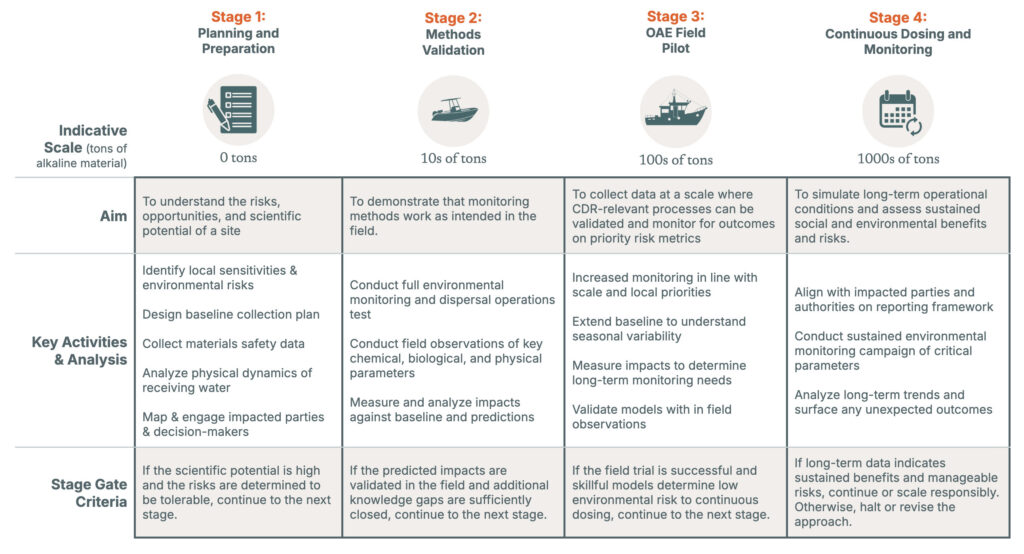
Part II of this document, Practical Guidance for Framework Implementation, details these activities in further detail. The section begins by highlighting the need for early and meaningful stakeholder and rightsholder engagement (Section 5) to allow for free, prior, and informed consent, and for data sharing. The creation of an environmental monitoring plan (Section 6) that appropriately reflects the unique considerations of an OAE intervention should be informed by stakeholder and rightsholder engagement and the establishment of a baseline (or benchmark) for the relevant environmental variables. The environmental variables should support the clear understanding of local sensitivities, hydrodynamics, and biogeochemistry, as well as the predicted impacts and potential risks of an alkalinity addition to aid in the prioritization of a project’s ecological and biological monitoring considerations. The final requirements of an environmental monitoring plan will be at the discretion of the designated permitting authorities and will vary by jurisdiction, making it critical for practitioners to reference the active regulations, relevant preceding projects, and the jurisdictional regulatory bodies for consultation and ultimate project approval (Section 7). In parallel with these considerations for designing an environmentally responsible OAE monitoring plan, practitioners should also establish best practices for preparatory and on-site operational health and safety (Section 8) as well as develop transparent data-sharing and reporting plans for operational and post-operational project phases (Section 9).
As the ultimate goal of any OAE project is to understand its influence on the carbonate system, there are standard carbonate chemistry parameters (e.g., Total Alkalinity, TA; Dissolved Inorganic Carbon, DIC) that are highly likely to be monitored regardless of any project’s specific goal or circumstance. Recognizing that OAE projects may have diverse objectives (e.g., research, carbon accreditation, etc.), this framework aims to align field practitioners around a common approach for environmental monitoring. Table 1 summarizes the Regulatory Parameters that are most consistently required by regulators for the purpose of environmental safety during OAE operations. The information in Table 1 is based on a comprehensive analysis of recent field trial monitoring plans and permits, though this should not be taken as legal advice or supersede direction provided by a local regulator (see Section 7). Additional parameters – referred to here as Attribution and Context-Specific Parameters – support the interpretation of biological impacts and attribution; and their inclusion will depend on the OAE method and receiving ecosystem, as outlined in Table 2 and discussed throughout the framework. Further information on monitoring methods and reference material for these parameters is provided in Table 5.
Table 1. Prioritized Parameters for Environmental Monitoring of OAE
Further information on parameter monitoring methods and external reference material is provided in Table 5. Additional considerations for parameter selection and monitoring design is provided in Section 7. Key Parameters for Monitoring.
| Environmental Monitoring Parameters | |
| Regulatory Parameters | These parameters are consistently required by regulators for environmental monitoring. |
| pH | Measuring pH is essential to track changes in seawater acidity resulting from alkalinity addition, which directly influences carbonate chemistry and biological processes.3, 4 |
| Temperature | Temperature affects the solubility of gases like CO₂ and reaction rates in seawater, thereby modulating the efficacy and potential ecological impacts of OAE.5 |
| Salinity | Salinity influences carbonate system speciation and buffering capacity, and it is critical for interpreting biogeochemical changes and mixing processes post-alkalinity addition.5 |
| Total suspended solids (TSS) | Monitoring TSS detects changes in particulate matter that may arise from mineral additions or pH shifts, which can affect light penetration, sedimentation rates, and benthic habitats.4, 6 |
| Trace metals (if relevant for feedstock) | Measuring trace metals ensures that OAE materials do not introduce harmful concentrations of contaminants, protecting marine organisms and maintaining water quality.7, 8, 9 |
| Attribution Parameters | These parameters are needed to further parameterize and identify the source of observed impacts. |
| Dissolved oxygen (DO) | Monitoring dissolved oxygen helps assess ecosystem health and potential biological responses, such as shifts in respiration or photosynthesis, due to changes in seawater chemistry.10, 11 DO is occasionally required by regulators, in which case it would be a regulatory parameter. |
| Total alkalinity (TA) | Measuring TA quantifies the added alkalinity and tracks its persistence and distribution, which are central measures to assessing the carbon sequestration potential and geochemical impacts of OAE.3, 12 |
| Dissolved inorganic carbon (DIC) | DIC measurements are critical to evaluate the ocean’s carbon uptake in response to alkalinity enhancement and to assess the balance of the carbon system.3 |
| Turbidity | Turbidity indicates changes in water clarity and potential particle formation or resuspension, which may result from mineral-based alkalinity inputs and which can affect light penetration and marine life.13, 14 |
| Plankton | Plankton monitoring helps identify potential ecological shifts or stress responses in primary and secondary producers, which are sensitive indicators of altered seawater chemistry.15, 16 |
| Chlorophyll-a | Chlorophyll-a is a proxy for phytoplankton biomass and is used to assess changes in phytoplankton that may result from OAE-induced shifts in pH or nutrient and light availability.17 |
| Partial pressure of carbon dioxide (pCO2) | Monitoring pCO₂ captures the effectiveness of OAE in reducing surface ocean CO₂ levels, thereby indicating the system’s capacity to enhance atmospheric CO₂ uptake. Very low pCO2 may also be an indicator of phytoplankton carbon limitation.3, 18 |
| Context-specific Parameters | The need for these attribution parameters is highly dependent on feedstock, location, dispersal method, and predicted impacts. |
| Benthic habitat and sediment biogeochemistry | Monitoring benthic parameters captures potential ecological and geochemical changes on/in the seabed resulting from OAE,19 including impacts on community structure, accumulation of materials, physical habitat, carbon or nutrient cycling, and potential impact on sediment alkalinity fluxes. |
| Benthic organisms | Monitoring the abundance, behavior, community composition, and/or distribution of specific benthic organisms can provide direct data on species that may have increased vulnerability or sensitivity.19 |
| Local commercially, ecologically, and/or culturally significant species | Monitoring the status of species that may hold significant ecological, economic, or cultural value provides critical insight into potential community-level impacts. Monitoring should be tailored to the specific sensitivities and habitat use patterns of these species.20, 21 |
| Dissolved organic carbon (DOC) | DOC measurements help assess how OAE may influence organic carbon cycling, microbial activity, and the potential for changes in remineralization or carbon export.22, 23 |
| Photosynthetically active radiation (PAR) | Measuring PAR determines the availability of light for photosynthesis, which may be affected by changes in water clarity due to suspended solids or other OAE-related factors.24 |
| Nutrients (detail below) | Nutrient measurements are necessary to detect changes in biogeochemical cycling that could result from altered pH and carbonate chemistry, potentially affecting productivity and ecosystem dynamics. This may include one or more of the parameters listed below.25 |
| Phosphate | Monitoring phosphate is essential to detect potential changes in nutrient availability that could influence primary productivity and community composition in response to altered seawater chemistry. |
| Silicate | Silicate levels are important for tracking potential impacts on diatom populations, which rely on silica for growth and may be differentially affected by shifts in carbonate chemistry. |
| Ammonia-nitrogen (NH3-N) | Measuring ammonia is important to evaluate potential impacts on nitrogen cycling and toxicity, as pH changes can shift the equilibrium between less harmful ammonium and toxic-free ammonia.4 |
| Nitrate-nitrogen (NO3-N) and nitrite-nitrogen (NO2-N) | Monitoring nitrate and nitrite tracks key steps in the nitrogen cycle, helping to identify shifts in nutrient dynamics or microbial processes affected by OAE. |
| Sulphate | Sulphate measurements are used to monitor the conservative behavior of major ions and detect any unintended changes from mineral additions that could alter ionic balance or microbial sulphate reduction.26, 27 |
Introduction
A number of philanthropic, academic, and private sector initiatives are working to evaluate and unlock ocean-based solutions to climate change. Among a range of many promising solutions, one stands out for its potential to deliver long-lasting climate benefits: ocean alkalinity enhancement (OAE).28, 29 As a result, research, development, and demonstration projects for OAE are growing, and with that there are questions about environmental impacts of OAE. However, OAE is a broad term referring to many different pathways, feedstocks, and methodologies, which makes a single, universal method for its safety evaluation difficult to achieve.
The authors of this document see as a first and necessary step the need to organize the best available science, methodologies, and thinking from the field’s leading practitioners on OAE environmental impact monitoring. This framework aims, for the first time, to deliver a single document field researchers and decision-makers can draw from as a reference to support their own work, with the full recognition that each project is unique. By aligning in some critical areas, we believe the field can advance more quickly and transparently.
We see an aligned network of field research and demonstration projects as the best mechanism to get real research plans and pilots onto the desks of decision-makers, and into the conversations of communities. We hope the first iteration of this framework will inspire additional teams to apply these strategies and codify their experiences to share with the world for the benefit of the field.
2. Purpose and Guiding Principles
The objective of this Environmental Impact Monitoring Framework is to provide structured and practical guidance on safely scaling OAE field research. It is intended to help researchers, regulators, and stakeholders design and evaluate environmental monitoring activities that are scientifically rigorous, context-sensitive, and aligned with the evolving understanding of the potential risks and benefits of OAE.
Field trials and demonstrations are critical to building real-world evidence on the ecological safety and carbon removal potential of OAE. However, if field activities outpace the growth of the knowledge base and regulations, the risk of unintended environmental harm increases. This framework is therefore guided by the principle that environmental risks remain low and manageable when the scale of activity is matched by proportional gains in scientific understanding.
To support this, the framework is structured in two parts: 1) an introduction and rationale for the framework’s design, and 2) guidelines for its successful implementation by a range of audiences—from academic researchers and project developers, to regulators and community members.
OAE harbors unique challenges and opportunities for environmental impact monitoring. Regulatory- and research-guided environmental monitoring, while robust, requires a unifying framework tailored to the specific needs of OAE projects.
The development of this framework is driven by these Guiding Principles:
- Staged progression through decision gates: Clear benchmarks should guide research progression and risk assessment. Early low-risk trials may require less intensive monitoring than larger longer-duration deployments, but all should be designed to anticipate possible impacts and prevent escalation.
- Based on best available knowledge: Recommendations draw on best available academic and operational knowledge, and they are complementary to available international standards and regulations.
- Flexible across OAE methods: The framework is designed to accommodate a variety of OAE approaches, materials and project environments, providing standards where possible and flexibility where necessary.
- Monitoring is not a substitute for risk mitigation: Monitoring is the last step in a long process of risk mitigation, which begins with rigorous project planning and dispersal design. Monitoring alone cannot mitigate impacts once they have occurred.
- Designed for practical implementation: The framework balances scientific rigor with operational feasibility and practical realities of dynamic ocean contexts while remaining adaptable over time.
Guided by these principles and building on existing regulations, the goal is to create a framework rooted in precaution and environmental stewardship while remaining practical and adaptable to project operators. This ensures the health and safety of the local environment at a project site while pursuing the broader goal of climate regulation.
Importantly, this framework is provided for informational purposes only. While care has been taken to ensure the accuracy of the methods and assumptions herein, the authors make no representations or warranties regarding the completeness, reliability, or applicability of this framework to any specific project or context. Any use of this framework is at the user’s sole discretion and risk. The authors expressly disclaim any liability for direct or indirect damages or consequences resulting from the use, reliance upon, or interpretation of this framework.
^ RETURN TO TABLE OF CONTENTS ^
Methodology
This report was developed in partnership between PML Applications (the commercial subsidiary of Plymouth Marine Laboratory (PML)) and the Carbon to Sea Initiative, beginning in May 2024 (Appendix E). Several methods were used to produce this framework, including (but not limited to):
- A thorough analysis of peer-reviewed scientific literature (literature reviewed up to February of 2025 as seen in the reference list), drawing on PML Applications’ experiences in conducting OAE field trials and other environmental monitoring
- Collaborative engagement with other members of the scientific community (questionnaires, email correspondence, interviews, and workshops) aiming to achieve as much input and consensus as possible, and drawing on relevant expertise in key sections (see list of contributors)
- Attendance and participation in scientific workshops and cross-pollination with adjacent working groups, including for example:
- SeaCURE Workshop – September 2024
- eNGO mCDR working group – Monthly meetings
- Global Ocean Acidification Observing Network (GOA-ON) mCDR Working group – Monthly meetings
- Iterative draft development, with phased feedback internally at PML, in collaboration with Carbon to Sea, and through a closed comment period with 27 reviewers
- An interactive workshop with 33 participants held at the Carbon to Sea 2025 Annual Convening to preview key assets, collect feedback, and deepen discussions on impact threshold tolerance
- Synthesis of existing legal texts, and additional analysis and review commissioned to inform the regulatory sections. Summary tables of permitted projects in active regions (US, Canada, EU, and UK) were drafted and reviewed by project owners.
- The public comment period collected and documented comments from the wider community, including 13 reviewers representing OAE projects, regulatory bodies, scientists, and other interested stakeholders.
3. Background on OAE
To mitigate the worst impacts of climate change, large-scale carbon dioxide removal (CDR) must complement urgent and substantial emissions reductions, according to the Intergovernmental Panel on Climate Change.30 To limit global warming to 1.5-2°C, at least 100–1000 gigatonnes of CO₂ must be removed throughout the 21st century.31 To meet this need, a diverse portfolio of CDR approaches is emerging, including a number of marine-based approaches.
The ocean, as the largest active carbon sink on the planet, stores about 38,000 Gt of carbon, the majority of which is in the form of inorganic carbon. This is due to a property of ocean chemistry called alkalinity, which influences carbon speciation and plays a crucial role in global carbon cycling and climate regulation. Alkalinity is mainly produced in the process of rock weathering by natural forces and in sediments, which are carried into waterways and ultimately the ocean. Several processes also act to remove alkalinity from seawater, resulting in an alkalinity cycle with sources and sinks that are almost balanced on geological timescales.32 Emerging technologies seek to accelerate the addition of alkalinity in the ocean to increase ocean storage of carbon on human-relevant timescales. The ocean’s massive storage capacity33, 34 poses an opportunity to store anthropogenic carbon emissions at the gigaton scale if OAE can be proven to be safe, effective, and scalable.
Ocean alkalinity enhancement (OAE) works by perturbing seawater carbonate chemistry, which controls the exchange of CO2 with the atmosphere. The key reactions involved in the air-sea gas exchange of CO2 are listed in equations 1-4. In the first equation, any partial pressure difference between atmospheric and aqueous CO2 will promote the transfer of CO2 across the liquid-gas interface. In the case that CO2 dissolves in seawater, some of that CO2 will hydrate to form carbonic acid (H2CO3) (Equation 2).This carbonic acid dissociates into bicarbonate (HCO3– in Equation 3), carbonate ions (CO32- in Equation 4), and hydrogen ions (H+) with the extent of dissociation controlled by the water pH. This is a set of reversible reactions with each of the constituents existing in balance with one another. Of these different species, only CO2 (aq) can exchange with atmospheric CO2.
When OAE is conducted, the atmospheric CO2 is removed and is permanently stored in a two-step process: First, the alkalinity of seawater increases through the dissolution of alkaline minerals or the removal of acidity. Second, OAE shifts the equilibrium away from CO2 (aq) and toward bicarbonate and carbonate. This produces a disequilibrium between air and water, allowing the ocean to absorb more CO2 via Equation 1. Then, air-sea gas exchange begins the process of drawing down additional atmospheric CO2 (g) on a timescale of months to years in most settings.33, 35 During this period, CO2-depleted water must be in contact with the air for the exchange to take place. As a result of these reactions, OAE has the potential benefit to counteract ocean acidification in areas near the release and on temporary timescales, before equilibration completes.

Figure 2: Atmospheric CO2 is removed and durably stored in two steps
This figure illustrates the processes by which alkalinity induces carbon removal.
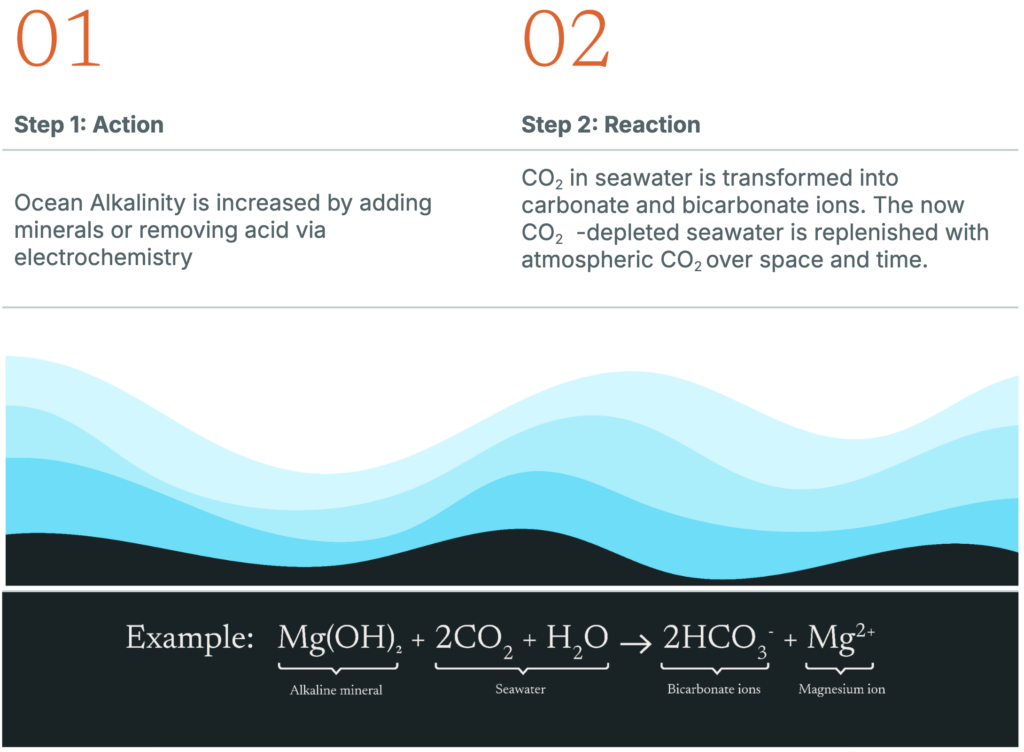
This reaction impacts four key carbonate parameters: total alkalinity (TA), potential of hydrogen (pH), partial pressure of CO2 (pCO2), and dissolved inorganic carbon (DIC). Total alkalinity measures all of the bases (proton acceptors) and acids (proton donors) in a solution and increases with OAE. pH measures the relative amount of free hydrogen ions in the water, and pCO2 measures the amount of carbon dioxide present in seawater. DIC is a measure of total inorganic carbon in seawater and includes aqueous CO2, carbonic acid, carbonate, and bicarbonate. These parameters are highly correlated: pH rises in response to increasing alkalinity and lowers with re-equilibration of gases with the atmosphere, while pCO2 initially lowers and later rises through equilibration. Variability in this system does not always result in perfect equilibration, and there are regions of the ocean with persistent trends of CO2 absorption or outgassing. As equilibration occurs after OAE, DIC will increase until the ocean carbonate system reaches an equilibrium with the atmosphere.
Scientists and companies are exploring a range of approaches for increasing ocean alkalinity for the purpose of mitigating climate change. This chapter provides a deeper introduction into OAE by examining the general carbonate chemistry changes induced by this method, ways to identify and mitigate risks, commonly used feedstocks in research, and a detailed overview of OAE methods. This will provide the necessary foundation for understanding the core stage-gating concepts that underpin the Environmental Impact Monitoring Framework, which is introduced in Section 4.
^ RETURN TO TABLE OF CONTENTS ^
3.1 Environmental Impacts of Biogeochemical Changes
The biogeochemical changes that result from alkalinity enhancement pose potential environmental risks that should be monitored using methods tailored to the specific technology and deployment context (more information on these impacts are detailed in Sections 6.2 and 6.3). Changes in ocean chemistry can serve as indicators of environmental health, and they have impacts on biology and ecology, as explained below. Laboratory, mesocosm, modeling, and controlled field research36 have surfaced unique risks, benefits, and considerations that must inform monitoring strategies during any OAE field trial.
Common considerations for environmental monitoring include a) where and how alkalinity is delivered and b) the physical and chemical characteristics of the alkaline feedstock.37
The location and method of delivery—including the baseline chemical composition and physical mixing of the receiving water—will influence the rate of biogeochemical change. Baseline conditions such as temperature, salinity, and pH38 will determine the rate of feedstock dissolution and its impact on chemical speciation. The volume, turbulence, and lateral and vertical transport of the receiving water39 will determine the dilution of alkalinity and the magnitude of impact on surrounding water chemistry. This will also indicate where in the water column monitoring should occur, depending on the speed of dissolution in relation to dispersal rate and alkalinity delivery point.
Feedstocks may be more or less suitable for a given location and delivery method based on their physical and chemical characteristics. These characteristics will determine the dissolution rate — the rate at which alkalinity is increased. The dissolution rate, in combination with dilution, can determine the risk of chemical spikes (i.e., rapid changes in, for example, pH) or secondary precipitation, whereby dissolved alkalinity remineralizes, returning some of the bicarbonate ions to solid minerals and carbon dioxide.40 A feedstock’s properties will also determine how it interacts with the chemistry and biology of receiving waters. Before deployment, operators must understand, through lab testing and modeling, the implications of using any particular feedstock. For example, if using a particulate feedstock, operators should ensure that the grain size is appropriate for the field site’s physical and biological conditions (including the presence of sensitive early life stages), that their methodology produces stable alkalinity, and that the feedstock will not release harmful amounts of trace metals.
Each of these considerations is heavily impacted by dissolution and dilution rates, which are features unique to a feedstock and project site that must be understood before determining the experimental design. For OAE to be most effective, the alkalized waters should remain at the surface where it can induce CO2 uptake from the atmosphere,41 while avoiding thresholds for secondary precipitation and biological impacts. The physical mixing of perturbed water at an alkalinity addition site will in part determine its impact on the environment and its potential carbon uptake efficiency. The concentration of alkalinity that is achieved after adding a feedstock is governed by three main processes: diffusion, advective transport, and feedstock dissolution (for solid feedstocks).42, 43
Diffusion is the transfer and dilution of the feedstock particles or alkalized water from high concentration areas into lower concentration areas, primarily forced by molecular diffusion. Advective transport is the movement of feedstock particles or the alkalized water with physical currents, which can change the concentration of alkalinity as mixing and dilution occurs. Dissolution is the process of feedstock particles dissolving into the surrounding water, leading to a change in the water’s alkalinity. Particulate alkaline feedstocks have unique considerations as the dissolution of the material varies according to the physical and biogeochemical properties of the receiving water, and also because the material can sink and possibly settle on the seabed.
^ RETURN TO TABLE OF CONTENTS ^
3.1.1 Enumerating and Mitigating Environmental Risks
Identifying risk categories of the project
Taken together, these location and feedstock variables help determine potential risks and where and how to monitor them. These risks44, 45 can be grouped into four major categories:
- Elevated pH – Elevated pH may impact the acid-base balance of organisms, cellular exchange with the environment, enzymatic activity, or chemical signaling.
- Chemical speciation changes – Chemical speciation changes may impact carbon and nutrient assimilation biochemistry, with implications for ecosystem composition and structure.
- Elevated particulates – Particulates in the water column may affect filter feeders, alter light penetration (affecting photosynthesis and predation), and accumulate on the seafloor, which may impact benthic habitats and organisms.
- Feedstock metal impurities – Trace metals may be toxic or bioaccumulate, particularly at higher trophic levels.
Mitigating risk with experimental design
While monitoring for these specific risks is important, steps should first be taken to mitigate the risk through thoughtful experimental design. Researchers, engineers, modelers, and operators should work together to consider how their deployment design can adjust important trial levers such as site selection, target alkalinity concentration, dispersal engineering, and volume to mitigate risk. The following are examples of risk mitigation through experimental design:
- Select field site locations with available baseline data and/or set project timelines to allow for gathering baseline data.
- Select field site locations and operational timelines that minimize risk to critical organisms and ecosystem processes.
- Time research with seasonal chemical and ecological variability, and with existing marine usage in mind.
- Identify protective zones or time periods where sensitive or culturally important organisms are present that may be at risk of OAE impacts.
- Through high-resolution modeling, understand the dispersion and dilution of receiving waters .
- Validate dispersal and monitoring approach with dye tracer study and/or small methods test.
- Engineer dispersal mechanisms or release strategies to facilitate rapid dispersion (flow rate, mixing, etc.).
- Design sensitive control mechanisms for alkalinity release (with in-water sensing and feedback loops).
- Release only the minimum volume necessary to achieve the experimental objectives and generate statistically robust data, while avoiding unnecessary environmental perturbation.
- Reduce the concentration of feedstock through fresh- or saltwater dilution.
- Ramp up operations gradually through a stage-gated approach with assessment criteria.
Monitoring strategy in the context of the spatial-temporal project scale
Many of these mitigation steps require prior planning and research—including lab, mesocosm and modeling studies, and small-scale field testing (e.g., of the dosing system without adding alkalinity)—to understand the potential for impact. Depending on the location, this may include extended timelines (e.g. years for some benthic species). Risks should not only be identified, but they should be studied to reflect the spatial and temporal scale of expected changes. The following are high-level categorizations of spatial and temporal scales, and their corresponding monitoring considerations:
- Limited scale – Impacts may dissipate within minutes to hours and within meters from the dispersal point. High-frequency monitoring close to the outfall is required to detect rapid pH or chemical speciation changes.
- Local scale – Alkalinity may disperse rapidly over days or weeks and over a distance of meters to kilometers, depending on the dosing regimen and physical characteristics of the receiving waters. Dissolution and dilution rates will determine the appropriate monitoring location in the water column and/or seabed.
- Regional scale – Very large deployments may result in dispersion over tens to hundreds of kilometers. Slow-dissolving alkaline materials may be transported to or accumulate on the seafloor, while fast-dissolving alkaline feedstocks will likely not be detectable at the outer edges of the regional scale. Monitoring should capture down-current and vertical distribution patterns where feasible.
- Basin scale – While ocean currents could theoretically distribute dissolved alkalinity across thousands of kilometers, detecting environmental impacts at this scale is not currently feasible. Chemical signatures are likely to be diluted below detection thresholds, and biological impacts cannot be meaningfully attributed without confounding influences. Basin-scale observational monitoring is therefore not practical or necessary for field trial-scale deployments. However, model-based extrapolations can provide insight into long-range distribution and guide future research.
OAE benefits from a wide range of methods by which alkalinity can be enhanced in the ocean. In addition to some commonalities, each method of alkalinity enhancement has unique considerations that result from varying feedstocks, deployment method, and location. These method-specific considerations are helpful in identifying focus areas for monitoring. For OAE projects that combine more than one method, the focus areas for monitoring should account for all included methods. The methods of OAE currently being proposed for field research, and their unique considerations for risk and scale, are summarized in Table 2.
Table 2. OAE Methods Definitions and Unique Focus Areas for Monitoring
| Method | Description | Typical Alkalinity Form | Key Monitoring Locations | Unique Focus Areas for Monitoring |
| Open Ocean Alkalinity Addition | Alkalinity dispersed from a vessel or autonomous platform into offshore waters. | Aqueous or Particulate/ Slurry | Water column | Managing elevated pH at point of releaseAssess near-field scale biological responses in water column Monitor vertical mixing and sinking potential of particulatesAssess detectability and gradient of chemical signatures Assess risk of secondary precipitation and stability of alkalinity |
| Coastal Outfall Pipe Alkalinity Addition | Alkalinity dispersed from an outfall pipe into coastal waters. | Aqueous or Particulate/ Slurry | Water column and seabed | Monitor and analyze interaction with pre-existing effluents (e.g. wastewater, desalination), including potential for mineral precipitationMonitor near-field plume influenced by discharge pipe structure and flow ratesAssess risk of benthic accumulation near discharge zoneAssess ecosystem impacts from transient pH and alkalinity changesCharacterize shoreline ecology potentially exposed to altered chemistry |
| River Alkalinity Addition | Alkalinity dispersed into rivers with discharge to the ocean waters. | Aqueous or Particulate/ Slurry | Upstream, instream and downstream of the discharge site, and head of tide | Track transformation of alkalinity as it moves from freshwater to marine environments, and biogeochemical interactions in estuarine zonesMonitor river flow rate and mixing dynamicsIdentify sensitivity of freshwater species to transient pH changesEvaluate potential impacts on estuarine sediment chemistryConsider adjacent use cases for river water up and downstream |
| Electrochemical Acid Removal | Alkalinity dispersed into coastal or offshore waters that is produced from seawater using electrodialysis or electrolysis. | Aqueous | Upstream, instream, and downstream of the discharge site, seabed, and water column | Assess ecosystem impacts from acid stream disposal, storage and/or treatmentMonitor biogeochemical and temperature impacts of alkaline streamMonitor impacts of high volume intake of seawaterMonitor for mineral precipitation and possible redissolution near the discharge site, including changes to water clarity or local chemistry |
| Coastal Enhanced Weathering | Spreading of alkaline material on beach, along the shoreline or on the continental shelf. | Solid Particulate | Water column and seabed | Characterize the composition and consistency of feedstock for impuritiesTest for trace metal release and potential for bioaccumulation in local food websTrack mobility of fine particles under tidal and wave energyMonitor abrasive or smothering effects on intertidal or benthic habitatsTrack seasonal changes in material residence time on shoreline |
^ RETURN TO TABLE OF CONTENTS ^
3.1.2 Commonly considered feedstocks for OAE
To increase seawater alkalinity, reactive alkaline substances—commonly referred to as alkaline minerals or rocks—must be introduced. Minerals are naturally occurring inorganic solids characterized by specific chemical compositions and crystal structures, while rocks are aggregates of one or more minerals. The chemistry of OAE is often described in terms of adding pure minerals. However, in practice, alkaline feedstocks can be either processed/synthetic or naturally occurring minerals that contain additional elements; these feedstocks should therefore be well-characterized to understand any elemental impurities. Pure minerals are often, but not always, synthetically produced, while rocks are natural46. The chemical and physical properties of each feedstock influence a feedstock’s effectiveness in enhancing ocean alkalinity, its potential impacts on marine ecosystems, and the need for safety measures during the handling of feedstock material (Table 3). Key monitoring considerations include the feedstock’s dissolution rate in receiving water, its effects on ocean chemistry, and its potential release of impurities such as heavy metals or nutrients, which then translate into the environmental risks noted in Section 3.1.1. Although the table below summarizes feedstocks commonly used in OAE research, alkaline materials have several other uses, such as, drinking water treatment, wastewater treatment, food and beverage applications, and pH control in aquaculture.
Table 3: Characteristics of commonly considered OAE feedstocks
See Appendix for additional emerging and deprioritized feedstocks for research.
| Commonly Considered Feedstocks for Research | ||||
| Category | Feedstock type | Chemical formula examples | Description and applicability | Ref. |
| Naturally occurring rocks and minerals | Silicates (e.g., olivine) | Mg2SiO4 CaSiO3 | Abundant minerals with relatively slow dissolution rates, and higher theoretical efficiency than carbonates. These minerals are sometimes found in rock deposits that may contain elements such as Ni, Cr, or Fe. | 47 48 |
| Carbonates (e.g., limestone [calcite, aragonite], dolomite, Magnesite) | CaCO3 CaMg(CO3)2 MgCO3 | Abundant rocks with dissolution kinetics that constrain application to acidic areas (e.g., upwelling regions, acidic rivers, or anoxic waters). These may contain elements such as Si or Fe. | 49 | |
| Brucite | Mg(OH)2 | Brucite is the natural mineral form of Mg(OH)2 with relatively quick dissolution compared to other natural minerals. These may contain elements such as Fe, Mn, or Zn. | 5051 | |
| Processed or synthetic feedstocks | Calcium hydroxide, Slaked lime, Hydrated lime, Portlandite | Ca(OH)2, CaO | Abundant synthetic minerals that readily dissolve in seawater. These are relatively pure, but energy intensive to produce. | 52 |
| Magnesium oxide | MgO | Artificial mineral produced through calcination. Reactivity and dissolution vary with production conditions; it hydrates to Mg(OH)₂ in seawater. | 53 | |
| Sodium carbonate, soda ash | Na2CO3 | Widely industrially available feedstock that is highly soluble in acidic waters | 54 | |
| Sodium hydroxide | NaOH | Electrochemically produced, highly soluble alkalinity source rarely used in solid form and typically free of additional elements | 55 56 | |
| Steel Slag | varied oxides | Byproduct material of steel production that is highly alkaline and soluble. The composition and elements vary by source and can include Fe, Cu, Ni, Mn, Zn, Cd, or Cr. | 57 58 | |
3.2 OAE Methods
3.2.1 Open Ocean Alkalinity Addition – Aqueous
Adding dissolved alkaline substances to the ocean typically involves the use of a hydroxide. The main advantage of this technique is that the increase in alkalinity happens immediately and rapidly shifts carbonate chemistry to lower the pCO2 level since the feedstock doesn’t need to slowly dissolve, as would happen with a solid mineral feedstock, before increasing the ocean pH. From an environmental perspective, the alkalinity increase takes place primarily in the water column rather than in sediments, though precipitation-redissolution and/or hydrography (currents) may bring sediments into contact with elevated alkalinity when done at large scales. It is important to ensure that alkalinity dispersal does not cause a localized pH spike that breaches regulatory or permitted discharge limits. This could not only lead to negative environmental impacts but it could also be a cause for secondary precipitation59 of alkaline material out of solution, which decreases the effectiveness of the OAE process. All of these factors should be taken into consideration when deciding on the temporal and spatial scale of the alkalinity addition.
^ RETURN TO TABLE OF CONTENTS ^
3.2.2 Open Ocean Alkalinity Addition – Particulate/Slurry
This technique involves the addition of fine particles of alkaline minerals such as brucite or carbonate minerals as a slurry (where particle diameters are < 10μm) to the open ocean60, 61. As these particles dissolve, they increase the alkalinity of the nearby seawater. Particle size and density are critical as they determine whether particles disperse or sink before they dissolve and, consequently, they determine if the environmental impact is focused on the water column or on the seabed. Based on Stokes law, smaller particles (e.g., diameters of 2 μm or smaller) with settling velocities of a few cm/h may act as quasi-dissolved, i.e., they are easily dispersed by currents and dissolve before they reach the seabed.45 In contrast, larger particles (e.g., diameters of approximately 10 μm or more) have settling velocities of tens of cm/h, based on Stokes law, which means that a proportion of these particles may reach the seabed locally.42 Particle aggregation during deployment and ingestion by filter feeders should be considered. Particles may also affect the underwater light field, impacting photosynthetic or photosensitive organisms. As such, particular consideration to grain size, dispersal location, and timing is required when using this method to ensure dissolution occurs.
^ RETURN TO TABLE OF CONTENTS ^
3.2.3 Coastal Outfall Pipe Alkalinity Addition
This approach uses purpose-built or existing coastal infrastructure—such as wastewater treatment plants, desalination plants, and other outfalls where water is discharged directly into the ocean environment—to add alkaline feedstocks.62 This may mean discharges are constrained by existing discharge limits for key parameters associated with the effluent, which would typically cover TSS, pH, and metals. The alkalinity source can be in the form of either a fully dissolved solution or a slurry of partially dissolved alkaline material. This method provides a dispersal mechanism for alkalinity addition with a strong potential to effectively mix the treated water with background ocean water.
Careful monitoring is required to ensure that the alkalinity treatment does not interfere with other components of the regular effluent outfall. For example, vivianite and struvite precipitates may form during alkalinization of treated wastewater, which can alter nutrient availability and generate particulates that, if they accumulate locally, could affect benthic or filter-feeding organisms.63 A good understanding of the water temperature and chemistry within the regularly discharged water is also required. For example, industrial cooling water may need to factor in the increased risk of precipitation at higher temperatures. Also, wastewater outfalls may contain elevated carbon dioxide, which is typically emitted to the atmosphere in the vicinity of the outfall. Alkalinization will thereby first result in emission avoidance before atmospheric CDR occurs (if alkalinity is increased enough).
A related methodology, sometimes referred to as Accelerated Weathering of Limestone (AWL),64 is an emission reduction method that captures CO2 at a point source and neutralizes it with alkaline materials in a ship-based or coastal reactor, forming bicarbonate. This bicarbonate is introduced for long term storage in the ocean. Although this method is similar to OAE, it is not carbon dioxide removal as no additional CO2 is captured from the atmosphere. The unique environmental impacts and monitoring requirements of AWL are not within the scope of this report.
^ RETURN TO TABLE OF CONTENTS ^
3.2.4 River Alkalinity Addition
This approach follows a very similar set of considerations to the previous three approaches, with the only distinction being the addition of the alkaline substance to a river as opposed to coastal waters or the open ocean.65 This method provides a regular and reliable method of dispersal of alkaline material downstream from the point of addition. Special considerations are needed, however, because the lack of salts and the lower volume of water in rivers compared to coastal seas, impact the fundamental chemistry of OAE. These river system considerations will be dependent on the catchment area of the river, and careful consideration needs to be given to downstream anthropogenic use of the river in addition to environmental monitoring.
^ RETURN TO TABLE OF CONTENTS ^
3.2.5 Electrochemical Acid Removal
In addition to directly dispersing alkaline material, there are electrochemical methods that can be used to enhance surface ocean alkalinity.55 While there are a number of different techniques that can accomplish this, the key process involves the splitting of water at the cathode to form hydrogen gas (which can be captured and used as a fuel gas, or for other purposes) and OH–, with the generation of H+ and O2 or CO2 at the anode (depending on the electrochemical cell configuration). One such technique uses electrochemistry to convert the NaCl in seawater into HCl (aq). The acid is then removed from the system, while the alkali (NaOH) is mixed back into the remaining seawater and returned to the ocean.55
Unique environmental concerns for this method include the ecological impacts of large volumes of water intake; consideration and monitoring will need to be given to organisms present in the uptake water to ensure that this is not a cause of community shift in plankton species. In addition, electrochemical alkalinity production generates high volumes of hydrochloric acid (HCl), which must be neutralized or diverted for controlled off-site industrial use such that no untreated or partially treated acid is released back into the marine environment.
^ RETURN TO TABLE OF CONTENTS ^
3.2.6 Coastal Enhanced Weathering
The introduction of alkaline sand material usually occurs in coastal areas, where it may offer additional benefits such as coastal protection and beach replenishment. In principle, the alkaline materials slowly dissolve over time, gradually releasing alkalinity into the surrounding area.66 This approach could offer a longer-term and more sustained alkalinity enhancement, with minimal maintenance, when compared to the previous four methods. Research into the co-benefits of this method aims to assess whether it may offer the added benefit of slowing coastal erosion, especially in conjunction with other natural or engineered solutions (e.g. coastal habitat restoration, seawalls, breakwaters, etc). However, because the bulk placement of materials is irrevocable, feedstocks should be thoroughly characterized and tested for dissolution rate and predicted levels of trace metal or nutrient release, in the effort to mitigate related environmental impacts. When depositing material to the benthos, careful monitoring of benthic communities becomes an essential monitoring metric. The scale of this monitoring effort will be proportional to the footprint of the deposit and should account for the transportation of sediments over time.
In addition to these method descriptions, two reports—the Guide to Best Practices in Ocean Alkalinity Enhancement Research67 and Assessing the technical aspects of ocean-alkalinity-enhancement approaches68—published in 2023 provide comprehensive assessments of common OAE methods.
4. Environmental Impact Monitoring Framework
Defining an environmental impact
Ocean alkalinity enhancement (OAE) aims to mitigate climate change by increasing the ocean’s capacity to absorb and store carbon dioxide. Yet, like all interventions in dynamic ecosystems, OAE carries the potential to affect marine environments. In this framework, we define an environmental impact as a measurable change in the biological, chemical, or physical condition of a marine ecosystem caused by OAE. Impacts can be positive, neutral, or negative, and the significance of an impact depends on its magnitude, duration, reversibility, context, and perceived benefit of the activity itself.
For an emerging field like OAE, there are no widely accepted quantitative thresholds or reference standards for impacts—aside from general, often country- or treaty-specific guidance on how to conduct environmental impact assessments in marine environments.68 Effects may be subtle, localized, or temporally delayed, or they may emerge only under specific environmental conditions. Natural variability—seasonal, spatial, or climate-driven—or other anthropogenic activities can obscure the cause and effect. This means environmental monitoring must be fit-for-purpose, grounded in strong site knowledge, and designed to detect changes that are relevant to ecological function and project decision-making.
This framework introduces a stage-gated approach to guide the responsible advancement of OAE field research. It offers practical guidance for environmental monitoring across four phases—from early planning to methods validation, field trials, and long-term research and demonstration projects.
Safe research, demonstration, and piloting of OAE hinges on its environmental impact at the organism and ecosystem level. However, environmental monitoring for OAE field trials is novel, complex, and challenging.
^ RETURN TO TABLE OF CONTENTS ^
4.1 High-Level Framework for Responsible Research Advancement
While this document is specific to field trials, a preparatory stage is included within this framework, which is key to identifying the main risks early in the research and development (R&D) cycle, as well as identifying partnerships and existing “baseline” data that can add value to the monitoring program. As such, this preparatory stage can guide the formulation of an effective monitoring program and demonstrate due diligence prior to in-water activity.
The choice of “what to measure” must be informed by alkalinization-related risk factors for the OAE method under consideration and by the organisms and habitats at the specific location (Appendix B). The subsequent sections (4.1.1-4) describe the recommended stages of an OAE project from planning to long-term field experiments, noting the environmental monitoring required at each stage. A successful outcome is a prerequisite for moving forward to each subsequent stage, as outlined in Figure 1.
^ RETURN TO TABLE OF CONTENTS ^
4.1.1 Stage 1: Planning and Preparation
The first stage in any successful field trial is the Planning and Preparation stage. This stage is where baseline data is collected, relationships with the community are initiated, and operational plans are designed to create a comprehensive understanding of the risks, opportunities, and scientific potential of the project site, i.e., the unique features of the study location that may contribute to or impede the successful execution of OAE field research.
Best practices in community engagement recommend that relationship building with community members should begin as early as possible in project planning. This will include conversations with regulators (on permitting), nonprofits, civic society, Indigenous communities, fishing communities, research organizations, and relevant people in federal government and academia to collect longitudinal data in the area. Further effort should be made to become familiar with the broader range of individuals who have community influence and who should be involved in decision-making. This early mapping of the community will help operators understand the public perception of OAE,69, 70 decision-making authorities, the appetite for engagement, and assets that may accelerate or inform the planning stage. More information can be found in Section 5.
Before release, an impact analysis of the feedstock being deployed is required. Operators should conduct a feedstock risk assessment and review of ecotoxicological information from Material Safety Data Sheets (MSDS), chemical regulations (e.g., the European Union’s Registration, Evaluation, Authorisation and Restriction of Chemicals (EU REACH) regulations), ecotoxicology experiments, or closed system trials. The assessment should aim to understand how the feedstock will interact with the receiving water and ecology and should address any potential risks. Operators may consider generic information for the primary active substance (e.g., Mg(OH)2) and metal or other impurities separately when documentation for a specific feedstock is not available.71
An understanding of local hydrodynamics through modeling, physical oceanographic measurements, and/or a tracer release experiment(s) is required prior to any field trials. In this stage, planning in situ measurements and potentially hydrodynamic modeling should be done. Modeling is required at both the near-field scale (10-100’s m) and regional scale (100’s m to km). This analysis will constrain the expected dilution of the alkalinity perturbation and thereby enable an assessment of elevated alkalinity concentration exposure times and the spatial extent of alkalinization. The expected concentrations, along with the ecotoxicological information obtained above, can be used to define zones of expected impact and direct further investigations, including defining the domain of interest. Numerical hydrodynamic models are generally a cost-effective solution for this purpose as they can be refined during the R&D cycle and expanded to include chemical speciation and/or ecosystem models for the purpose of environmental impact assessment (see Section 6.4). Nevertheless, physical dilution and dispersal may also be assessed by tracking drifter buoys or mapping tracers such as low salinity from an outfall45 or inert dyes (as exemplified in the LOC-NESS43 project, Dalhousie tracer study42 and Ebb’s Project Macoma).
Projects must identify local sensitivities, predict environmental impacts, and anticipate safety thresholds. Local research centers, public entities, or community resources may be able to provide and help interpret existing data on sensitive or culturally important species and habitats. Other sensitivities (e.g., hypoxic/anoxic zones or vulnerability to harmful algal blooms) must be identified and appropriately considered in the monitoring plan. At this stage, operators will need to collect data—sometimes existing but often bespoke to the pathways/location—on predicted impacts and anticipated safety thresholds. This will include a combined analysis of all local, lab, mesocosm, and in-situ data, as well as species sensitivity analysis at different life stages to clearly outline the predicted impacts.72 Threshold limits should be set based on this data and regulator/community input. These threshold limits will be measured against the baseline and/or control site data during environmental monitoring and will define what is considered an impact. It is important to have baselines and threshold information for all predicted impacts. Without it, monitoring will result in data that are difficult, if not impossible, to interpret.
Where data do not yet exist, operators must develop a baseline collection plan targeted to capture the natural variability of predicted impact parameters and local sensitivities. Project developers at this stage should compile any and all existing baseline data for their site and assess data gaps. Baseline data are critical for defining an impact and for measuring additionality. It should be a priority for operators to have a robust baseline with a long enough time series to understand seasonal variability and weather events.
If the scientific potential of the planned project is high and if the risks are determined to be tolerable, continue to Stage 2.
^ RETURN TO TABLE OF CONTENTS ^
4.1.2 Stage 2: Methods Validation
Following the preparatory phase, the Methods Validation stage aims to demonstrate and validate the dispersal and monitoring methods intended for use in a full-scale trial. Fundamental to this stage is the analysis of physical dynamics at the test site conducted in stage 1. Physical dynamics will determine where monitoring will take place and help operators calculate the minimum amount of alkalinity needed to detect a signal in the essential parameters as verification of the monitoring plan. If baseline data do not exist, begin collecting data using the baseline collection plan from Stage 1. If baseline data or data on locally important species are available, researchers should begin to fill any gaps in these data and/or update them to the present. It is important to have a robust baseline before any dispersal testing begins. More information can be found in Section 6.1.
Using these inputs from Stage 1, operators will design and conduct a full environmental monitoring and dispersal operations test. This can only take place with appropriate/required permits. The lowest possible volume of alkalinity that can still be detected (~10s of tons/year) should be used to minimize the environmental impact of the test while validating the operational and scientific capabilities of the project (e.g., signal detection, magnitude and extent of alkalinity perturbation, and measurement against baseline data). At this stage, monitoring should also try to detect predicted impacts in the receiving water, especially for sensitive organisms. Operators should also seek to surface any gaps in their understanding of the location or operation that must be resolved before a larger-scale trial can proceed. More than one test at this scale may be required to answer all of the questions necessary to advance to Stage 3. In stage 2, the project team should aim to have multiple lines of communication with the community and should be sharing its research activities with this network. As research activities progress, new members of the public may become involved, and the communications and engagement plan should be continually revisited to ensure it is adaptable to a growing community of interest.
If the predicted impacts are validated in the field and additional knowledge gaps are sufficiently closed, continue to Stage 3.
^ RETURN TO TABLE OF CONTENTS ^
4.1.3 Stage 3: OAE Field Pilot
The escalation to Stage 3 should only be made with appropriate/required permits, support from community members, and confidence in the best available science that an increase in scale will not exceed anticipated environmental impact thresholds that have previously been determined to be acceptable. This stage aims to collect data at a scale where CDR-relevant processes can be validated, and to monitor project performance against priority risk metrics. Here, the scale of alkalinity addition will increase to meet research or CDR goals to the approximate range of 100s of tons of alkalinity per year, depending on the purpose of the trial and local priorities. With an increased volume of alkalized water, it should be expected that a signal will be detected among the Attribution and Context-specific parameters. For more information, see Section 6.
In Stage 3, monitoring should increase in line with scale and local priorities, such as identifying any environmental perturbation compared to baseline or impacts to socioeconomically or culturally important species. A robust understanding of the background spatial, seasonal, and interannual variability of the environment and ecosystem is therefore highly desired. Key questions pertain to the spatial and temporal variability of the four key risk factors (elevated pH, chemical speciation changes, elevated particulates, and feedstock metal impurities) and an assessment of OAE-related changes to ecosystems. Monitoring for anticipated impacts should become more rigorous at this stage, as the increased scale may increase the likelihood of their occurrence (e.g., if turbidity is identified in Stage 2 as an anticipated impact, it is more likely to occur in Stage 3 unless otherwise mitigated).
Monitoring should also target increased risk to priority organisms/ecosystems as indicated by the community in Stages 1 and 2, and in collaboration with regulators; see Section 7. An assessment of ecosystem change will include field surveys (e.g., occurrence/abundance of species, biodiversity, ecosystem processes such as respiration) and/or partnership with local environmental monitoring groups as identified in Stage 1. Field observations are to follow established and consistent methodologies throughout to ensure comparable results with other data, as per the Guide to Best Practices in Ocean Alkalinity Enhancement Research.67
Multiple trials may be conducted at this stage before moving to Stage 4. Longer-term measurements should be made throughout, including an extended baseline that captures seasonal and, ideally, interannual variability and significant weather events; see Section 6.1 for additional detail on baseline collection. For most parameters, the baseline data collection can only resume after signals of the OAE perturbation have subsided or if the baseline data are collected at an adjacent site outside of the alkaline plume. Baseline data, whenever possible, should aim to capture significant weather events—especially events that occur seasonally or annually such as marine heat waves, seasonal flooding, drought, and other impactful weather—to understand the extremes of natural variability at the site. The occurrence of a significant weather event should be noted in the metadata, and additional monitoring will depend on the type of weather (i.e., flooding may increase turbidity whereas a heat wave may decrease carbon solubility). In addition to natural variability, extended monitoring should aim to understand the potential for delayed-onset and long-term impacts. These are impacts that may occur only after alkalinity has accumulated or at high trophic levels.
It is additionally important to validate the models created in Stage 1 and 2 against field observations and refine the models with the additional data. For example, increased resolution and/or more complex sediment resuspension models may resolve local circulation features that lead to the accumulation of the OAE signal. In turn, this may direct the observational effort to target such locations. Coupled hydrodynamic-ecosystem-biogeochemistry models can identify complex interactions and aid in developing mitigation strategies.73, 61
Activities conducted and data collected in this stage should be highly transparent and available to the public. It is critical at this stage to have an effective communication plan that facilitates regular exchanges of information with significant opportunities to receive feedback from the community. If an earnest effort has been made to build relationships in the community in earlier stages, projects may benefit from recruiting local advocates and receiving the community’s trust to operate.
If the field trial is successful, and if observations and suitable models determine low environmental risk from continuous dosing, continue to Stage 4.
^ RETURN TO TABLE OF CONTENTS ^
4.1.4 Stage 4: Continuous Dosing and Monitoring
This stage aims to simulate long-term operational conditions and assess sustained social and environmental benefits and risks. As the scale of additions increase or move to continuous dosing, so does scrutiny on the environmental impacts of feedstock and any unresolved knowledge gaps. This is because impurities at small scales will be compounded at larger scales. Progression to Stage 4 not only represents the completion of previous stages but a robust understanding of the field site, alkalinity source, and the short- and long-term impacts of alkalinity addition. To reach this stage, it is recommended to adopt an iterative process involving multiple tests and trials in Stages 2 and 3 to gain a complete understanding of the site at scales that minimize negative impacts and maximize knowledge building.
Once a robust understanding of the site and operation is established, operators will conduct sustained environmental monitoring campaigns of critical parameters. The project team must make informed decisions about the parameters that will be monitored long-term and the parameters that can be measured less frequently. For example, if the alkalinity source has proven to rapidly dissolve and be very stable across varied dosing volumes and throughout seasonal variability in earlier stages, the operator may decide to reduce the frequency or number of measurement locations for TSS. These critical decisions must be made in consultation with regulatory bodies and the community and will be documented in a continuous monitoring plan that should be regularly updated as long as dosing continues. This plan must also include procedures to process the data promptly and make it publicly available in perpetuity. This may involve transferring data to an external repository.
Here, analysis of long-term trends must also be conducted based on the models validated and data collected in Stage 3. A periodic review and appraisal program should critically examine long-term observations for ecological and biogeochemical effects. This will be one step in creating an iterative process that collects and analyzes data long-term, and adjusts the monitoring plan if necessary.
As dosing becomes sustained and as volumes increase, environmental stewardship must extend beyond the field site. Operators should begin assessing the environmental impacts of sourcing alkalinity at increasing scales, including upstream activities such as mining, processing, and transport. These impacts—such as land use, emissions, and ecosystem disruption—should be weighed alongside the anticipated climate benefits of OAE. Tools such as life cycle assessment (LCA)74 can help evaluate whether net environmental outcomes remain positive. Integrating these considerations supports ecosystem-based management and responsible scaling.
If long-term data indicate sustained benefits and manageable risks, continue or scale responsibly. Otherwise, halt dosing, revise the approach, or iterate on previous stages.
Project Closing and Conclusion
Although this framework recommends a staged and responsible progression through increasing scales, a project can off-ramp at any point in this process if it is no longer viable or if it has completed its desired research goals. To close a project, a full analysis of the operational and environmental learnings should be documented and shared with regulators and relevant community members. This includes transparent sharing of data collected into a public repository in accordance with data standards protocol; see Section 9. Infrastructure may also need to be decommissioned and removed.
Part II: Practical Guidance for Framework Implementation
This framework serves as a guide for benchmarking knowledge generation over time as OAE projects grow in maturity and scale, lowering environmental risks and creating transparency for stakeholder evaluation. However, no two projects are the same, and individual circumstances may not fit neatly within this framework.
Here, we address the practical aspects of establishing a field site and conducting environmental monitoring. The sections below will help project leaders navigate early stakeholder engagement, identify key monitoring parameters, understand the regulatory environment, and take precautions for operational safety. This guidance aims to make the stage-gated approach outlined in the framework achievable by sharing standards and best practices learned from the field. Readers should keep in mind that although we do provide insight into the regulatory process, this document is not designed to provide legal advice; projects must comply with all applicable laws and must be developed in coordination with relevant authorities.
5. Stakeholder, Rightsholder, and Public Involvement and Consultation
5.1 Priorities for Engaging Communities
As OAE research advances from controlled laboratory environments to in-ocean field trials, it enters the public domain, where community members, stakeholders, rightsholders, and governing bodies hold a legitimate interest in project activities and outcomes. At this stage, public engagement becomes a critical component of responsible research conduct. Decisions that were once confined to operators and academic researchers increasingly intersect with local governance, public values, and regulatory scrutiny.
Community engagement serves multiple essential functions: it enables more informed decision-making; builds trust between project developers, stakeholders, and local rightsholders; and surfaces site-specific knowledge that may otherwise be overlooked. When communities are excluded from meaningful participation, the resulting sense of disempowerment can undermine project legitimacy and, in some cases, halt implementation altogether. To avoid such outcomes, public engagement strategies must be developed early and with clear intent—framed by the core questions of who, why, when, and how to engage.
Consideration must be given to who will lead the community engagement effort. Certainly, the operators and scientists will be involved, but they should be guided by social science. Creating a map of potential interested or affected parties is a valuable exercise that should involve all team members. Project operators should seek to partner with community advocacy groups, grassroots organizers, or local leaders early on in engagement and maintain consistent points of contact throughout the project. These outside experts may hold valuable knowledge about the local context and ensure that engagement is pursued using best practices.
Clarifying the rationale for public engagement is a foundational step that shapes the scope, depth, and tone of community interaction throughout a project’s life cycle. In some cases, regulatory requirements may dictate minimum levels of consultation, particularly in the jurisdiction of Indigenous rightsholders or as a permitting requirement. However, beyond these regulatory obligations lies a broader opportunity to engage communities as informed participants in the research process.
Determining the appropriate level of public influence—guided by frameworks such as the Spectrum of Public Participation75 developed by the International Association for Public Participation—ensures transparency in how decisions will be made and what role, if any, the public will have in shaping them. Where a high level of influence is offered to communities, projects are more likely to secure enduring support. Critically, the intention behind engagement must be authentic. Project developers should never imply community influence where none exists. Doing so risks eroding credibility and damaging relationships.
Figure 3: Public Participation Spectrum, developed by the International Association for Public Participation, 2014

The design of a community engagement strategy must be responsive to local priorities, capacity, and context. Early engagement—ideally before site selection—supports relationship-building and allows communities to shape project design in meaningful ways. A comprehensive community engagement and communication plan should include:
- Background and Local Context: Project overview, objectives, key issues, relevant community groups, and intended engagement level
- Logistics and Support: Meeting formats, timelines, budget, roles, and resource requirements
- Communication Components: Target audiences, outreach strategies, communication tools, and tailored messaging
- Evaluation Plan and Feedback Mechanisms: Methods for collecting input, measuring effectiveness, and incorporating lessons learned
Such plans should be treated as living documents that are adaptable to evolving community needs, shifting project scopes, and new insights gained during implementation.
5.2 Background and Local Context
Identifying relevant stakeholders is not always straightforward. While some participants—such as regulatory agencies, rights holders, or local government bodies—are readily identifiable, others may emerge more gradually. It is important to include not only those who will be directly affected by a project, but also those who perceive themselves as impacted, as both groups can shape the trajectory of public discourse and project outcomes.
Early efforts should focus on mapping the local stakeholder landscape, beginning with formal authorities and expanding to include civil society organizations, community associations, and individuals with knowledge of or interest in the project site. Grassroots outreach is particularly valuable for uncovering local leadership structures and informal networks. Gathering existing information and resources on community perspectives before outreach can further enrich these early efforts, as it provides project operators with additional context on how to best approach community priorities. For example, in parts of the US and Canada, Indigenous communities may have significant cultural connections and hold governance rights to a proposed project area. Resources such as Informing mCDR: Best Practices Guidance for Tribal and Indigenous Engagement provide helpful insight on engaging Indigenous communities and how Traditional Ecological Knowledge can be used to meaningfully inform environmental monitoring design and management of the project. The United Nations Declaration on the Rights of Indigenous Peoples serves as a comprehensive international instrument to promote and protect the collective and individual rights of Indigenous people.
It is also important to note that interest does not always equate to influence. Community leaders may be constrained by competing priorities, and the individuals most vocal about engagement may not represent the broader population. Understanding what matters to local stakeholders—how OAE intersects with their values, concerns, and objectives—enables project proponents to frame carbon removal in ways that are relevant and compelling at the community level.
5.3 Logistics, Support, and Communication Components
Engagement logistics—ranging from meeting schedules to communication styles—should be designed to lower barriers to participation and should reflect the specific context of the community. Flexibility in format, location, and timing can significantly improve accessibility and foster a more inclusive environment.
Project developers should anticipate a degree of trial and error in identifying the most effective strategies. Consistent and culturally appropriate outreach demonstrates a sustained commitment to transparency and accountability. As community interest increases, project proponents must be cautious not to overextend promises or suggest influence where none can be meaningfully offered. Managing expectations is critical, particularly as the number of stakeholders expands.
Communication strategies should be tailored to the knowledge base and preferences of the community. In many cases, researchers will be operating in environments characterized by low institutional trust and high concern. In such settings, technical messaging must be reframed by using clear and accessible language that is delivered through trusted messengers and familiar channels. When engaging with coastal communities, project leads should reference best practice guidelines such as Engaging Coastal Communities on OAE76 and Effective Engagement of the Fishing Community in a mCDR Context.77
Researchers and project proponents should keep in mind that the research questions and environmental concerns from a scientific perspective do not always map to community concerns. Designing a messaging, engagement, and communications approach that authentically explores and prioritizes community input will create a more successful project and more trusted outcomes. The table below lists various engagement and communication strategies that can be used during the engagement process.
Table 4: List of public engagement strategies78, 79, 80
| Public Engagement Strategy | Advantages | Disadvantages |
| Public “town hall” type meetings | Allow a gathering of multiple interested parties to exchange information. | It can feel impersonal and limit the ability to tailor the message to the audience. |
| A series of public consultation meetings | Provide more opportunities for people to attend compared to a single “town hall.” | Time and cost. |
| A series of stakeholder workshops | May answer particular questions or gain insights into specific areas of the OAE project. | Restricted by stakeholder availability and willingness to participate. |
| Community-led listening sessions | Allow local community members and groups to create their own agenda to be heard. | Little to no influence over the agenda. |
| Communities of practice | Offers a longer term collaboration among like-minded practitioners. | Time and cost. This requires substantial interest in mCDR in a specific region. |
| Thematic consultation meetings (e.g., local fishery, youth climate action) | Invite deeper engagement by focusing on a specific topic in a small group setting. | This can lead to an imbalance of influence over the project if one industry or group is overrepresented. |
| Public notices (including leaflets and newsletters posted to locals) | May be distributed by local groups trusted by their audience. | Purely informational with no mechanism for input or feedback. |
| Local press releases (e.g., distributed to online, television, radio, and newspaper news sources) | Cover a larger readership and have a low associated cost. | Lack of control on what the published news story reports. |
| Science workshops/educational campaigns | Help address gaps in understanding in a hands-on way. | Mainly directed at or integrated into educational and academic programs, and therefore is often focused on youth |
| Websites, e-newsletters, or virtual town halls | Low cost and direct control over content. | Limited opportunities for interpersonal relationship and trust building. |
| Public input mechanisms such as surveys, comment form, or public review periods | Provide direct and measurable feedback from the community. | Additional administrative burden to monitor and manage input. |
5.4 Evaluation plan and process
Engagement strategies must remain dynamic and responsive to changing project and community conditions. As field activities scale or attract broader attention, the composition of stakeholders may shift, and engagement approaches must adapt accordingly.
Regular evaluation provides the means to assess the effectiveness of engagement efforts and identify areas for improvement. Feedback may be collected through formal tools—such as surveys, comment forms, or public review periods—or through more informal mechanisms, such as community listening sessions.
When early engagement efforts have successfully established trust, community members are more likely to provide candid and constructive feedback. This iterative process reinforces mutual accountability and strengthens long-term relationships. Critically, engagement does not end with the completion of field trials or the cessation of dosing; ongoing dialogue may be necessary to address post-project monitoring, reporting, or community concerns. In this way, engagement is not a single phase of project development, but a continuous and evolving practice embedded throughout the life of an OAE initiative.
6. Key Parameters for Monitoring
An essential step in developing an environmental monitoring plan is to determine which parameters to measure, in addition to those that are required by regulators during the permitting process. The ability to detect an impact and mitigate or control it once it has occurred depends entirely on one’s ability to measure it and attribute its cause. This is especially important in OAE, where field research is nascent and thorough monitoring serves both to safeguard ecosystems and to contribute to the industry’s growing knowledge base. OAE induces changes to the biogeochemistry of the field site and surrounding waters, potentially impacting water quality and local ecology. A robust monitoring plan is informed by baseline data collected before alkalinity release, and the plan should identify thresholds for each parameter beyond which ecologically significant impacts may occur. This can enable early detection and mitigation of potential environmental impacts. The deployment method and alkalinity type will inform which risks to assess in a monitoring plan.
Effective risk mitigation begins with OAE project design. This includes thoroughly understanding the project site, feedstock characteristics, and dispersal mechanism—and then designing the dispersal to minimize negative impacts and to maximize learning. This foundation enables effective monitoring that targets the correct parameters, at the right locations and frequencies, to detect and respond to potential impacts. However, some critical questions about OAE’s potential environmental effects cannot be resolved through project design alone, even if extensive modeling or lab work is done, as answering these questions requires in-field investigative monitoring.
As OAE field research matures and projects advance, the roles and responsibilities of key actors—scientists, regulators, and the private sector—can come into tension. While scientists are tasked with advancing knowledge and furthering scientific understanding of the OAE process, and regulators are tasked with protecting ecosystems and public trust, private developers often operate under cost and efficiency pressures. This means that their views on what can or should be monitored for a particular project may differ from the views of scientists and regulators, although regulators have the final say about what must be monitored at a minimum.
In recognition of the unique features and risk profiles of each OAE project, monitoring parameters are categorized in three ways:
Regulatory Parameters – These parameters are a minimum suite required across OAE monitoring programs by regulators of OAE projects (though this may vary by jurisdiction; see Section 7 for the jurisdictions consulted). These parameters are mostly physicochemical proxies that provide early warning of potential ecological stress. Some of the parameters also serve as proxies for plume detection and tracking (e.g., pH and TSS) or provide information needed to interpret other measurements (e.g., salinity and temperature).
Attribution Parameters – These parameters are measured to further assess and attribute environmental impacts resulting from OAE. The parameters include biological, ecological, and water quality indicators that link OAE exposure to ecological impact. They also include additional carbonate parameters, of which a minimum of two are needed to calculate changes to the carbonate system. Combinations such as TA and DIC or TA and pH are preferred over pH and pCO2 due to reduced redundancy and reduced uncertainty in derived carbonate system calculations.
Context-specific Parameters – The monitoring of these parameters should be tailored to the project-specific design. The selection of these parameters is highly dependent on the project’s feedstock, location, dispersal method, predicted impacts, and community priorities. These parameters address risks that may not be universal to all OAE deployments but are critical for impact attribution in specific project contexts.
Although categorized as context-specific, these parameters may be equally important to measure because they add to the knowledge base of the field site and provide critical information on a wide range of ecological processes. They may also be especially important for understanding long-term or accumulated impacts. While regulatory frameworks may prioritize a limited number of parameters, effective environmental protection ultimately depends on the comprehensive monitoring of ecological responses. Therefore, a comprehensive impact assessment requires the strategic integration of parameters across all three categories. Attribution and context-specific parameters provide critical context for attributing causation to OAE versus natural variability (or other anthropogenic activities), for cumulative impact detection, and for building the knowledge base needed for responsible scaling. In some cases, this means that even when causality is uncertain or when impacts are unlikely, certain measurements may still be warranted. These measurements are not warranted to confirm specific risks, but rather to reduce uncertainty over time and strengthen the broader evidence base that future permitting decisions will rely on. As OAE field research advances through the stages, incorporating biological indicators alongside regulatory parameters becomes critical for linking OAE perturbation to ecological responses. It is therefore recommended that regulatory parameters be complemented by additional relevant biological indicators, especially when detectable impacts are expected.
Only once sufficient knowledge has been gained to confidently assess environmental risk and attribute observed impacts—as agreed upon through engagement with regulators, scientific partners and affected stakeholders—may it be appropriate to reduce the number of parameters that are measured or the frequency of measurements. Additional effort is needed to develop monitoring frameworks for private industry, who must rigorously monitor environmental safety while considering cost efficiency and practical constraints. This is hard to discern with the current unknowns about the biological impacts of OAE.
This chapter, in addition to identifying the parameters to measure, will introduce the different areas of focus of a robust monitoring plan. Below, we explore how to approach baseline data collection and the utility of a control site, planktonic and benthic monitoring, and the role of modeling in informing environmental impacts research.
Table 5: Prioritized parameters and monitoring methods for environmental impact monitoring
Additional considerations for parameter selection and monitoring design are provided in Section 6.2 and Section 6.3.
| Priority | Parameter | Role in Environmental Monitoring | Methods | Resources |
Regulatory Parameters These parameters are consistently required by regulators for the purposes of environmental monitoring. In some jurisdictions, regulators may require additional parameter monitoring. Always check with regulators to determine what is actually required. | pH | Measuring pH is essential to track changes in seawater acidity resulting from alkalinity addition, which directly influences carbonate chemistry and biological processes. | Sensor or discrete samples; noting that recording the pH scale used (NBS or total) is essential | Guide to Best Practices for Ocean CO₂ Measurements3 Standard Methods for the Examination of Water and Wastewater, 4500-H+ pH4 |
| Temperature | Temperature affects the solubility of gases such as CO₂ and reaction rates in seawater, thereby modulating the efficacy and potential ecological impacts of OAE. | Sensor | ISO 22804:2023 Marine technology — General technical requirement of marine conductivity-temperature-depth (CTD) measuring instrument5 | |
| Salinity | Salinity influences carbonate system speciation and buffering capacity, and is critical for interpreting biogeochemical changes and mixing processes post-alkalinity addition. | Sensor | ISO 22804:2023 Marine technology — General technical requirement of marine conductivity-temperature-depth (CTD) measuring instrument5 | |
| Total suspended solids (TSS) | Monitoring TSS detects changes in particulate matter that may arise from feedstock additions, which can affect light penetration, sedimentation rates, and benthic habitats.81 | Discrete samples | Standard Methods for the Examination of Water and Wastewater, 4500-H+ pH4 | |
| Trace metals (if relevant for feedstock) | Measuring trace metals ensures that OAE materials do not introduce harmful concentrations of contaminants, and thus can help protect marine organisms and maintain water quality. | Water column, sediment, and pore water sampling | Environment Agency report no. SC030194, Environmental Quality Standards for trace metals in the aquatic environment82Sampling and Sample-handling Protocols forGEOTRACES Cruises9 | |
Attribution Parameters These parameters are needed to further parameterize and identify the source of observed impacts. | Dissolved oxygen (DO) | Monitoring dissolved oxygen helps assess ecosystem health and potential biological responses, such as shifts in respiration or photosynthesis, due to changes in seawater chemistry. | Sensor | ISO 17289:2014 Water quality — Determination of dissolved oxygen — Optical sensor method10 EPA: Field Measurement of Dissolved Oxygen11 |
| Total alkalinity (TA) | Measuring TA quantifies the added alkalinity and tracks its persistence and distribution, which is central to assessing the carbon sequestration potential and geochemical impacts of OAE. | Discrete samples | Guide to best practices for ocean CO₂ measurements3 | |
| Dissolved inorganic carbon (DIC) | DIC measurements are critical to evaluate the ocean’s carbon uptake in response to alkalinity enhancement and to assess the balance of the carbon system. | Discrete samples | Guide to Best Practices for Ocean CO₂ Measurements3 | |
| Partial pressure of carbon dioxide (pCO2) | Monitoring pCO₂ captures the effectiveness of OAE in reducing surface ocean CO₂ levels, thereby indicating the system’s capacity to enhance atmospheric CO₂ uptake. Very low pCO2 may also be an indicator of phytoplankton carbon limitation.83 | Sensor | Guide to Best Practices for Ocean CO₂ Measurements3 NASEM | A Research Strategy for Ocean-based Carbon Dioxide Removal and Sequestration18 | |
| Turbidity | Turbidity indicates changes in water clarity and potential particle formation or resuspension, which may result from mineral-based alkalinity inputs or secondary precipitation and which can affect light penetration and marine life.81 | Sensor or discrete samples | ISO 7027 Water quality — Determination of turbidityPart 1: Quantitative methods14 | |
| Plankton | Plankton monitoring helps identify potential ecological shifts or stress responses in primary and secondary producers, which are sensitive indicators to altered seawater chemistry. | Plankton tow, optical sensors, or other methods | GOOS Essential Ocean Variable Specification Sheet –Phytoplankton Biomass and Diversity15 GOOS Essential Ocean Variable Specification Sheet –Zooplankton Biomass and Diversity16 | |
| Chlorophyll-a (Chl a) | Chlorophyll-a is a proxy for phytoplankton biomass and is used to assess changes in biomass that may result from OAE-induced shifts in carbonate chemistry (pH, pCO2, DIC) or nutrient availability. Note that other biological parameters may be better for understanding impacts, but Chl a is cheap and easy to measure and has a long history of being used for biological monitoring. | Sensor or discrete samples | EPA-NERL: 445.0: Chlorophyll and Pheophytin in Algae by Fluorescence17 | |
| Context-Specific Parameters These additional attribution parameters are highly dependent on feedstock, location, dispersal method, and predicted impacts. Depending on the context, there may be additionally relevant parameters that are not mentioned here. | Benthic habitat and sediment biogeochemistry | Monitoring benthic parameters captures potential ecological and geochemical changes on the seabed resulting from OAE, including accumulation of materials, physical habitat, carbon or nutrient cycling, and potential impact on alkalinity flux. | Benthic survey or image observation | Joint Nature Conservation Committee guidance for benthic habitat monitoring84 Standard Operating Procedure EAP039, Version 1.4: Obtaining Marine SedimentSamples85 |
| Benthic organisms | Monitoring the abundance, behavior, community composition, and/or distribution of specific benthic organisms can provide direct data about species that may have an increased vulnerability or sensitivity. | Benthic survey or image observation | GOOS Essential Ocean Variable Specification Sheet –Benthic Invertebrate Abundance and Distribution19 | |
| Local commercially, ecologically, and/or culturally significant species | Monitoring the status of species that may hold significant ecological, economic, or cultural value provides critical insight into potential community-level impacts. Monitoring should be tailored to the specific sensitivities and habitat use patterns of these species. | Marine survey or image observation | In addition to the phytoplankton and benthic organism resources: GOOS Essential Ocean Variable Specification Sheet – Marine mammal abundance and distribution21 GOOS Essential Ocean Variable Specification Sheet – Fish Abundance and Distribution20 | |
| Dissolved organic carbon (DOC) | DOC measurements help assess how OAE may influence organic carbon cycling, microbial activity, and the potential for changes in remineralization or carbon export. | Discrete samples | ISO 5667-26, Water quality — Sampling23 ISO 8245:1999 or SCA blue book 15722 Guide to Best Practices for Ocean CO₂ Measurements3 | |
| Photosynthetically active radiation (PAR) | Measuring PAR determines the availability of light for photosynthesis in surface waters, which may be affected by changes in water clarity due to suspended solids or other OAE-related factors. | In situ sensor (potentially complemented with satellite remote sensing) | Photosynthetically Active Radiation: Measurement and Modeling24 | |
| Nutrients | Nutrient measurements are necessary to detect and attribute changes in biogeochemical cycling that could result from natural processes or OAE-induced alterations in pH and carbonate chemistry, potentially affecting productivity and ecosystem dynamics. This may include one or more of the parameters below. | Discrete samples | GOOS Essential Ocean Variable Specification Sheet –Nutrients25 Standard Methods for the Examination of Water and Wastewater, 4500-P PHOSPHORUS86 Standard Methods for the Examination of Water and Wastewater, 4500-N NITROGEN87 Sulphate in Waters, Effluents and Solids27 | |
| Phosphate | Monitoring phosphate is essential to detect potential changes in nutrient availability that could influence primary productivity and community composition in response to altered seawater chemistry. | Discrete samples | ||
| Silicate | Silicate levels are important for tracking potential impacts on diatom populations, which rely on silica for growth and may be differentially affected by shifts in carbonate chemistry. | Discrete samples | ||
| Ammonia-nitrogen (NH3-N) | Measuring ammonia is important to evaluate potential impacts on nitrogen cycling and toxicity, as pH changes can shift the equilibrium between less harmful ammonium and toxic-free ammonia. | Discrete samples | ||
| Nitrate-nitrogen (NO3-N) and nitrite-nitrogen (NO2-N) | Monitoring nitrate and nitrite tracks key steps in the nitrogen cycle, helping to identify shifts in nutrient dynamics or microbial processes affected by OAE. | Discrete samples | ||
| Sulphate | Sulphate measurements are used for monitoring the conservative behavior of major ions and to detect any unintended changes from mineral additions that could alter ionic balance or microbial sulfate reduction.26 | Discrete samples |
^ RETURN TO TABLE OF CONTENTS ^
6.1 Baseline and Control Sites
Detecting OAE-induced impacts requires distinguishing them from natural variability. This can be achieved through two complementary approaches: baseline data collection and control site monitoring. These two methods can be used, either independently or in unison, to measure OAE impacts against the background conditions. Baseline data are collected at the project site before the release of alkalinity to understand natural variability for all parameters to be measured in the absence of a perturbation. A control site is a location with similar physical, chemical, and ecological characteristics or subject to similar environmental conditions as the intended field site, which can indicate ongoing conditions of the field site unaffected by a perturbation. Here, we outline how to establish the research domain and when it is recommended to use a control site as well as a baseline.
Baseline data collection is always necessary before the release of alkalinity. Without a well-characterised baseline, it is difficult to attribute an OAE-induced environmental impact or create a model that can quantify carbon removal with high certainty. The longer the historical record of baseline data at a site, the more likely it is that carbon removal efficacy can be accurately measured, and that potential negative impacts or co-benefits can be attributed to OAE. It is important that baseline data cover appropriate spatial and temporal scales for the OAE monitoring activities. As such, baseline data should aim to capture seasonal variability and include data taken in different weather conditions (e.g., after heavy rain, drought, and high wind, etc.) as well as across depth gradients. If possible, collecting enough data to characterize interannual variability is also very useful. Many of the Regulatory Parameters, such as pH and temperature, will vary seasonally, in response to weather events (e.g., TSS and salinity), or any number of confounding variables such as diurnal cycles, tidal cycles, river discharge, geomorphology, and pollution. Depending on project resources or the site’s history, capturing this range of variability in a baseline assessment may not be possible.
The advantage of a control site is that it experiences the same environmental drivers and confounding variables as the trial site, which facilitates the attribution of any observed differences to the OAE intervention. In theory, a control site can explain the current conditions of the test site, not just past trends. This is especially relevant in the context of climate change, where ‘natural’ variability is changing significantly from the historical record. This shifting baseline must be considered when evaluating the relevance of existing baseline data in representing ongoing conditions. Establishing a control site can help identify where current data stray from the past.
Nevertheless, it is not always practical to identify a suitable control site. For example, in coastal OAE projects, two adjacent coves may have similar water chemistry but they may differ in key processes such as mixing dynamics and sedimentation, making it difficult to establish one of the coves as a control site if the other is where a field trial is planned. In contrast, a shipborne or coastal outfall release of alkalinity may overcome this limitation by performing a simultaneous tracer release that allows for the identification of dynamic control conditions outside of the perturbed patch of water (i.e., in plume and out of plume sampling). The latter has been applied in field experiments to understand nutrient limitations, ocean mixing, and air-sea gas exchange.88 89 90 91 Because of this, it is always recommended to collect baseline data before release, and only include a control site when that site is environmentally comparable to the test site with respect to monitoring for key risks. Combining baseline and control site monitoring—when doing so is feasible—provides the most robust framework for attributing OAE-induced changes and evaluating potential impacts.
^ RETURN TO TABLE OF CONTENTS ^
6.2 Ecological and Biological Considerations
As discussed in Section 3.2, the design of ecological and biological monitoring efforts should reflect the unique considerations of the OAE feedstock, the dispersal method, and the characteristics of the site in which it is applied. Key components of an ecological monitoring plan include defining the spatial and temporal domain of sampling (where and when to monitor), determining which species are relevant for monitoring, and establishing criteria on how to determine and interpret impacts.72 Long-term or continuous dispersal projects should also consider monitoring cumulative and indirect impacts (ecosystem-level changes resulting from food web interactions or behavioral responses) that may occur over extended timeframes.
Monitoring strategies for OAE can be broadly categorized into confirmatory and investigative approaches.84 Confirmatory monitoring aims to detect and demonstrate ecological responses, or lack thereof, but it does not explore underlying mechanisms or provide information to make predictions. Thus, it is designed to verify outcomes against predefined expectations or thresholds rather than to resolve underlying ecological mechanisms. In contrast, investigative monitoring is more comprehensive and hypothesis-driven, aiming to understand ecological processes and feedback by collecting data on multiple variables to evaluate how and why OAE impacts occur. Regardless of the approach, high-quality data are essential. This means data must be representative, replicated across relevant spatial and temporal scales, and account for the multiple interacting factors influencing OAE impacts. Identifying sources of variability in the system, in addition to alkalinity—such as land use, climate variation, or natural disturbances—allows operators and regulators to determine the sampling effort needed to detect real changes amidst environmental “noise.”
Determination of spatial-temporal scales
The spatial monitoring area and exact monitoring locations will be driven by the initial placement and expected pathway of the alkalized water (or added feedstock), as well as by the site’s hydrodynamic conditions. Understanding a site’s hydrodynamic characteristics and where alkalized water may be transported can be investigated using inert dye tracers such as Rhodamine. Typically, the monitored spatial domain should include (1) the point of initial alkalinity release, (2) local near-field areas where perturbations are highest, (3) far-field areas along predicted transport pathways, and (4) control sites outside the project area. The monitoring strategy used should also align with the release type; for example, fixed-point monitoring suits stationary releases such as industrial outfalls, while mobile, wide-scale releases require spatial surveys that can dynamically monitor the movement of the alkalinity plume.
Temporal monitoring design will be driven by the alkalinity release schedule and dosing rate, and it will reflect the predicted estimates for the extent and duration of a perturbation. A slow and continuous alkalinity addition will warrant equally-spaced time-series monitoring, while short-term or pulse releases will warrant more adaptive monitoring where higher frequency is used near the time of release and scaled down as the alkalinity perturbation dissipates and conditions return to baseline. To ensure comprehensive impact detection, the monitoring strategy should aim to continue beyond the expected spatial and temporal reach of the perturbation. This accommodates model uncertainties and ensures detection of unexpected far-field or delayed effects. Further description of the variables determining the monitoring domain can be found in Section 3.1.
Determination of when to begin and end monitoring
The Before–After–Control–Impact (BACI)92 design is widely recommended. This involves collecting data before and after alkalinity addition at both trial and control sites, enabling researchers to separate the effects of OAE from natural variability. How long before or after to begin or extend monitoring depends on the characteristics of the system, especially its variability. Establishing a robust baseline is therefore necessary to quantify when to begin and end monitoring. When comprehensive BACI is not feasible, alternatives include:
- Before–After (BA): This method collects data at a site before and after the addition. Without control sites, this design cannot distinguish OAE impacts from broader environmental changes.
- Extended Post-Treatment (EPT): This method focuses on detailed post-addition monitoring across space to compensate for the lack of baseline data.
- Before–After–Gradient (BAG): This method adds a spatial dimension by assessing changes at varying distances from the restoration site, improving statistical power and helping define the spatial extent of effects.93
Conducting and utilizing ecotoxicology research to support OAE fieldwork
Ecotoxicology is the study of how chemical substances affect organisms, typically by measuring concentration-response relationships under controlled conditions. Ecotoxicology studies provide critical data for assessing risks associated with specific aspects of OAE feedstocks, such as trace metal concentrations or resulting turbidity, and at specific organism life stages and behaviors. Feedstock Material Safety Data Sheets (MSDS) often include ecotoxicology data, particularly half maximum effective concentration (EC50 values)— the concentration at which 50% of the organisms have a response, e.g., growth inhibition. These values are typically reported for standard freshwater species, such as invertebrates (Daphnia magna) and fish (Pimephales promelas)71—thus, caution must be taken when extrapolating these results to a marine context. The widespread use of these standard species in ecotoxicology allows for broad comparisons between feedstocks and active substances and may help define the upper limits of feedstock in the receiving water. However, while these data can help inform preliminary screening of feedstock hazards, extrapolation to marine field conditions relevant for OAE applications requires careful consideration of differences in sensitivity across species and life stages. While acute and chronic effects testing are important, it is paramount that the exposure time of the ecotoxicological studies (24 to 96 hours for acute, 14+ days for chronic) is considered within the context of the timescale of the proposed field trial. Furthermore, MSDS ecotoxicology data are based on testing using pure substances and do not reflect the mixture of impurities present in many alkaline feedstocks. Therefore, projects using complex feedstocks should consider new testing to accurately assess ecological risks. MSDS data should be further supplemented with ecotoxicity studies that use marine species representative of the field test site and OAE-relevant stressors. Priority test organisms include calcifiers sensitive to carbonate chemistry, regionally or locally important fish species, and phytoplankton.94 Processes such as photosynthesis or calcification should also be assessed.95, 93 An example of recent papers demonstrating the biological and ecological impacts associated with alkalinity enhancement can be found in Appendix B, and these papers can be used in developing monitoring plans. Importantly, these experiments identify upper concentration limits that can be considered in the context of the likely concentrations encountered during OAE application and the likely endpoint provided by the regulator (i.e., EC50 or EC10, etc.).
To translate laboratory data into field relevance, regulatory toxicology often derives a predicted no-effect concentration (PNEC)—the concentration of feedstock (or material) below which no adverse effects are expected in an ecosystem. It is common to derive PNEC from one of two methods: using an Assessment Factor (AF) or Species Sensitivity Distribution (SSD).96
Numerical models of dispersion and carbonate chemistry can estimate the spatial reach, concentration, and duration of pH excursions or particulate plumes for a proposed trial (see Section 6.4 below). These modeled fields can then be compared against ecotoxicological thresholds (e.g., EC50, PNEC) to assess the likelihood of reaching harmful levels. In practice, this means overlaying species-specific sensitivity data onto modeled exposure maps to identify when and where risk may occur. This integration of laboratory toxicity data with modeled exposure scenarios provides a practical basis for monitoring plans, ensuring they target the species and locations most at risk.
Adapting environmental risk assessment approaches from adjacent fields.
As the study of OAE grows, practitioners and researchers also look to actionable guidance and regulatory precedent from other industries. One such example is the recently published Framework for Ecotoxicological Modeling of mCDR (FEMM)97 from Hourglass Climate. The framework provides a unifying methodology to quantify ecotoxicological risks, enabling project site selection and environmental monitoring design. The framework’s flexible design allows for risk assessment of proposed and already-implemented projects.
Selection of Biological/Ecological Indicators for Monitoring
The distribution, concentration, and residence time of the placed feedstock or alkalized water should guide the selection of ecological zones and organisms prioritized for biological monitoring. If project design features, such as nearshore deployment, slower-dissolving feedstocks, or potential secondary precipitation, increase the likelihood of alkaline materials settling on the seafloor—or in the case of coastal enhanced weathering, where the feedstock is intentionally placed there—benthic monitoring that includes sediment-dwelling indicator species should be emphasized. Conversely, if alkalized water is expected to remain in the upper water column due to stratification or surface deployment, monitoring should prioritize pelagic communities, particularly phytoplankton and sensitive life stages of zooplankton, fish, and invertebrates. It must be noted that impacts are dependent on exposure, concentration, duration, and organism sensitivity. Immobile (e.g., sessile organisms like barnacles) or slow-moving marine organisms, or early life stages of marine organisms (larvae, eggs, juveniles) will likely be more susceptible to impacts due to their reduced avoidance capacity and therefore a higher likelihood of extended exposure time, while also generally having less physiological adaptive capacity (i.e., are more sensitive). Marine calcifiers may be particularly sensitive to carbonate chemistry changes regardless of their mobility. Analytical tools to better predict and mitigate the biological risks of OAE are actively being developed, including the recent prepublication of the Ecological Activity Index by the Woods Hole Oceanographic Institute.94 These tools can provide insights on how to best plan the operational timing and location of a trial to minimize exposure for different species and life stages.
Biological indicator selection should also reflect local ecological, commercial, cultural, or scientific importance, as identified through stakeholder and Indigenous engagement (see Section 5). For projects in areas with active fisheries, consultations with local fishers can help identify not only the high-value or sensitive species, but also their prey species and food web dynamics that support them—ensuring that monitoring captures both direct and indirect biological effects of OAE.
In addition to considering ecological indicators, it may also be pertinent to consider monitoring for changes in physiology, which can provide an indication of ecosystem process impacts and stability beyond just the community structure. These individual-based parameters include: calcification, photosynthesis (primary production or photosynthetic rate), movement, reproduction, growth, mortality, and feeding. However, these individual-level measures are often difficult to monitor in the field and are better studied in early laboratory or mesocosm stage assessments of potential impacts on organisms that can then help guide field planning and implementation procedures. In the field, monitoring for these parameters generally requires sacrificial sampling (depending on species) and organisms being taken back to the laboratory for assessment—to examine reproductive state or egg production, for example. In some situations, there are in situ sensors that can be used in the field, and these may become more common; for example, benthic chambers have been developed and used to follow net calcification and net production in situ.
Assessing and Interpreting Observed Impacts
Marine ecosystems are inherently dynamic, and interpreting biological monitoring data requires distinguishing OAE-induced changes from natural variability by comparing observations against baseline conditions, seasonal patterns, and control site data, while accounting for the predicted distribution and intensity of the alkalinity perturbation.
Potential ecological impacts may be acute, occurring within hours to days of exposure, and reversible once conditions return to baseline. These potential impacts are typically driven by temporary changes in pH, carbonate chemistry, or particle concentrations that rapidly dissipate through dilution and dissolution. In contrast, other impacts may be longer-lasting or cumulative, such as trace metal bioaccumulation in sediments or organisms. These impacts warrant greater concern as they may be irreversible and can cascade through foodwebs. Monitoring programs must be designed to detect when changes are observed and to be able to attribute them to natural variability or OAE. Assessments should pay special attention to the duration, magnitude, spatial extent, and reversibility of observed changes while evaluating ecological impacts. When evaluating impacts, one should always use best statistical practice and design monitoring with the following points in mind.
- Exposure duration matters. Different responses can manifest from acute (short-term) “shock” exposure or from chronic (long-term) lower level exposure. In classic ecotoxicological studies, acute toxicity measures rapid, often lethal effects from short-term exposure (days), commonly using LC50 (lethal concentration). Chronic toxicity measures long-term, sublethal effects (weeks/years) on growth, reproduction, or behavior from continuous or repeated exposure. In terms of biological responses, recovery implies that the stressor is reduced or removed, whereas acclimation, by contrast, occurs when exposure continues but organisms adjust physiologically or ecologically over time. For example, in some cases longer-term low intensity exposure may allow for acclimation, such as in phytoplankton communities that display initial declines following alkalinity addition but that rebound within days to weeks.98 Depending on deployment method, if there are break periods in deployment (i.e. pulse additions versus continuous additions) some organisms may be able to use these periods to recover. Some sites will need to monitor for longer periods of time to capture long-lived impacts, such as accumulation of feedstock in sediment, especially in slow-to-recover benthic species (e.g. corals).
- Ecological processes can be maintained despite community shifts. Changes in community composition do not necessarily indicate a loss of ecological processes, due to functional redundancy, where multiple species perform similar ecological roles. This is particularly common at the microbial level; for example, microbial denitrification has been observed to persist across a broad pH range (pH 7.0 – 9.5), even as specific bacterial taxa change.99 Monitoring may include ecological process metrics such as primary production and trophic efficiency in addition to compositional metrics (species diversity, community structure) to distinguish ecologically significant impacts from benign species turnover.
- Direct versus indirect effects: OAE can affect organisms directly through physiological stress (e.g., via changes in pH, carbonate chemistry, or trace elements)100 or indirectly through environmental changes that influence feeding, reproduction, or habitat suitability. These indirect effects may propagate across trophic levels and influence overall ecosystem structure.
Selecting the appropriate metrics for a species observation plan is essential for robust interpretation. In addition to direct biological observations through imagery or surveys, non-biological parameters—such as pH, TSS, or nutrient concentrations—can help to better characterize if biological changes are caused by OAE or by other processes, e.g., seasonal nutrient limitation in temperate systems.
Ecosystem-based Management and Monitoring
Regulatory regimes increasingly require users of marine space and resources to utilize an ecosystem-based approach in their project decision-making to maintain and protect the health of the project area. Ecosystem-level management monitoring approaches are relevant to OAE, which has the potential to affect multiple ecosystem components simultaneously. Therefore, as the sector’s understanding of OAE’s biological effects advances, monitoring is expected to shift from detecting acute, organism-level impacts to tracking chronic, cumulative, cascading, and system-level changes in community structure and ecosystem function. As increasing scales of research introduce a broader range of potential impacts, ecosystem-based approaches can integrate biological and physicochemical factors101 and account for food web dynamics, species diversity, and life cycles. These holistic approaches offer a more comprehensive impact assessment than species-specific or chemical threshold assessments alone.102, 103, 104
One key component of ecosystem-based monitoring is multi-trophic monitoring, which entails monitoring across trophic levels (phytoplankton, zooplankton, fish) to detect the direct and cascading effects. For example, OAE effects on calcifying zooplankton could cascade to larval fish populations via feeding, even without the direct effects of pH on fish. A second key approach is monitoring of indicator and keystone species.72, 105, 106, 107 Indicator species are organisms whose presence, abundance, or condition reflects specific environmental conditions and can be used as early warning signals to attribute ecological responses to OAE activities. The selection of indicator species should be based on sensitivity to OAE-related stressors (pH, carbonate chemistry, trace metals, etc), ecological or cultural importance, and feasibility to monitor. Keystone species, on the other hand, play a crucial functional role in maintaining ecosystem balance. Monitoring these species helps detect OAE-induced changes that may cascade through the ecosystem, even if the species themselves show no direct impact of OAE. While keystone species may be considered in assessing the ecological significance of potential OAE impacts, indicator species are more practical for routine monitoring and impact detection. OAE ecosystem-based monitoring should draw on these established approaches while tailoring selection to site-specific conditions and predicted exposure pathways.
In assessing and interpreting biological monitoring data, previous research indicates that relying solely on binary classifications (impact vs. no impact, positive vs. negative change) risks obscuring important ecological variability in responses. A recent meta-analysis108 also suggests that monitoring should emphasize deviation from natural variability, in addition to absolute deviations from baseline conditions. Monitoring should also capture the diversity and direction of responses, as average metrics such as phytoplankton abundances may mask significant ecological shifts. For example, opposing responses among two subspecies (one declining, another increasing) can lead to community restructuring and broader ecosystem changes that could be obscured if monitoring tracks aggregate species abundances that reflect no net change.
Comprehensive ecosystem-based monitoring, such as tracking deviation, diversity of responses, and functional metrics, represents best practice, but it may face practical limitations such as baseline data gaps or budget constraints in early-stage OAE research. Projects should implement these approaches wherever feasible to enhance long-term ecological insight and strengthen monitoring outcomes despite these challenges.
Ecosystem-based management aims to effectively balance economic activities and their socio-ecological impacts by adopting strategies for sustainable resource management and biodiversity protection. OAE’s integration into such management regimes will be beneficial to ensure industry alignment and minimize the chance of significant new risks introduced by OAE. The adaptive management approach to ecosystem management allows project-based environmental management to include broader ecological and social considerations in real-time.
The International Union for Conservation of Nature (IUCN)109 and National Oceanic and Atmospheric Administration (NOAA)110 have helpful resources on how ecosystem-based management can be incorporated into project design and operations to inform a holistic management plan, rather than the management focusing on individual species or problems in isolation.
^ RETURN TO TABLE OF CONTENTS ^
6.3 Monitoring Planktonic and Benthic Communities
An important part of the baseline assessment for OAE, as an extension of the ecological and biological parameters, is a focus on monitoring planktonic and benthic communities. Planktonic and many benthic communities form the foundation of the marine food web and are sensitive indicators of environmental change. They should therefore be monitored as important groups to protect and as proxies for environmental health. This section refers to a range of monitoring techniques that vary in accessibility. Research-grade analyses may be more accessible to projects with academic partnerships, and less practical for project developers working with commercially-available monitoring suites.
Plankton monitoring
OAE may affect planktonic organisms through changes in pH, carbonate chemistry, and potential interactions with dissolved or particulate components of the alkalinity feedstock (particles, trace elements, nutrients). While current research suggests that coccolithophores (calcifying organisms) and diatoms (silicifying organisms) show a limited to neutral response to limestone-inspired alkalinization in terms of growth rates and elemental ratios,111 uncertainties remain about how altered conditions could affect community composition, reproduction, behavior, and productivity in the long-term. For instance, alkalinity addition may benefit one species over another, changing the phytoplankton community’s composition in the longer term and influencing higher trophic levels.95, 112 Additionally, enhanced calcification by calcifying plankton (e.g., coccolithophores, foraminifera, and pteropods) may reduce the efficacy of OAE by consuming alkalinity and altering carbon export dynamics through increased CaCO₃ production and ballasting. Given these potential impacts, baseline measurements should assess the presence and role of calcifying organisms to determine whether calcification feedback could become significant. Relevant metrics may include the ratio of particulate inorganic carbon to particulate organic carbon (PIC:POC), relative abundances of calcifying versus non-calcifying taxa, community composition, or direct calcification rates measured in field or laboratory settings.
Monitoring should be prioritized where calcifiers are present or where an OAE approach is expected to stimulate calcification; where calcifiers are absent and unlikely to occur (e.g., seasonally), calcification metrics may be deprioritized. In addition to marine calcifiers, OAE may also influence non-calcifying phytoplankton such as diatoms, with potential implications for silicification, community composition, and carbon export, though these responses are likely to be highly site-specific. Therefore, an adaptive approach, using baseline data to determine if and how specific ecosystem processes are monitored, should be applied broadly across biological parameters, ensuring monitoring efforts remain ecologically relevant and proportional to site-specific risks.
A range of monitoring techniques is available to assess plankton dynamics, each with specific advantages and limitations. Traditional microscopy remains foundational for species identification and quantification, offering high taxonomic resolution, though it is time-consuming and labor-intensive. To complement traditional microscopy, automated imaging technologies such as FlowCam and Imaging FlowCytobot (IFCB)113, 114 allow for rapid sample analysis and species classification using machine learning and AI. eDNA sequencing85 can also complement these approaches. Emerging eDNA techniques involve extracting the DNA in an environmental sample, then sequencing genetic barcodes that can identify all known organisms (whose DNA has already been sequenced) or target known species of interest. This is an indicator of species diversity and abundance at the trial location, but eDNA detection is strongly influenced by environmental conditions115, 116 and there is limited understanding of how the genetic material reacts to real-time changes in seawater chemistry. Fast Repetition Rate Fluorometry (FRRF) provides real-time estimates of phytoplankton primary productivity and physiological health. Remote sensing, combined with AI-driven classification systems, can generate near-real-time data from underwater microscope platforms mounted on moorings or towed systems. Each technique yields different types of data and is subject to operational constraints, reinforcing the need for a multimethod approach. Importantly, novel technologies must be properly ground-truthed and used alongside conventional methods to ensure data reliability. Long-term datasets are crucial for interpreting observations in the context of natural variability driven by tides, seasonality, and riverine inputs, and for making informed assessments of OAE’s ecological consequences.
Benthic monitoring
Benthic communities are similarly important to monitor for many OAE approaches because the communities may be vulnerable to accumulation of undissolved alkaline particles on- or dissolving in- the sediment, impacting benthic fluxes and potentially smothering sessile organisms.117 However, benthic monitoring strategies may differ from pelagic monitoring strategies because of the longevity of benthic species and varied response times.118, 119 and therefore they may need to be observed over longer time scales to identify and attribute an environmental impact. Benthic habitats are also spatially heterogeneous and require adequate spatial sampling to characterize them well.120 Limited baseline data in areas with insufficient resources to carry out time-series measurements over an adequate area may create challenges for benthic monitoring. In some cases, this can be overcome by integrating existing, available benthic or habitat data from local monitoring programs, environmental agencies, or community-based initiatives and proxy indicators121 (e.g., sediment characteristics, organic content, etc.) with targeted surveys and modeling tools to infer baseline benthic conditions. This allows for establishing a functional baseline without starting from zero. Similar to planktonic calcifiers, benthic calcifiers are especially important to monitor as they may reduce the net impact of carbon removal by stimulating biological CO2 release. Additionally, an adaptive, tiered approach, prioritizing sensitive or high-accumulation zones can enhance the robustness of benthic monitoring even under data-limited conditions.
There are a range of approaches for monitoring the benthos—including quantitative and qualitative monitoring techniques. Qualitative monitoring typically involves the use of video transect surveys, where video observations from a remotely operated vehicle (ROV) or towed camera behind a vessel captures imagery near the seabed surface to assess the distribution and diversity of benthic epifauna (residing on the sediment surface) along the transects. Similarly, a stationary camera can be deployed for longer periods of time at a single location or multiple locations to assess epibenthic community composition,122 water clarity, and the appearance of the sediment surface. While such in-water image collection approaches can be expensive and time consuming, advances in computer vision image detection algorithms are improving faunal classification and localization abilities.123, 124These approaches are suitable for broad-scale assessments and when substantial habitat change is anticipated.
In contrast, quantitative monitoring uses a grab or coring device to retrieve sediment samples and assess infaunal (residing in the sediment) diversity through manual identification and eDNA sequencing.85 Traditional manual identification can pinpoint the exact species and abundance of benthic organisms, but it is time- and labor-intensive, requiring an expert to identify species. eDNA analyses have some advantages over manual identification, but also have some limitations (see discussion in the above plankton monitoring section).
^ RETURN TO TABLE OF CONTENTS ^
6.4 Role of Modeling
Modeling is fundamental to simulating and predicting the biogeochemical and physical responses to OAE interventions, particularly through establishing the temporal and spatial scales over which monitoring must operate to detect meaningful signals above natural variability.125 Hydrodynamic models, which simulate physical processes including vertical and horizontal mixing, diffusion, tidal circulation, and wind-driven current dynamics, are instrumental in evaluating feedstock dispersion. When hydrodynamic models are coupled with chemical speciation, biogeochemical, ecosystem, or food web (fisheries) models, they provide detailed insights into coupled system behavior. However, many model components were not developed with OAE in mind, and thus the models may lack the processes and parameterizations necessary to simulate the response of some variables (e.g., phytoplankton community composition) to OAE.126 Given the complexity of these coupled systems, it is essential for users to assess whether the model is fit for purpose in an OAE context, and it is essential for modelers to enable this assessment by clearly documenting and communicating the rationale behind their choice of processes and parameters. Model validation and skill assessment are critical for establishing model credibility in OAE applications.127 Below, we briefly outline some of the key considerations for modeling OAE in the context of environmental monitoring. More detailed information on OAE modeling can be found in Fennel et al. (2023)128 and Fennel, 2026.129
Spatially well-resolved models help researchers predict what impacts to monitor for and where monitoring should occur. Scale-specific models are often required to understand near-field (centimeter to meter), regional (kilometers to basin), and large-scale (global) dynamics, as the governing physical and biogeochemical processes differ fundamentally across these scales.130 In particular, high-resolution modeling of the injection point or release zone is important, as this is where dilution is lowest and the potential for localized impacts is greatest. Although some models can simulate multiple spatial scales via nesting131 or with unstructured grids132, 133 near-field, regional, and global models are generally distinct (i.e., separate software packages) with at least near-field and regional models likely needed to establish meaningful context for local field trials.43 Moreover, to best simulate the system it may be necessary for one model to provide information to another, whether through dynamic coupling or as external forcing.128 Global models are useful for large-scale applications and for providing boundary conditions to regional models.134 However, for field trials, global models are more useful for making strategic decisions, e.g., on where to site a project to achieve CDR,41 than planning local monitoring. For instance, global circulation models have demonstrated that regional variations in equilibration kinetics influence carbon dioxide removal efficiency; for near-coastal deployments, strong coastal currents enable large uptake fluxes, whereas downwelling zones are suboptimal due to subduction of the added alkalinity.135 In contrast, several subduction regions in open ocean settings have been found to permit similar OAE efficiencies as in global deployments.136, 137
To ensure reliability, all hydrodynamic models that are used to simulate OAE must undergo rigorous calibration, verification, and validation.138, 139 Calibration involves tuning model parameters for specific locations to improve the representation of historical observations.Verification addresses the definition of fit-for-purpose criteria and confirms proper implementation of relevant processes. Validation ensures alignment of model outputs with real-world observations. Ideally, model skill assessment should provide quantitative uncertainty estimates of the target variable (i.e., the OAE-induced CDR), particularly when used to inform practical monitoring decisions. Ensemble-based approaches—in which multiple model runs are generated by perturbing initial conditions, boundary conditions, or parameters—provide a good framework to assess model sensitivity to structural choices, but other approaches are required to identify potential biases in the model mean and to quantify uncertainty. The biogeochemical component of these models also needs rigorous calibration, verification, and validation,140 but this can be much more difficult, especially for biological variables (e.g., phytoplankton growth rates) with limited field observations and process understanding.141, 142 Uncertainty is correspondingly larger for biological outputs than for physical or abiotic chemical outputs, and this should be clearly communicated when model results are used to interpret or design biological monitoring programs. That is, with our current knowledge of OAE, the hydrodynamics and abiotic chemistry of most systems can very likely be skillfully simulated, allowing for monitoring to be planned. However, because most biological processes potentially impacted by OAE are not implemented or are poorly parameterized in models due to a lack of process understanding and empirical data, these models may not be fit to simulate such impacts and are therefore no substitute for biological impact monitoring. In time, as the knowledge base on OAE biological impacts grows, models can be developed to include a robust and well-validated biological component which will then be able to complement in situ measurements for biological monitoring.
Assimilation of new environmental data into models is one means of continual model refinement. Data assimilation methods include variational data assimilation143, 144 (which minimizes discrepancies between model outputs and observations over time), the extended Kalman filter145 (which updates nonlinear model states based on incoming data), the ensemble Kalman filter146 (which uses multiple model runs to estimate and reduce uncertainty), and Green’s functions143 approach (which uses input and/or parameter perturbations to better fit models to observations). The frequency and quality of data updates critically influence assimilation accuracy and model performance. Because biological observations are costly and logistically demanding, it is important to deploy monitoring assets where they will yield the most useful information. Observing system simulation experiments (OSSEs)128, 147 help address this challenge by using data-assimilative simulations to evaluate different sampling strategies—varying the number, type, and placement of monitoring platforms such as moorings, gliders, and autonomous vehicles—and to identify configurations that maximize information gain for a given monitoring objective. In the context of biological monitoring, OSSEs can help determine where biological sampling efforts should be concentrated based on how alkalized water is distributed—for instance, near the injection zone where perturbations are greatest—versus further afield where the perturbation is minimal. In future applications, integrated feedback systems—linking modeling, monitoring, and dosing in real time—could evolve into digital twins for OAE field sites. A digital twin148 is a coupled model-observation system that mirrors the state of an OAE field site in near real time and is used to test scenarios and optimize operations.
Biogeochemical and hydrodynamic models are indispensable planning and interpretive tools for biological monitoring of OAE, but they cannot replace the direct observation of biological responses. Until models incorporate robust, well-validated representations of organismal response to carbonate chemistry perturbations, trace metal exposure, and food web dynamics, in situ biological monitoring remains the primary means of detecting ecological impacts. Progress will require close iteration between empirical research and model development: laboratory and mesocosm studies that characterize physiological sensitivities can inform new model parameterizations, which in turn can guide the design of more targeted field monitoring programs through tools such as OSSEs. As this knowledge base matures, models will increasingly complement—rather than merely help plan and contextualize—biological observations, ultimately enabling more efficient, adaptive monitoring of OAE deployments at scale.
7. Regulatory Considerations for Ocean Alkalinity Enhancement
When researchers and technology developers initiate early-stage in-ocean research and demonstration efforts in diverse jurisdictions, they must navigate regulatory frameworks that were often not designed with marine carbon dioxide removal (mCDR) in mind. Project developers will need to engage with regulators to implement various water, waste, and environmental protection laws. Given that OAE represents a novel scientific and climate use case for regulators, project proponents may face some unanticipated requirements as both parties navigate the application of existing law.
However, as the OAE sector develops and grows, there has been increased direct engagement with regulators, and clear implications for the sector are beginning to emerge. For example, in the USA, the Fast-Track Action Committee (FTAC) on mCDR provided advice for project proponents on responsible, safe, and effective mCDR research.149
How to engage with regulators
It is important to note that each audience is at a different point in its learning journey, and you may be the first to introduce the concept of OAE to a particular regulator or perhaps you may be speaking to an expert ocean biogeochemist. Calibrating your message and approaching each discussion with mutual respect, humility, and authenticity will help to earn the collaboration needed to create progress for your project. Below are a few tips for successful regulatory engagement:
- Understand your regulatory landscape: Becoming familiar with the jurisdictions, regulatory officials, and relevant procedures before engagement can help ensure efforts are targeted to the appropriate decision-makers.
- Co-design rather than present: Do not wait until you have a fully baked design; rather, invite regulators to help define acceptable thresholds, monitoring metrics, or experimental constraints. This builds trust and shared ownership of decisions.
- Use a range of engagement formats: Meetings, workshops, bilateral discussions, “site visits,” and informal briefings all help share and invite different perspectives in.
- Lower barriers to participation: Because regulators have many competing priorities and limited staff, offer one-pagers, executive summaries, and flexible meeting modes to engage more easily.
- Be responsive and formalize feedback loops: Solicit feedback, adjust methods, and emphasize iterative learning as a matter of course.
- Understand the regulator’s position: The role of the regulator is to primarily ensure legislation is adhered to, but in some cases the regulator may not be able to adapt thresholds or constraints to the project, despite a compelling case that the proposal is safe.
Relevant regulatory frameworks for OAE
This section offers a practical synthesis of how current regulatory frameworks may apply to future projects while also pulling from real-world permitted projects across the United States, Canada, the United Kingdom, and elsewhere. Across jurisdictions, most applicable laws and permitting processes have been developed to protect environmental quality and ecosystem health, with few such laws and permitting processes directly naming emissions reduction targets. Consequently, regulators understandably prioritize environmental risk and safety, evaluating proposals first and foremost on minimizing impact on marine life, maintaining water quality, and ensuring public and stakeholder transparency.
Alignment with a nested, multi-level governance structure
Environmental regulation for OAE must consider formal and informal guidance at all levels of government.
- At the international level, treaties and norms, laws—such as The United Nations Convention on the Law of the Sea (UNCLOS), the London Convention and the London Protocol (LC/LP), the Conservation and Sustainable Use of Marine Biological Diversity of Areas Beyond National Jurisdiction Agreement (BBNJ)—and the no-harm rule of customary international law establish broad principles on environmental protection, pollution prevention, environmental quality standards, and scientific research allowances.
- At the regional/national/federal level, countries implement international obligations and regional frameworks (such as the European Union’s Water Framework Directive) and address national concerns through domestic laws – such as the US Clean Water Act (CWA) and Marine Protection, Research, and Sanctuaries Act (MPRSA), Canada’s Canadian Environmental Protection Act (CEPA), Oceans Act and Fisheries Act, the UK’s Environmental Permitting Regulations, and Germany’s transposition of the Water Framework Directive.
- At the subnational/regional level, states, provinces, regional bodies, and other subnational actors implement delegated national authorities and, in some cases, their own regulations, which are adapted to local ecological and societal contexts, such as state-level National Pollution Discharge Elimination System (NPDES) permits in the US, or provincial watercourse permits in Nova Scotia, Canada.
Project-level permitting occurs at the national and subnational level, through project-specific permit requirements, which will be influenced by site-specific risk assessments and monitoring plans. These project approvals may deviate from typical water quality thresholds, allowing higher pH or suspended solids, if justified by rigorous monitoring, temporary conditions, public or stakeholder review, and the project’s public interest or research value.
This multi-layered system ensures a range of environmental protections, while also allowing flexibility for responsible innovation. However, the system does create complexity as project developers must often navigate complex, overlapping, or ambiguous legal frameworks, with each having different triggers and interpretations of risk.
Please be aware that the following section does not offer legal advice and should not be used to forego legal consultation. This area of regulation is dynamic and aspects of what is written here may currently be under review or revision. To avoid inaccuracies we have erred on the side of generalization, but project developers should be aware of potential additional regulations specific to their area.
^ RETURN TO TABLE OF CONTENTS ^
7.1 International Regulatory Framework
London Convention (1972) and London Protocol (1996) (LC/LP)
The London Convention and the London Protocol regulate the at-sea disposal of waste or other matter from vessels and aircraft, and from platforms and other structures. Disposal must be permitted by the country under whose jurisdiction it occurs. Notably, however, permits are not required for the “placement of matter for a purpose other than mere disposal thereof, provided that such placement is not contrary to the aims of” the LC/LP.
The parties to the LC/LP have adopted multiple statements and resolutions clarifying that “legitimate scientific research” (which has yet to be defined) into mCDR is allowed (2008) and providing an assessment framework to guide the evaluation of research projects (2010). An amendment to the LP establishes specific rules for certain “marine geoengineering” activities (2013), but it has not yet entered into force. Some forms of OAE may fall within the definition of marine geoengineering, but even so, the 2013 amendment is not directly applicable to OAE (2023).150
The United Nations Convention on the Law of the Sea (UNCLOS)96
The United Nations Convention on the Law of the Sea (UNCLOS) establishes the legal architecture for ocean governance. Among other things, UNCLOS divides the maritime space into zones such as internal waters, territorial sea, contiguous zone, exclusive economic zone (EEZ), continental shelf, and the high seas. The jurisdiction, rights, and obligations of States vary by maritime zone, and thus, the location of an OAE activity has regulatory implications.
Article 210 of UNCLOS obliges coastal states to “prevent, reduce, and control pollution of the environment by dumping” within their jurisdiction, and to adopt laws and regulations to this effect. More broadly, Part XII of UNCLOS establishes a broad, precaution-based duty under Articles 192 and 194 for all States to “protect and preserve the marine environment” and to take “all necessary measures” to control “any source” of marine pollution, which has been interpreted as requiring states to address the increasing amount of CO2 in the ocean.151 While UNCLOS sets this foundational mandate, it delegates the creation of more detailed marine dumping frameworks to global and regional agreements.
At the same time, UNCLOS explicitly affirms the importance and legitimacy of marine scientific research. Under Articles 238-265, States not only have the right to conduct marine scientific research but they are also obliged to “promote and facilitate” it, “promote international cooperation,” and “create favourable conditions” for research, subject to coastal State conditions and with coastal State consent. These provisions ensure that responsible marine research can proceed in accordance with scientific norms, transparency, and coastal State authority.
UNCLOS is broadly accepted within the international community, with 167 countries and the European Union as parties to the agreement.152
Figure 4: Maritime zones as defined by the United Nations Convention on the Law of the Sea (UNCLOS)150

^ RETURN TO TABLE OF CONTENTS ^
7.2 National and Subnational Legal Frameworks
International law is not directly binding on private actors. As a result, the permitting and other regulation of individual projects occurs at the national and subnational levels. Proactively engaging regulators—often many months ahead of formal applications—lays the foundation for smoother permitting. Most OAE permit decisions hinge on a clear demonstration of environmental risk management, while some permitting authorities also want to see a demonstration of how the project contributes to the region’s environmental and climate obligations.
As the science and experience in the field of OAE continue to evolve, engaging with regulators should be a collaborative exercise in risk management, emphasizing transparency, protective thresholds, adaptive planning, and feedback loops that improve as new information is learned. Project developers and researchers should be ready to provide answers to these common areas of inquiry:
- Project Scope, Site, and Regulatory Context – Overview of project goals, activities, location, equipment/platforms, team credentials, timeline, and regulatory requirements
- Material Transport, Storage, and Discharge/ Placement and Material Characterization – Details about the substances or materials to be released/placed in the ocean, expected volumes, pH/alkalinity change, concentrations of any contaminants, release/placement points and mechanisms, project duration, and logistics for on-shore storage, at-sea transport, and management of any waste streams
- Environmental Risk Assessment – Demonstrated understanding of local baseline conditions (chemistry, and commercially, culturally or ecologically important species and habitats), pre-project baseline survey obligations, modeled dispersion/dilution, impact thresholds, qualitative risk assessments; and any avoidance, minimization, or mitigation measures
- Monitoring and Reporting Plan: Real-time measurements and control systems, sampling locations/frequency, data review protocols, public disclosure mechanisms, post-project monitoring commitments, minimum data-retention period, permittee reporting schedule, and on-demand access for regulators
- Operational Controls and Safety: Infrastructure layout, start-up / shut down protocols, spill or exceedance response measures, team roles and training, species-protection timing windows, adaptive management triggers, and mandatory halt/termination criteria
- Governance and Stakeholder Coordination: Impact on Indigenous groups and other members of the community, plans to engage with authorities and decision-makers, data sharing, and review timelines
- Post-Project Stewardship: If warranted and required by regulators, plans and/or obligations for site decommissioning or habitat restoration
Depending on the nature of the project, additional information may also be required.
OAE projects are actively permitted or in exploration stages around the world. The table below highlights just a few nations to illustrate the types of regulations that may be relevant for researchers or developers in these regions. This is not an exhaustive list, and there may be additional laws that apply to specific projects that are not included here. These additional laws include federal and subnational acts under which a researcher may need to obtain approval, meet a standard, or seek an exemption. It is important to remember that the permitting authorities are bound to base their assessments on objective criteria and plausible arguments on a case-by-case basis. Additionally, regulators involved in marine conservation or spatial planning may have relevant information about where conservation areas may be sited in the future and the viability of OAE research projects. There are very few relevant precedents, and each decision process is unique.
Table 6: Regulation by Marine Zone and Jurisdiction for Key Nations (not an exhaustive list of regulations)
| USA | Canada | UK | Iceland | |
| Authorities with Relevant Jurisdiction or Influence | U.S. Environmental Protection Agency U.S. Army Corps of Engineers U.S. National Oceanic and Atmospheric Administration U.S Fish and Wildlife Service U.S. Bureau of Ocean Energy Management State Agencies and local bodies (e.g., state environment agencies with delegated NPDES programs) | Environment and Climate Change Canada Fisheries and Oceans Canada Impact Assessment Agency of Canada Crown-Indigenous Relations and Northern Affairs Canada Provincial Authorities (e.g., Nova Scotia Environment and Climate Change, Ministry of Environment and Climate Change Strategy, British Columbia) | Environment Agency Centre for Environment, Fisheries and Aquaculture Science Marine Management Organisation Inshore fisheries and conservation authorities Natural England Joint Nature Conservation Committee Local authorities | Icelandic Environment and Energy Agency (Umhverfisstofnun) Ministry of Environment, Energy and Climate Icelandic Coast Guard Icelandic Transport Authority Local water regional committees Ministry of Foreign Affairs National Planning Agency Ministry of Industries |
| Maritime Zone | Potentially Relevant Laws and Regulations for OAE Pilots and Demonstrations | |||
| Internal waters and rivers (landward of baseline) | Clean Water Act (CWA) Rivers and Harbors Act (RHA) Endangered Species ActMarine Mammal Protection Act State-level water quality and coastal zone management programs | Canadian Environmental Protection Act (disposal at sea) Fisheries Act Canadian Navigable Waters Act Impact Assessment Act Provincial Acts e.g. Nova Scotia Environmental Act, British Columbia Environmental Management Act | Environmental permitting regulations (discharge consents) Water Environment Regulations (good ecological and chemical status) Abstraction permits (currently through the Water Resources Act) Salmon and Freshwater Fisheries Act Habitats Regulations Act Town and Country Planning Act | Water Management Act Regulation on Water Management Chemicals Act |
| Coastal /transitional waters (seaward of baseline) | Clean Water Act (CWA) Marine Protection, Research, and Sanctuaries Act (MPRSA) Endangered Species Act Marine Mammal Protection Act State and local laws, including coastal Zone Management programs | Canadian Environmental Protection Act (disposal at sea) Fisheries ActOceans Act | Water Environment Regulations (good chemical and chemical status) Salmon and Freshwater Fisheries ActMarine and Coastal Access Act (including marine protected areas) Habitats Regulations Marine Works (Environmental Impact Assessment) Regulations The Offshore Marine Conservation (Natural Habitats, &c.) Regulations | Act on Territorial Waters, EEZ and Continental Shelf Act on Prevention of Marine & Coastal Pollution Water Management Act Chemicals Act |
| Exclusive economic zone / Outer Continental Shelf | Marine Protection, Research and Sanctuaries Act Endangered Species Act Marine Mammal Protection Act Outer Continental Shelf Lands Act | Canadian Environmental Protection Act (disposal at sea) Fisheries Act Oceans Act (MPA jurisdictions) | Marine and Coastal Access Act (including Marine Protected Areas) Habitats Regulations Marine Works (Environmental Impact Assessment) Regulations | |
| High seas | Domestic laws apply based on the vessel flag, the citizenship of individuals on board the vessel, and the location where material is loaded onto the vessel. | |||
^ RETURN TO TABLE OF CONTENTS ^
7.2.1 USA
The USA is a party to the London Convention and has signed—but has not ratified—the London Protocol. The Marine Protection, Research and Sanctuaries Act (MPRSA)153 implements the London Convention domestically and regulates most activities, such as OAE, involving the introduction of substances into the ocean from vessels or other vehicles. The MPRSA applies to activities seaward of the “baseline” out to 12 nautical miles of the U.S. coast and anywhere in the world if the vessel used is registered or loaded in the U.S. It should be noted that the MPRSA applies to substances transported via vehicles and does not apply to discharges via outfalls or pipes, which are instead regulated under the Clean Water Act (CWA).
Under the MPRSA, the U.S. Environmental Protection Agency (EPA) generally oversees permitting for a wide range of activities, such as OAE, that may introduce matter into the ocean. It provides distinct permitting pathways for scientific research and commercial activities. However, MPRSA permits for the placement of dredged or fill material on beaches are overseen and issued by the U.S. Army Corps of Engineers (USACE). When issuing permits under the MPRSA, EPA, and USACE, these permitting bodies must consult with other agencies, such as National Oceanic and Atmospheric Administration (NOAA), the U.S. Fish and Wildlife Service, etc., on matters under these agencies’ jurisdiction that may be impacted by the proposed activity.
Additionally, under the Rivers and Harbors Act, USACE is responsible for permitting associated structures below the mean high-water line. If structures will be attached to the seabed of the U.S. outer continental shelf, a lease or other authorization may also be required from the Bureau of Ocean Energy Management under the Outer Continental Shelf Lands Act.
Coastal outfalls in the territorial sea are regulated under section 402 of the Clean Water Act (CWA). Activities landward of the baseline are similarly regulated under the CWA, with permitting authority often delegated to the states. In general, discharges of pollutants from point sources into waters of the United States require a National Pollutant Discharge Elimination System (NPDES) permit from the EPA or an authorized state agency under the CWA. Some discharges (of material classed as “dredge” or “fill”) require permits from USACE under section 404 of the CWA. In some cases, both 402 and 404 permits may be required.
To receive an NPDES permit, regulators apply technology-based effluent limitations (TBELs) and water quality-based effluent limitations (WQBELs) to ensure that the applicable water quality standards are achieved (Figure 8 in the appendix).
The process to earn an MPRSA or CWA permit for OAE is summarized in Figures 7 and 8 in the appendix.
Using permissible pH concentration limits as an example, the EPA states that, for open ocean waters where the depth is substantially greater than the euphotic zone, the pH should not be changed more than 0.2 units from the naturally occurring variation, nor should the pH be outside the range of 6.5 to 9.0.
For shallow, highly productive coastal and estuarine areas where naturally occurring pH variations approach the lethal limits of some species, changes in pH154 should be avoided, but, in any case, they should not exceed the 6.5-9.0 limits. The EPA also provides recommendations for maximum concentrations of pollutants (as measured within the pipeline) to protect aquatic life when discharges occur through a pipeline (Table 10 in the appendix).
For each permitting case, the state, territory, or tribe reviews the permit and documentation to determine whether to waive or grant a Clean Water Act section 401 certification (indicating that the permit will achieve the applicable state water quality standards). If state or public review of the permit results in changes to the draft permit, a second round of review or public notice and comment might be needed. For most NPDES permits, an authorized state is the permit-issuing authority, and much of the process is similar to the process followed when EPA issues the permit.
Examples of permitted OAE projects in the United States include:
| LOC-NESS Project | |
| Organizations | Woods Hole Oceanographic Institution (WHOI) |
| Date | August 2025 |
| Location | Wilkinson Basin, Gulf of Maine, USA |
| Method | Controlled release of NaOH into the surface ocean to study CDR |
| Permit Type | Research permit under the Marine Protection, Research and Sanctuaries Act (MPRSA), U.S. Environmental Protection Agency (EPA) |
| Permit Scope | Controlled addition of up to 167,5000 gallons of purified alkalinity (NaOH), co-released with up to 275 gallons of Rhodamine water tracer dye |
| Status | Completed and Permitted |
| Reference | 2025 Field Trial Press release, Permit Announcement from LOC-NESS, EPA Fact Sheet |
| Project Macoma | |
| Organizations | Project Macoma, LLC, a subsidiary of Ebb Carbon |
| Date | The permit is effective December 1, 2024 and expires November 30, 2028. Discharge authorization is effective for two years from the start of the pilot project. |
| Location | Port Angeles Harbor, Washington, USA |
| Method | Electrodialysis: removing acid from seawater, resulting in the release of alkaline seawater to stimulate the uptake of atmospheric CO2 |
| Permit Type | Individual National Pollutant Discharge Elimination System (NPDES) permit (granted under Federal Clean Water Act), Department of Ecology, State of Washington. (In addition to about 9 other operational permits) |
| Permit Scope | Discharge of alkaline‑enhanced seawater for a two‑year pilot; pH limit at discharge point between 7-12; pH must remain 7.0–8.5 at the edge of the mixing zone; continuous flow‑rate and water‑quality monitoring required |
| Status | Permitted |
| Reference | Department of Ecology Water Quality Permitting and Reporting Information System page for Project Macoma |
| Coastal Enhanced Weathering Pilot, Duck, NC | |
| Organizations | Vesta PBC Research Collaborators:Hourglass Climate (independent monitoring), USACE Engineer Research and Development Center, and The Coastal Studies Institute |
| Date | 2024+ |
| Location | Duck, North Carolina, USA |
| Method | Deployed milled olivine sand in nearshore waters to accelerate natural weathering processes for purposes of CDR. Approximately 8,200 metric tons of olivine sand were deployed at approximately. 25 feet depth, 1,500 feet offshore from Duck, NC. |
| Permit Type | U.S. Army Corps of Engineers (USACE) under the Clean Water Act, North Carolina Department of Environmental Quality (NCDEQ) approved project under the Coastal Area Management Act (CAMA) |
| Permit Scope | USACE authorized placement of up to 7,000 cubic yards of olivine sand in nearshore waters for research purposes |
| Status | Permitted and Ongoing pilot |
| Reference | Project Page and research overview on the Vesta website |
^ RETURN TO TABLE OF CONTENTS ^
7.2.2 Canada
Canada is a party to both the London Convention and the London Protocol, which prohibit dumping of all but low risk materials at sea. The Canadian Environmental Protection Act (CEPA, 1999) is the legislation that enforces the Convention and Protocol, by establishing permits and other requirements for activities involving “disposal at sea” and protection of the marine environment from land-based sources of pollution.
CEPA requirements may apply to a subset of OAE activities, as a “disposal at sea”, if the activities include deposition of a substance from a ship, aircraft, or platform or other structure into the ocean. “Disposals at sea” of scheduled substances may be allowed under CEPA pursuant to a permit issued by Environment and Climate Change Canada (ECCC).
There is also a collaboration between Fisheries and Oceans Canada (DFO) and the National Oceanic and Atmospheric Administration (NOAA) in the USA around the issues of ocean acidification155 which includes information on ongoing OAE research in the two countries, and these considerations may weigh on DFO’s decision to grant a disposal permit
ECCC’s published guide156 on disposal at sea permits provides a list of activities that do not require a disposal at sea permit. These activities include the placement of a substance for “a purpose other than disposal” so long as the placement is not contrary to the purpose or the aims of the LC/LP and so long as it is approved pursuant to departmental policy (which has not been fully developed). Applications are reviewed by the Disposal at Sea Program Regional staff.
The Canadian Fisheries Act is primarily administered by DFO, although ECCC is responsible for administering and enforcing provisions addressing the deposition of deleterious substances. A substance is considered “deleterious” if its addition to water degrades or alters the water’s quality to the point that it is deleterious to fish, fish habitat, or the human use of fish. The Fisheries Act aims to protect fish and fish habitat in marine and freshwater environments by prohibiting deposition of “deleterious substances.” Authorization under the Fisheries Act may be required for proposed activities that impact fish or fish habitat, and DFO may impose conditions on such activities if the activities are authorized. An activity that deposits deleterious substances into water frequented by fish, or under conditions where the deleterious substance may enter such waters, may also be authorized and prescribed specifically by regulation under the Fisheries Act. An example of such a regulation is the Wastewater System Effluent Regulations (WSER)157 under the Fisheries Act, which regulates the release of effluent from wastewater systems.
Since 2019, certain decisions made under the Fisheries Act require the consideration of Indigenous knowledge and of the impact of the decision on the rights of Indigenous peoples as well as accommodation of the duty to consult. Any permitting sought by a project proponent for OAE may be subject to accommodation based on consultation.
In addition, other federal legislation, such as the Species at Risk Act (SARA) and the Migratory Bird Conventions Act (MBCA), prohibit the disturbance or harm of listed species and their habitats. Both the SARA and MBCA permit activities that may result in these prohibited outcomes in very specific circumstances. Specifically, the Fish and Fish Habitat Protection Program, administered by DFO, ensures compliance with relevant provisions under the Fisheries Act and SARA. The program reviews proposed works, undertakings, and activities that may impact fish and fish habitat. If a project is taking place in or near water, the proponent is responsible for understanding project-related impacts on fish and fish habitat, applying for authorization, adhering to any conditions of authorization, and applying measures to avoid and/or mitigate impacts to fish and fish habitat.
Notably, the Oceans Act allows for the establishment of marine protected areas (MPAs) in Canada’s internal waters, territorial sea, or EEZ, to conserve and protect species, habitats and their ecosystems. Oceans Act MPA regulations specify permissible and prohibited activities, based on the site’s conservation objectives which could have implications for potential OAE projects.
Specifically, for an OAE project, these impacts could include (but are not limited to) precipitation of compounds on the benthic community and changes to water chemistry, resulting in impacts on aquatic species. In cases where impacts on fish and fish habitat cannot be avoided or completely mitigated, proponents should submit a Request for Review to DFO. A review will determine whether authorization under the Fisheries Act is required.
In addition to the statutes above, any structures—such as pipelines, outfalls, diffuser systems, platforms, or intake systems—constructed, altered, moved, or decommissioned in navigable waters require prior approval from the Minister of Transport under the Canadian Navigable Waters Act. Some kinds of “works” may not require approval if they are accepted by the Minor Works Order. Any “major work” set out in the Major Works Order will require approval. Structures that may be considered minor work may include buoys, piers, or works that are minimally intrusive or temporary.
The Impact Assessment Act (IAA) is used to plan for and assess major projects that may cause significant adverse environmental effects (e.g., hydroelectric dams, large-scale marine development, major coastal infrastructure, power plants). All projects, or types of projects, listed in the IAA Physical Activities Regulations will require approval through the impact assessment process, in applicable jurisdictions.
Even if an OAE research pilot or demonstration project is not a designated project and does not presumptively require an impact assessment (IA), engagement with the Impact Assessment Agency of Canada (IAAC) before the commissioning phase is possible to ensure compliance with the IAA. If an IA is ordered, IAAC may require the proponent to submit a detailed project description. The initial project review conducted by the agency will determine if a full IA is required. If so, comprehensive environmental, socioeconomic studies, public engagement, and Indigenous consultations will be required. The timelines for the IA process are set out in the Act, and include: up to 180 days for IAAC’s initial review, up to 300 days for the IAAC’s impact assessment report from the agency to the minister, and up to 90 days for a final decision.
Each province has specific legislative environmental assessment requirements, for example, a project assessment under the Nova Scotia Environment Act. Each provincial environmental assessment may have slightly different technical standards that a project proponent must satisfy in the assessment. As an example of a technical requirement, the EQSs in Nova Scotia37, 38 for Surface Water and Groundwater Discharging to Surface Water are available in Table 12 in Appendix D. Nova Scotia has an Environment and Climate Change Department158 that has a specific approval process, as published on its website.
Figure 5: Canadian Ocean Governance
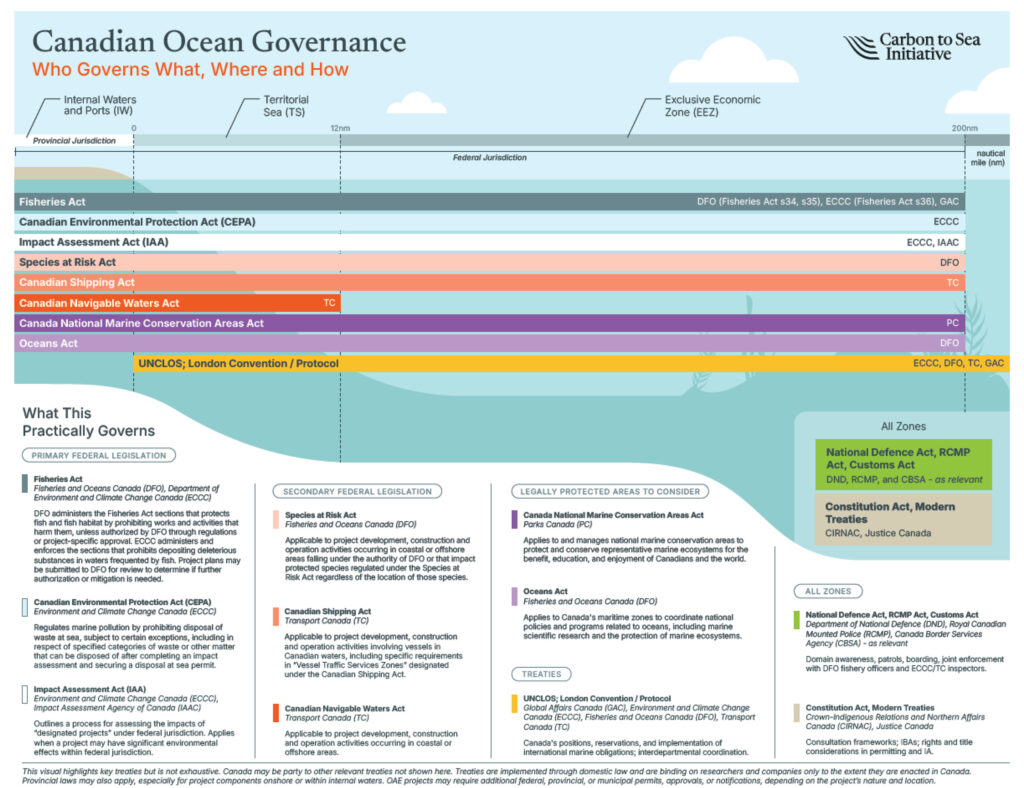
Examples of permitted OAE projects in Canada include:
| Planetary Technologies | |
| Organizations | Planetary Technologies, Nova Scotia Power, Dalhousie University |
| Date | 2023+ |
| Location | Halifax, Nova Scotia, Canada |
| Method | Mineral-based Alkalinity Enhancement with Mg(OH)2 addition to the cooling water outflow of Nova Scotia Power’s Tuft’s Cove Generating Station. 1,000 net tons removed so far, 10,000 tons annual site capacity. |
| Permit Type | Standalone provincial permit issued by the Nova Scotia Department of Environment and Climate Change (NS-ECC) |
| Permit Scope | Chemical storage, spill contingency plans, air quality, water quality, and noise. Stated end-of-pipe pH and total suspended solids limits |
| Status | Ongoing pilot |
| Reference | Project Page on Planetary website159 |
| CarbonRun | |
| Organizations | CarbonRun, Dalhousie University |
| Date | 2025+ |
| Location | Nova Scotia, Canada |
| Method | Addition of crushed limestone to rivers to raise their pH, storing CO2 as dissolved bicarbonate in the river and ultimately the ocean |
| Permit Type | Water Withdrawal Permit for processing purposes. River Liming is a designated activity under the Watercourse Alteration Permit, administered by Nova Scotia Environment and Climate Change (NSECC). Some activities may proceed by way of notification only, in particular if they improve fish habitat. Activities are exempt from Federal Environmental Impact Assessment (precedent). Fisheries Act Species-At-Risk is relevant when a species’ habitat is present (historical or contemporary). |
| Permit Scope | All necessary permits are scoped per-project and active. |
| Status | Permitted, Project active (not public) |
| Reference | Frontier Purchase Agreement160 details, Canada Department of Fisheries, Overview of Liming Techniques.161 |
^ RETURN TO TABLE OF CONTENTS ^
7.2.3 UK
The UK is a party to both the London Convention and the London Protocol. In the UK, marine-based research and deployment activities are regulated through a comprehensive system of water and environmental laws, including, for example, the Environmental Permitting (England and Wales) Regulations 2016, through which permits are issued, and the Marine and Coastal Access Act 2009, through which licences are issued. The following UK government resources provide information on permitting and licensing requirements for projects: environmental permit or marine license. While several government agencies are involved in authorizing activity in the marine environment, the Environment Agency and Marine Management Organization are of greatest relevance to mCDR activities, along with Natural England, JNCC, and Cefas, all of which are statutory advisors to the UK government.
In addition, the Water Environment Regulation (Water Framework Directive) (England and Wales) 2017 transposes the EU standards into UK law to ensure inland, transitional, and coastal waters maintain “good ecological” status up to one nautical mile from baseline or “good chemical status” through 12 nautical miles from baseline.162 Through the Water Framework Directive (WFD) assessment (Clearing the Waters for All),163 the UK provides guidance on how to assess the impact of any estuarine or coastal activity . A WFD assessment should be carried out in three stages: screening, scoping, and then the impact assessment (if required). The screening stage will identify if scoping is required, and then the scoping stage will identify all potential risks to each receptor (hydromorphology, biology, habitats, and fish), water quality, and protected areas. The WFD includes a template that can be used for this activity164 and provides suggestions for using the Water Body Summary Table165 and Magic Maps166 to find information on the location and size of WFD habitats. Invasive non-native species (INNS) should be included in the impact assessment if the activity could introduce or spread INNS to the OAE delivery site.
An environmental quality standard (EQS) is a set level of concentration of specific pollutants in water bodies, established to ensure the water maintains or achieves a “good status”. For most of the substances covered by the EQSs, the regulator will set numerical limits in permits, so that compliance results in the waters meeting the EQSs. A summary of the UK Government EQS167 limits is available in the appendix (Table 11).
For coastal outfalls, regulations specify pH limits at the edge of the initial mixing zone (IMZ), defined as the region where the effluent rises under its own buoyancy. The distance between the outfall and the IMZ edge is variable in space and time, depending on tidal flows and mixing by winds, but it is generally in the order of tens of metres.168
Biological safeguards are embedded through obligations such as those under the Eels Regulations (England and Wales) 2009, which regulates the impact of structures on eel movement and migration, and which may require the installation of fish screens and other mitigations to facilitate eel movement. The Salmon and Freshwater Fisheries Act 1975 aims to protect fish species, spawning environments, and habitats potentially impacted by chemical discharge. Additionally, the Water Resources Act 1991 governs abstraction and pollution of controlled waters, making the Act a primary tool for oversight of project-related water quality interventions. For OAE, this necessitates securing a water discharge consent and/or permit from the Environment Agency for wastewater and chemical release, along with necessary monitoring and mitigation planning. While not specific to OAE, these regulations collectively create a layered control system that the relevant authorities use to assess and regulate ocean activities.
In addition, other agencies may become involved in the permitting process if a proposed location for OAE activities is protected or has species of concern. For example, Natural England has responsibility for nature conservation, and it provides advice to the EA (the regulator) about the English coastal region within territorial waters. For another example, OAE materials themselves may fall under regulation (such as the EU’s REACH regulation (EC No 1907/2006), which requires chemical imports of more than one tonne per year to be registered with the European Chemicals Agency (ECHA).69 To aid OAE field trial time management, it must be understood that applications for permits or licenses for novel activities may take as long as 1-2 years.
Figure 6: Regulatory responsibilities for estuaries, coasts, and marine environments in England
EA = Environment Agency, EPR = Environmental Permitting Regulations, IFCA = Inshore Fisheries and Conservation Authorities, JNCC = Joint Nature Conservation Committee, NE = Natural England, SAFFA = Salmon and Freshwater Fisheries Act, SSSI = Site of Special Scientific Interest, WER = Water Environment Regulation, WFD = Water Framework Directive, WRA = Water Resources Act.

Examples of permitted OAE projects in the UK include:
| SeaCURE | |
| Organizations | Exeter University, Plymouth Marine Laboratory, SEA LIFE Weymouth Aquarium |
| Date | 2024+ |
| Location | Weymouth, United Kingdom |
| Method | Direct Ocean Capture via electrodialysis with release of basic CO2-depleted seawater |
| Permit Type | Bespoke Environment Agency Discharge Permit |
| Permit Scope | Discharge permit to release pH-adjusted seawater between a pH of 7 and 10. Daily discharge limit up to 14,200 m3/day. Permit issued for the period of research contingent on an annual fee. |
| Status | Ongoing pilot |
| Reference | Project Announcement |
^ RETURN TO TABLE OF CONTENTS ^
7.2.4 Iceland
Iceland is a party to both the London Convention and the London Protocol, placing it under the same international duties as the other nations in this section. At the national level, a robust body of legislation shapes ocean activities.
Under the Act on Territorial Waters, Exclusive Economic Zone, and Continental Shelf (Act No. 41/1979),170 Iceland defines its marine jurisdiction, extending from internal waters through the continental shelf. This Act establishes a strong environmental precaution posture: Chapter V requires the avoidance of any pollution-causing activity, and Chapter VI mandates that all scientific research in marine zones receive pre-approval. This approval is typically provided by the Ministry of Foreign Affairs, with consultation from a range of expert authorities. Applications for research – including alkalinity additions – must be submitted at least six months in advance and receive a decision within four months. Project descriptions must include methodology, substances used, timing, vessel/equipment types, and involvement of Icelandic or foreign research entities.
In addition, the Act on Prevention of Marine and Coastal Pollution (Act No. 33/2004)171 prohibits the disposal of any substance into the sea without a permit. However, it provides an important exception for lawful scientific research, when approved under the 1979 Act above.
In freshwater and coastal systems landward of the baseline, the Water Management Act (Act No. 36/2011) and its affiliated Regulation No 935/2011 transpose the EU Water Framework Directive standards into the Icelandic legal framework. Iceland is considered a single River Basin District (IS1). IS1 is divided into four water regions, each of which has a dedicated water region committee that includes representatives from the local authorities and the local health inspectorates and which is led by a representative from the Icelandic Environment Agency. The role of the water region committees is to coordinate the work within each water region and gather information when it comes to the river basin management plan, monitoring plan, and their implementation, especially the Programme of Measures. The Water Framework Directive assigns ecological and chemical “good status” to water bodies, and requires environmental impact assessments and permitting for interventions that might alter water quality or ecosystem integrity. Oversight is coordinated by regional water management structures under the Environment Agency of Iceland.172 The EQSD indicates maximum allowable concentrations (MAC) and annual average concentrations (AA) of some key substances that are known contaminants to potential OAE materials. A section of this table is available in the appendix.
Because OAE projects frequently involve chemical additions or tracer usage, Iceland’s Chemicals Act (Act No. 61/2013) and Fluorinated Greenhouse Gases Regulation (Reg. No. 1066/2019) impose controls on the handling, storing, and disposing of substances such as sodium hydroxide and sulfur hexafluoride. Permits are required, and operational protocols— including staff training and safety data sheet availability—must be in place.
Oversight of these activities is shared across government agencies. The Ministry for Foreign Affairs considers, evaluates, and issues ocean science research permits. The Ministry for the Environment, Energy, and Climate is responsible for policy development and strategic oversight across environmental protection, climate action, nature conservation, and energy regulation. The Environment and Energy Agency of Iceland oversees the administration of climate, environmental, and energy affairs, as well as resource management issues.173 The Ministry of Industries is responsible for the management, research, and monitoring of the conservation and utilization of fish stocks and other living marine resources and the seabed. The Marine and Freshwater Research Institute will conduct scientific research and advice related to the conservation and utilization of fish stocks and other living marine resources and the seabed. The Icelandic Coast Guard plays an important role in regulating infrastructure and marine use. Prior approval is needed for the use and deployment of equipment or objects in navigable waters from the Icelandic Transport Authority and prior approval for the use of telecommunications is needed from the Electronic Communications Office of Iceland.
Examples of permitted OAE projects in Iceland include:
| Ocean Alkalinity Enhancement Pilot, Hvalfjörður, Iceland | |
| Organizations | Röst Marine Research Center (lead); [C]Worthy; University of Iceland; Marine and Freshwater Institute (MFRI); VHE (engineering); Verkis (EHS compliance); Köfunarþjónustan (diving) |
| Date | 2026+ |
| Location | Hvalfjörður, Iceland |
| Method | Dispersal of alkaline solution via a bespoke mixing and dispersal unit, into surface waters 100 m offshore in a fjord, for the purposes of studying enhanced air sea gas exchange and mCDR. |
| Permit Type | Ministry of Foreign Affairs (MFA) Research Permit |
| Permit Scope | MFA authorized placement of up to 40,000 L of 30% NaOH solution diluted to 4.5% over a maximum continuous release duration of up to 96 hours into surface waters in the Icelandic fjord Hvalfjörður. |
| Status | Permitted and ongoing pilot (Fall 2026) |
| Reference | Project Announcement |
8. Operational Health and Safety
As project planning transitions from desktop and laboratory research to real-world implementation, it is critical to consider the safety of operators and operations. The exact nature of the health and safety (H&S) risk assessments, planning, and management must be based on the specific operational processes, materials, and equipment used in an OAE project. It is also important to engage local stakeholders during the development of the operational risk assessment and safety measures; this is especially important when OAE is performed where other users are present during or immediately after the alkalinity addition.
To avoid safety concerns developing from non-information or disinformation, safety information must be easily available to stakeholders and the wider public. Safety information available to the wider public must be easily accessible and understandable (to nonexperts) to avoid miscommunication.
^ RETURN TO TABLE OF CONTENTS ^
8.1 Occupational and Operational Risk Assessment and Mitigation Strategies
A systems approach to risk analysis should be used to identify operational hazards and define the precautions needed to address them. Risk assessments must be completed before any in-field activity to ensure safety measures are fit-for-purpose and address the risk from personnel interactions with materials and equipment. The OAE treatment process, dispersal method, and alkalinity sources will be the main factors in shaping these risks.
For guidance, the International standard—ISO 45001—provides a widely applicable framework for systematically identifying hazards and implementing controls. Building on this standard, the table below highlights common operational risks for OAE and the strategies to mitigate them. Environmental risks—such as potential changes to marine ecosystems—should be treated with the same precautionary planning as occupational risks.
Table 7 summarizes the overarching risks and mitigation strategies relevant for most OAE field trials. It does not attempt to catalogue the detailed risks specific to individual dispersal methods and/or alkalinity sources, which would need to be considered on a case-by-case basis during the initial planning and risk assessment phase of the OAE operation. For clarity, the table subdivides risks into occupational, environmental and operational, and assumes that appropriate risk assessments (including Control of Substances Hazardous to Health (COSHH) forms) are carried out in parallel with the operational health and safety risk and mitigation strategies.
Table 7: Operational Health and Safety Risks and Mitigation Strategies174
| Risk | Mitigation Strategy |
| Occupational Illustrative purposes only. A mitigation strategy must be developed according to the unique risk profile of each project. | |
| Injury to operators due to slips, trips, falls, etc. | All site workers are to be appropriately trained. There must be site access requirements.There should be regular maintenance checks on equipment functioning.Certain areas should have further restricted access. PPE should be worn correctly and be well-maintained. Access is available to nearby first aid equipment. There must be contingency planning for the site, including access for emergency vehicles available at all times. |
| Injury to members of the public due to slips, trips, falls, etc. | No access to the site should be given for unaccompanied members of the public. Visitors are to wear PPE (which must be worn correctly and be well-maintained). Access is available to nearby first aid equipment. There must be contingency planning for the site, including access for emergency vehicles available at all times. |
| Injury from materials used on site | Materials must be appropriately labelled, stored, and managed (as per the MSDS and RA). Only trained personnel may handle materials. Establish and practice safe material handling procedures. Access is available to nearby first aid equipment, including an eye washing station. There must be contingency planning for the site, including access for emergency vehicles available at all times. |
| Injury due to a fall into water (riverine, estuarine, or oceanic) and/or nontrivial exposure to wildlife | There must be operator training. There should be restricted access to members of the public. Appropriate safety equipment should be on site at key locations (e.g., life saver ring buoy with SOLAS reflective tape and/or throw rope). Access is available to nearby first aid equipment.If appropriate, operators are to wear life jackets while carrying out their tasks near the water. |
| Breathing risk (where OAE methods rely on the use of very fine particles) (People can breathe in suspended particles that have a diameter < 10µm (PM10); however, “high-risk” respirable particles are those that can penetrate to the ciliated regions of the lungs, and these have a diameter < 2.5µm (PM2.5)). | Wear breathing masks when handling particulate material. Only handle particulate material in well-ventilated areas. Monitor PM10 and PM2.5 using standard procedures (e.g., UK Government).175 |
| Operational Illustrative purposes only. Mitigation strategy must be developed according to the unique risk profile of each project. | |
| Severe weather, cold, or heat stress (realised or forecast) | Pause the dosing operation until severe weather subsides. Ensure weather-appropriate gear, sun protection, and proper hydration. |
| Effluent-related risk (if operation includes adding alkalinity to an outfall pipe) | All site workers are to be appropriately trained and equipped with proper PPE. Establish site access requirements and apply restricted access when appropriate. Hand washing is encouraged at the end of each task. Raw water contents are monitored for harmful bacteria (such as E. coli, cholera, dysentery, etc.). Access to first aid equipment is nearby. |
| Ship-related risk | Compile with all Standards of Training, Certification, and Watchkeeping (STCW) requirements and ensure the vessel is appropriate for the task. The ship’s master retains ultimate authority over ship-related decision-making. |
| Material-related risks (such as burns from material touching exposed skin or eye injuries from material getting into the eyes) | Materials must be tested in the lab before being used in field trials. Materials must be subject to a dedicated risk assessment that includes reference to the MSDS. Clean up and contain spillages immediately using the correct equipment and appropriate personnel. Spill equipment must always be kept nearby when material is being decanted or moved. Materials to be signed in and out of storage |
| Environmental Illustrative purposes only. A mitigation strategy must be developed according to the unique risk profile of each project. | |
| Local species and habitats risk | Ensure materials and dispersal methods are not anticipated to harm local species and habitats. Assess local hydrodynamics to avoid potential particle aggregation. Avoid dispersal near sensitive areas and during periods of grazing, mating, and spawning. Engage stakeholders and local communities to inform monitoring and identify key species or concerns. For endangered/culturally sensitive species/habitats, apply targeted protections and enhanced monitoring. Stop operations immediately if concerning and/or inexplicable changes occur. |
| Ecosystem function shifts | Use individual metric monitoring to detect broader functional impacts (e.g., nutrient cycling, food web). |
| Unexpected Hydrological/metocean changes | Monitor metrics (e.g., TA, pH, DO). Stop the project if thresholds are breached. |
^ RETURN TO TABLE OF CONTENTS ^
8.2 Safe Handling of Materials
Materials used in OAE operations, particularly the alkaline feedstock, can influence safety risks due to their potentially hazardous chemical properties. Thus, safe handling must be considered at every stage of feedstock use, including its production, transport, application, and storage.
Once the feedstock and any other materials are identified, the specific Material Safety Data Sheet(s) should be referenced to conduct a risk assessment. It is required that any material used for OAE is checked for compliance with the chemical regulations of the country of origin and the country where the OAE operations will be carried out. Summarized below are the general processes to ensure proper protocols are developed for the safe handling of materials for OAE operations.
- Identify materials required for the OAE method, consider previous experimental successes and material restrictions.
- Check regional regulations. Check chemical regulations for the country where OAE operations are being planned (e.g., REACH, TSCA, CEPA, etc.) and identify any restrictions or safety requirements.
- Check the Material Safety Data Sheet (MSDS). Identify hazards associated with the material, and identify safety requirements for working with the material.
- Conduct a material risk assessment. Include information from regulations and MSDS. Develop safe systems of work, and consider the area where OAE operations will take place.
As described above, hazardous material handling is governed by regulations that vary by country. Summarized below are the relevant regulating bodies in the US, Canada, the UK, and Iceland:
US
The Toxic Substance Control Act (TSCA) within the United States law regulates chemicals that are not regulated by other US federal statutes, providing the U.S. EPA with authority to require reporting, record-keeping and testing requirements, and restrictions relating to chemical substances.
Canada
The Government of Canada controls chemical usage in Canada, relying on federal legislation such as The Hazardous Products Act (HPA 1985)176 and the Canadian Environmental Protection Act (CEPA 1999).177 These acts establish standards for chemical classification and hazard communication via safety data sheets and enable the Canadian Government to manage risks to the environment and human health posed by chemicals.
UK and Iceland
The Health and Safety Executive (HSE) is the national regulator for workplace health. The HSE controls chemical usage in the UK using legislation such as the Control of Substances Hazardous to Health (COSHH) Regulation,178 the Classification, Labelling and Packaging of substances (CLP)179, and Regulation and Registration, Evaluation, Authorisation and Restriction of Chemicals (REACH).180 REACH is one of the key regulations in the EU and was replicated in UK law following BREXIT (known as UK REACH). The EU REACH regulation applies in all EU countries and in Iceland, where it is implemented through the Icelandic Regulation no. 888/2015.
^ RETURN TO TABLE OF CONTENTS ^
8.3 In-field Decision-making, Stop-triggers, and Resumption Requirements
Environmental risks should be mitigated through careful planning and project design. However, careful monitoring across occupational, operational, and environmental parameters will help project teams spot emerging issues and make corrections before major problems occur. Some events or outcomes could act as “stop-triggers” for trial activities, as summarized below:
- Any occupational or environmental health and safety (H&S) event (refer to Table 8).
- Any indicator that changes above or below a predetermined safety or regulatory threshold value for a sustained time period.
- Unexpected events with broad-reaching, irreversible, or uncontrollable outcomes.
OAE safety procedures must consider feedback mechanisms to ensure trials are halted promptly, either immediately or when safe, if an occupational safety hazard is observed or if environmental monitoring results fall outside expected ranges.
Given the well-understood chemistry, unexpected or concerning environmental monitoring results will warrant further investigation. There may also be cases when monitoring data show a significant environmental change that is still within the range of expectation. The decision to arrest OAE operations must account for varying levels of impact tolerance, which can shift depending on the context of the trial, particularly between short-term research and long-term commercial operations. Impact tolerance will be significantly influenced by stakeholder concern and will depend on the purpose and perceived value of the project, the short-lived or reversible nature of the impact, and the temporal and spatial scale. Due to the highly variable nature of water bodies, it may be difficult to attribute some impacts to a trial’s activity. In many cases, additional monitoring is recommended to better isolate the origin of an observed impact to inform decisions on whether and how to change trial operations. An illustrative example of a safety protocol for a coastal outfall OAE project can be seen below.
Table 8: Example of a safety protocol for a coastal outfall OAE trial
(Source: Planetary181)
| Type | Trigger/threshold | Arrest action(A) | Resumption requirements |
| Operational | Personnel Injury | Stop dosing immediately. | First aid is administered to the injured worker (if necessary), and preventative measures are put in place to ensure no repeat injury. Sufficient number of fit operators on-site |
| Equipment malfunction resulting in unsafe working conditions (e.g., leaks, sparks), un-monitored dosing, or loss of dosing data | Stop dosing immediately | Equipment fixed and safety-tested | |
| Spill occurs | Stop dosing immediately Inform the environmental regulator | Spill cleaned upRegulator informed of cleanup | |
| Inclement weather(realized or forecasted) | Stop dosing immediately | Inclement weather subsides | |
| Effluent | pH: rolling hourly median value outside of regulatory thresholds (measured within the pipe) | Stop dosing immediately | Reduce dosing rate Demonstrate values at a lower dosing rate that no longer exceed thresholds Regulator report sent within 48 hours of the event |
| TSS: rolling hourly median difference between up- and downstream stations outside national regulations | |||
| TA: total alkalinity over regulatory limit, relative to background | |||
| Ocean | pH: any in-plume measurement outside of regulatory thresholds | Initiate follow-up sampling and analysis to verify observed exceedance. Stop dosing if a link to the project is established. | Dosing will resume at a reduced rate and will be gradually increased to the previous rate. Increasing the dose rate will only occur when subsequent sampling demonstrates safe thresholds for all measured variables. Regulator report sent within 48 hours of the event. |
| TSS: Difference between in- and out-of-plume measurements greater than the regulatory limit | |||
| Dissolved oxygen: A) more than 10% below the natural concentration when DO >8mg/L B) below natural DO when DO <8mg/L | |||
| Total metals: in-plume concentration > EQS limit when out-of-plume concentration < EQS limit for any single metal | |||
| Sediment | Total metals: Sediment metals concentrations for any of 9 metals (Ag, As, Cd, Cr, Cu, Hg, Ni, Pb, Zn) exceed stop-trigger thresholds determined as statistical outliers against the long-term average of the local dataset | Initiate follow-up sampling and analysis to verify observed exceedance. Stop dosing if a link to the project is established. | Dosing will resume at a reduced rate and will be gradually increased to the previous rate. Increasing the dose rate will only occur when subsequent sampling demonstrates safe thresholds for all measured variables. Regulator report sent within 48 hours of the event |
| Biological / Ecological | Abnormal wildlife activity observed | Stop dosing immediately | Once wildlife activity ends, dosing can resume at an equal or reduced rate Closely monitor the area, and if wildlife activity resumes soon after restart, dosing must stop until further analysis can be completed. Activity must be noted in regular weekly regulator reports. |
(A) “Stop dosing immediately” is to be done ONLY when it is deemed safe to do so (e.g., if injury has occurred, the injured person must first be secured before taking further action). Stopping dosing must also be communicated clearly to the broader team.
^ RETURN TO TABLE OF CONTENTS ^
8.4 Safety Equipment
Depending on the materials used during OAE operations, certain safety equipment may be mandatory. At a minimum, personnel should be equipped with:
- Protective gloves
- Protective eyewear
- Protective clothing (e.g., coverall)
The risk assessment process should identify any additional equipment needs based on site-specific conditions. For example, some conditions may warrant the wearing of hard hats (e.g., if overhead equipment exists), high visibility jackets (if working in an area where there is a risk of being hit by a passing vehicle, etc.), walking boots or hard-capped boots, etc.
9. Transparent Data Publishing and Reporting Guidelines
This section is co-authored by Jacqueline Long and is adapted from the Ocean Alkalinity Enhancement Data Management Protocol.182
Transparent data publishing and reporting practices are central to maintaining a record of carbon removal and environmental monitoring that is of high integrity, is verifiable, and lives in perpetuity. To achieve these goals, the FAIR Guiding Principles for Scientific Data Management and Stewardship183 were published and subsequently adopted by the EU.184 The FAIR principle highlights the need to improve the Findability, Accessibility, Interoperability, and Reuse of data and acts as a set of guidelines for scientific data management to improve data infrastructure and services. Data collected as part of OAE field trials and operations should be well structured and standardized to maximally support intercomparison and to accelerate learning across projects, and it should be made openly available for the research and regulatory community. All data should be managed in accordance with FAIR to improve accessibility of the data that will form baseline environmental data for future OAE operations.
Data that comply with the principles of FAIR must be:
Findable
F1. All data are assigned a unique and life-long identifier.
F2. Data are accompanied by rich metadata (as per R1).
F3. Metadata include the identifier of the data described.
F4. All data are registered in a searchable database.
Accessible
A1. All data are retrievable by their identifier using a standard process.
A1.1 The process and database are open and free.
A1.2 The process allows for an authentication procedure where necessary.
A2. Metadata are accessible, even when the data they describe are no longer available.
Interoperable
I1. All data must use a formal, accessible, and shared language.
I2. All data must use respectful, accessible, and courteous vocabulary.
I3. All data must include accurate and useful references to other data where appropriate.
Reusable
R1. All data must be fully described with a number of accurate and relevant keywords.
R1.1. All data must be released under an accessible data usage licence.
R1.2. All data must have a traceable source.
R1.3. All data must meet domain-relevant standards.
Before executing any OAE activity, a data plan should be transparently shared that defines what data are anticipated to result from the project, and how data will be collected, monitored, stored, and shared.
Regulatory Reporting
Beyond the open data-sharing practices described above, OAE projects are subject to mandatory reporting obligations that vary by jurisdiction and that must be identified and met throughout a project’s lifecycle. These obligations fall into two broad categories. The first category concerns the conditions attached to the permits and authorizations that allow an OAE activity to proceed. Permitting authorities typically require periodic submission of monitoring data, compliance reports, and notification of any exceedances of permitted thresholds or deviations from the approved monitoring plan (see Section 7). The second category concerns operational and occupational reporting independent of the OAE permit itself, including the recording and reporting of workplace accidents, injuries, near-misses, spills, and other safety incidents in accordance with applicable occupational health and safety regulations (e.g., OSHA in the United States or the equivalent national authority) and any maritime or environmental incident-reporting requirements (see Section 8). Practitioners should establish clear procedures for both categories before field activities begin, ensuring that responsibility for each reporting obligation is assigned, that submission timelines and recipients are understood, and that records are maintained in a manner that satisfies regulators and supports transparency.
OAE Field Data Standards
In addition to, and informed by, the FAIR standards, Carbon to Sea has published a Data Management Protocol182 specifically for the OAE community. The protocol shares guidance and templates for submitting data for various types of projects and measurements in OAE. Metadata standards offer a common framework for submitting qualitative data that helps make experimental data understandable, discoverable, and reusable by humans and machines. The framework includes key details such as the method of collection, units, location, timestamps, data quality, and licensing. Guidelines for data management outline the specific requirements and recommendations for submitting data associated with OAE research. It covers general guidelines for adjusted and raw data, in situ sensor data, sediment processes, and biological/physiological data. Additionally, it provides instructions for creating unique project and experiment IDs to facilitate cross-linking of datasets (particularly for research cruises and other projects) and timelines for archiving data. Controlled vocabulary and column header names are also provided to ensure consistent naming structures for the comparability of data across projects.
Most important for the long-term preservation of data is the choice of the repository where the data is submitted and stored. Data can be stored in any scientific data repository that provides long-term preservation of data (ideally with version control capabilities), metadata hosting, and data citations with a unique DOI. Data may be stored in more than one repository if necessary; however, it is strongly recommended to choose a single repository to aid in discoverability. The choice of data repository may often be dictated by funder requirements. However, we make the following recommendations for data repositories.
- Discrete and sensor data, along with data from field trial studies, are recommended to be stored at:
- NOAA’s Ocean Carbon and Acidification Data System (OCADS) (includes metadata schema reflecting most of the contents in this protocol, up to 1 GB storage)
- Zenodo (up to 50 GB storage)
- SEANOE
- BCO-DMO (NSF-funded projects only)
- SeaDataNet (must be in an affiliated node)
- NOAA NCEI (must apply for a data agreement)
Data can also be backed up and stored in secondary locations. For ease of use, a secondary repository with a quicker submission workflow—such as Zenodo, Figshare, or PANGAEA—is recommended; other openly accessible options, such as GitHub or other domain-specific archives, are also permissible.
Additionally, Carbon to Sea and Submarine Scientific are developing an OAE Field Data Commons as an OAE-specific data platform for academic and private sector projects to share their experimental data. The OAE Field Data Commons builds on the standards and metadata requirements established by the OAE Data Management Protocol182 to provide a unified data repository that is easily accessible, searchable, and integrable with existing data repositories. The platform will allow project practitioners to search across relevant standardized datasets using category filters, including method type and site location, which will enable practitioners to conduct cross-site comparisons and other meta-analyses to inform their future project decision-making.
10. Closing Remarks
Ocean alkalinity enhancement holds significant promise as an approach for carbon dioxide removal. However, realizing that promise depends on demonstrating that field activities can be conducted without undue harm to the marine environment. This framework has sought to organize the best available science, methods, and practitioner experience into a single coherent reference for the environmental impact monitoring of OAE field trials. In doing so, this framework aims to provide researchers, commercial actors, regulators, funders, and the communities that share these waters a common foundation from which to design, evaluate, and learn from OAE field research.
A central theme of this document is that environmental risk remains low and manageable when the scale of activity is matched by proportional gains in scientific understanding. The phased gated structure of the framework is built to honor that principle: each stage advances only as the knowledge base grows, decision gates create deliberate points for critical evaluation, and monitoring is positioned not as a remedy for impacts but as the final layer of a risk-mitigation process that begins with careful planning and dispersal design. Monitoring alone cannot mitigate impacts once they have occurred, and the recommendations throughout this framework reflect that reality.
Equally important is the recognition that no single monitoring approach can serve every project. OAE encompasses a diversity of pathways, feedstocks, and receiving environments. This framework has therefore been designed to provide standardized guidance where alignment is valuable while preserving the flexibility that distinct methods and local contexts demand. The prioritized monitoring parameters, the emphasis on robust baselines and control sites, the attention to biological and ecological considerations, and the integration of modeling are all intended to be adapted thoughtfully rather than applied uniformly. Final monitoring requirements will ultimately rest with the relevant permitting authorities. Practitioners should treat this framework as complementary to, never as a substitute for, the regulations and consultation processes that govern their jurisdiction.
Transparency and engagement are the connective tissue that allow this work to earn trust. Early and meaningful involvement of stakeholders and rightsholders, together with open, FAIR-aligned data sharing, ensures that the evidence generated by OAE field trials is not only scientifically sound but that it is also accessible, comparable, and accountable to the wider community. An aligned network of research and demonstration projects, each contributing its results openly, offers the field its best opportunity to advance quickly, responsibly, and with public confidence intact.
Finally, this framework is offered as a first iteration rather than a final word. It reflects the state of knowledge and practice at the time of writing, and it is intended to be revisited and refined as research matures, methods evolve, and real-world experience accumulates. The authors hope this framework will encourage additional teams to apply, test, and improve upon these approaches, and to codify and share their own experiences for the benefit of the field. By grounding the responsible advancement of OAE in precaution, scientific rigor, transparency, and environmental stewardship, we can pursue the broader goal of climate mitigation while safeguarding the health of the ocean ecosystems on which that goal ultimately depends.
References
1. A Code of Conduct for Marine Carbon Dioxide Removal Research – Aspen Institute. https://www.aspeninstitute.org/publications/a-code-of-conduct-for-marine-carbon-dioxide-removal-research/.
2. Doney, S. et al. Principles for Responsible and Effective Marine Carbon Dioxide Removal Development and Governance. https://oceanpanel.org/publication/marine-carbon-dioxide-removal/ (2025) doi:10.69902/84b3a9a8.
3. Guide to Best Practices for Ocean CO₂ Measurements. (North Pacific Marine Science Organization, Sidney, BC, 2007).
4. 4500-H+ pH. in Standard Methods For the Examination of Water and Wastewater (American Public Health Association, 2017). doi:10.2105/SMWW.2882.082.
5. ISO 22804:2023. ISO https://www.iso.org/standard/73952.html.
6. ISO 5667-17:2008(en), Water quality — Sampling — Part 17: Guidance on sampling of bulk suspended solids. https://www.iso.org/obp/ui/en/#iso:std:iso:5667:-17:ed-2:v1:en.
7. ISO/IEC 17025 – General requirements for the competence of testing and calibration laboratories.
8. Bass, J. Using Science to Create a Better Place. Environmental Quality Standards for Trace Metals in the Aquatic Environment. (Environment Agency, Bristol, 2008).
9. GEOTRACES-cookbook-v4-2024.pdf.
10. ISO 17289:2014. ISO https://www.iso.org/standard/59515.html.
11. US EPA, O. Field Measurement of Dissolved Oxygen. https://www.epa.gov/quality/field-measurement-dissolved-oxygen (2015).
12. OCADS – Guide to Best Practices for Ocean CO₂ Measurements. https://www.ncei.noaa.gov/access/ocean-carbon-acidification-data-system/oceans/Handbook_2007.html.
13. O’Dell, J. W. DETERMINATION OF TURBIDITY BY NEPHELOMETRY. in Methods for the Determination of Metals in Environmental Samples 378–387 (Elsevier, 1996). doi:10.1016/B978-0-8155-1398-8.50021-5.
14. International Organization for Standardization. ISO 7027-1:2016, Water quality — Determination of turbidity Part 1: Quantitative methods. (2016).
15. Claire Davies, Raphe Kudela, & Frank Muller-Karger. Essential Ocean Variable Specification Sheet – Phytoplankton Biomass and Diversity. (2025).
16. Kim Bernard & Svenja Halfter. Essential Ocean Variable Specification Sheet – Zooplankton Biomass and Diversity. (2025).
17. NEMI Method Summary – 445.0. https://www.nemi.gov/methods/method_summary/7222/.
18. A Research Strategy for Ocean-based Carbon Dioxide Removal and Sequestration | The National Academies Press. https://nap.nationalacademies.org/catalog/26278/a-research-strategy-for-ocean-based-carbon-dioxide-removal-and-sequestration.
19. Henry Ruhl, Rachel Przeslawski, Monika Kędra, & Marta Szczepanek. Essential Ocean Variable Specification Sheet – Benthic Invertebrate Abundance and Distribution. (2025).
20. Anthony Bernard, Ana Lara-Lopez, & Tony Koslow. Essential Ocean Variable Specification Sheet – Fish Abundance and Distribution. (2025).
21. Dipani Sutaria & Samantha Simmons. Essential Ocean Variable Specification Sheet – Marine Mammal Abundance and Distribution. (2025).
22. ISO 8245:1999(en), Water quality — Guidelines for the determination of total organic carbon (TOC) and dissolved organic carbon (DOC). https://www.iso.org/obp/ui/#iso:std:iso:8245:ed-2:v1:en.
23. International Organization for Standardization. ISO 5667-26:2022 Water quality — Sampling, Part 26: Guidance on sampling for the parameters of the oceanic carbon dioxide system. (2022).
24. Mõttus, M., Sulev, M., Frederic, B., Lopez-Lozano, R. & Noorma, A. Photosynthetically Active Radiation: Measurement and Modeling. in Encyclopedia of Sustainability Science and Technology 7970–8000 (2011).
25. GOOS Biogeochemistry Panel. Essential Ocean Variable Specification Sheet – Nutrients. (August 25, 20217).
26. ISO 22743:2006(en), Water quality — Determination of sulfates — Method by continuous flow analysis (CFA). https://www.iso.org/obp/ui/en/#iso:std:iso:22743:ed-1:v1:en.
27. Standing Committee of Analysts. Sulphate in Waters, Effluents and Solids. (HMSO, London, 1989).
28. Minx, J. et al. The State of Carbon Dioxide Removal – 2nd Edition. https://doi.org/10.17605/OSF.IO/F85QJ (2024) doi:10.17605/OSF.IO/F85QJ.
29. Mitigation Pathways Compatible with Long-term Goals. in Climate Change 2022 – Mitigation of Climate Change (ed. Intergovernmental Panel On Climate Change (Ipcc)) 295–408 (Cambridge University Press, 2023). doi:10.1017/9781009157926.005.
30. Climate Change 2022 – Mitigation of Climate Change: Working Group III Contribution to the Sixth Assessment Report of the Intergovernmental Panel on Climate Change. (Cambridge University Press, 2023). doi:10.1017/9781009157926.
31. Chapter 1 — Global Warming of 1.5 oC. https://www.ipcc.ch/sr15/chapter/chapter-1/.
32. Middelburg, J. J., Soetaert, K. & Hagens, M. Ocean Alkalinity, Buffering and Biogeochemical Processes. Rev. Geophys. 58, e2019RG000681 (2020).
33. SP – Assessing the technical aspects of ocean-alkalinity-enhancement approaches. https://sp.copernicus.org/articles/2-oae2023/3/2023/.
34. Renforth, P. & Henderson, G. Assessing ocean alkalinity for carbon sequestration. Rev. Geophys. 55, 636–674 (2017).
35. BG – Limits and CO₂ equilibration of near-coast alkalinity enhancement. https://bg.copernicus.org/articles/20/27/2023/.
36. Marine Carbon Dioxide Removal Field Trials. Ocean Visions https://oceanvisions.org/mcdr-field-trials/.
37. A Research Strategy for Ocean-Based Carbon Dioxide Removal and Sequestration. (National Academies Press, Washington, D.C., 2022). doi:10.17226/26278.
38. Oelkers, E. H., Declercq, J., Saldi, G. D., Gislason, S. R. & Schott, J. Olivine dissolution rates: A critical review. Chem. Geol. 500, 1–19 (2018).
39. Balch, W. M., Plueddeman, A. J., Bowler, B. C. & Drapeau, D. T. Chalk-Ex—Fate of CaCO3 particles in the mixed layer: Evolution of patch optical properties. J. Geophys. Res. Oceans 114, (2009).
40. Moras, C. A., Bach, L. T., Cyronak, T., Joannes-Boyau, R. & Schulz, K. G. Ocean alkalinity enhancement – avoiding runaway CaCO3 precipitation during quick and hydrated lime dissolution. Biogeosciences 19, 3537–3557 (2022).
41. Zhou, M. et al. Mapping the global variation in the efficiency of ocean alkalinity enhancement for carbon dioxide removal. Nat. Clim. Change 15, 59–65 (2025).
42. Wang, B. et al. Maximizing the Detectability of Ocean Alkalinity Enhancement (OAE) While Minimizing Its Exposure Risks: Insights From a Numerical Study. Earth’s Future 13, e2024EF005463 (2025).
43. Subhas, A. V. et al. A tracer study for the development of in-water monitoring, reporting, and verification (MRV) of ship-based ocean alkalinity enhancement. Biogeosciences 22, 5511–5534 (2025).
44. Bach, L. T., Gill, S. J., Rickaby, R. E. M., Gore, S. & Renforth, P. CO₂ Removal With Enhanced Weathering and Ocean Alkalinity Enhancement: Potential Risks and Co-benefits for Marine Pelagic Ecosystems. Front. Clim. 1, (2019).
45. Magnesium hydroxide addition reduces aqueous carbon dioxide in wastewater discharged to the ocean | Communications Earth & Environment. https://www.nature.com/articles/s43247-024-01506-4.
46. Campbell, J. S. et al. Geochemical Negative Emissions Technologies: Part I. Review. Front. Clim. 4, (2022).
47. Flipkens, G. et al. Enhanced olivine dissolution in seawater through continuous grain collisions. Geochim. Cosmochim. Acta 359, 84–99 (2023).
48. Foteinis, S., Campbell, J. S. & Renforth, P. Life Cycle Assessment of Coastal Enhanced Weathering for Carbon Dioxide Removal from Air. Environ. Sci. Technol. 57, 6169–6178 (2023).
49. Subhas, A. V. et al. A novel determination of calcite dissolution kinetics in seawater. Geochim. Cosmochim. Acta 170, 51–68 (2015).
50. Pokrovsky, O. S. & Schott, J. Experimental study of brucite dissolution and precipitation in aqueous solutions: surface speciation and chemical affinity control. Geochim. Cosmochim. Acta 68, 31–45 (2004).
51. Moras, C. A., Cyronak, T., Bach, L. T., Joannes-Boyau, R. & Schulz, K. G. Effects of grain size and seawater salinity on magnesium hydroxide dissolution and secondary calcium carbonate precipitation kinetics: implications for ocean alkalinity enhancement. Biogeosciences 21, 3463–3475 (2024).
52. Renforth, P., Baltruschat, S., Peterson, K., Mihailova, B. D. & Hartmann, J. Using ikaite and other hydrated carbonate minerals to increase ocean alkalinity for carbon dioxide removal and environmental remediation. Joule 6, 2674–2679 (2022).
53. Nobre, J., Ahmed, H., Bravo, M., Evangelista, L. & de Brito, J. Magnesia (MgO) Production and Characterization, and Its Influence on the Performance of Cementitious Materials: A Review. Materials 13, 4752 (2020).
54. Kheshgi, H. S. Sequestering atmospheric carbon dioxide by increasing ocean alkalinity. Energy 20, 915–922 (1995).
55. Ringham, M. C. et al. An assessment of ocean alkalinity enhancement using aqueous hydroxides: kinetics, efficiency, and precipitation thresholds. Biogeosciences 21, 3551–3570 (2024).
56. Khangaonkar, T. et al. Mixing and dilution controls on marine CO₂ removal using alkalinity enhancement. Environ. Res. Lett. 19, 104039 (2024).
57. Moras, C. A., Joannes-Boyau, R., Bach, L. T., Cyronak, T. & Schulz, K. G. Carbon dioxide removal efficiency of iron and steel slag in seawater via ocean alkalinity enhancement. Front. Clim. 6, (2024).
58. Li, H. et al. Performance evaluation and environment risk assessment of steel slag enhancement for seawater to capture CO₂. Energy 238, 121861 (2022).
59. Hashim, M. S. et al. Mineral formation during shipboard ocean alkalinity enhancement experiments in the North Atlantic. Biogeosciences 22, 7149–7165 (2025).
60. Balch, W. M., Plueddeman, A. J., Bowler, B. C. & Drapeau, D. T. Chalk-Ex—Fate of CaCO3 particles in the mixed layer: Evolution of patch optical properties. J. Geophys. Res. Oceans 114, (2009).
61. Köhler, P., Abrams, J. F., Völker, C., Hauck, J. & Wolf-Gladrow, D. A. Geoengineering impact of open ocean dissolution of olivine on atmospheric CO₂, surface ocean pH and marine biology. Environ. Res. Lett. 8, 014009 (2013).
62. Kheshgi, H. S. Sequestering atmospheric carbon dioxide by increasing ocean alkalinity. Energy 20, 915–922 (1995).
63. Prot, T., Korving, L., Dugulan, A. I., Goubitz, K. & van Loosdrecht, M. C. M. Vivianite scaling in wastewater treatment plants: Occurrence, formation mechanisms and mitigation solutions. Water Res. 197, 117045 (2021).
64. Chou, W.-C. et al. Potential impacts of effluent from accelerated weathering of limestone on seawater carbon chemistry: A case study for the Hoping power plant in northeastern Taiwan. Mar. Chem. 168, 27–36 (2015).
65. Sterling, S. et al. Title: Addition of Alkalinity to Rivers: a new CO₂ Removal Strategy. ESS Open Arch. 2023,.
66. Meysman, F. J. R. & Montserrat, F. Negative CO₂ emissions via enhanced silicate weathering in coastal environments. Biol. Lett. 13, 20160905 (2017).
67. Oschlies, A. et al. Guide to Best Practices in Ocean Alkalinity Enhancement Research. https://sp.copernicus.org/articles/2-oae2023/ (2023) doi:10.5194/sp-2-oae2023.
68. Wang, Y. & Pan, X. Application of the environmental impact assessment provisions under the BBNJ Agreement in high seas marine protected area: challenges and suggestion. Front. Mar. Sci. 12, (2025).
69. Exploring public acceptability of direct air carbon capture with storage: climate urgency, moral hazards and perceptions of the ‘whole versus the parts’ | Climatic Change. https://link.springer.com/article/10.1007/s10584-023-03483-7.
70. Full article: Public evaluations of four approaches to ocean-based carbon dioxide removal. https://www.tandfonline.com/doi/full/10.1080/14693062.2023.2179589.
71. Acute toxicity of 50 metals to Daphnia magna – Okamoto – 2015 – Journal of Applied Toxicology – Wiley Online Library. https://analyticalsciencejournals.onlinelibrary.wiley.com/doi/abs/10.1002/jat.3078.
72. Widdicombe, S. et al. Unifying biological field observations to detect and compare ocean acidification impacts across marine species and ecosystems: what to monitor and why. Ocean Sci. 19, 101–119 (2023).
73. Fakhraee, M., Li, Z., Planavsky, N. J. & Reinhard, C. T. A biogeochemical model of mineral-based ocean alkalinity enhancement: impacts on the biological pump and ocean carbon uptake. Environ. Res. Lett. 18, 044047 (2023).
74. Delval, M. H., Thonemann, N., Henriksson, P. J. G., Tanzer, S. E. & Behrens, P. Life cycle assessment of ocean-based carbon dioxide removal approaches: A systematic literature review. Renew. Sustain. Energy Rev. 224, 116091 (2025).
75. US EPA, O. Public Participation Guide: Selecting the Right Level of Public Participation. https://www.epa.gov/international-cooperation/public-participation-guide-selecting-right-level-public-participation (2014).
76. Nawaz, S. & Belotti, G. Engaging Coastal Communities on Ocean Alkalinity Enhancement: A How-to Best Practice Guide. https://zenodo.org/doi/10.5281/zenodo.16127044 (2025) doi:10.5281/ZENODO.16127044.
77. mCDR_memo_engagement_final.pdf.
78. Jepsen, A. L., Eskerod, P., Chung, K. S. K., Zhang, J. & Ortiz, M. Using websites and social media to support local community stakeholder attendance at project town hall meetings. Proj. Leadersh. Soc. 6, 100164 (2025).
79. Kujala, J., Sachs, S., Leinonen, H., Heikkinen, A. & Laude, D. Stakeholder Engagement: Past, Present, and Future. Bus. Soc. 61, 1136–1196 (2022).
80. Huemann, M. & Turner, R. The Handbook of Project Management. (Routledge, London, 2024). doi:10.4324/9781003274179.
81. Standard Operating Procedure for: Total Suspended Solids. (2007).
82. J.A.B. Bass et al. Environmental Quality Standards for Trace Metals in the Aquatic Environment. (2008).
83. Riebesell, U., Wolf-Gladrow, D. A. & Smetacek, V. Carbon dioxide limitation of marine phytoplankton growth rates. Nature 361, 249–251 (1993).
84. Monitoring guidance for marine benthic habitats (Revised June 2018) | JNCC Resource Hub. https://hub.jncc.gov.uk/assets/9ade4be8-63dd-4bbc-afd0-aefe71af0849.
85. Standard Operating Procedure EAP039, Version 1.4: Obtaining Marine Sediment Samples.
86. 4500-p phosphorus. in Standard Methods For the Examination of Water and Wastewater (American Public Health Association, 2017). doi:10.2105/SMWW.2882.093.
87. 4500-N NITROGEN – Standard Methods For the Examination of Water and Wastewater. https://www.standardmethods.org/doi/10.2105/SMWW.2882.086.
88. Coale, K. H. et al. Southern Ocean Iron Enrichment Experiment: Carbon Cycling in High- and Low-Si Waters. Science 304, 408–414 (2004).
89. Law, C. S. et al. A Lagrangian SF6 tracer study of an anticyclonic eddy in the North Atlantic: patch evolution, vertical mixing and nutrient supply to the mixed layer. Deep Sea Res. Part II Top. Stud. Oceanogr. 48, 705–724 (2001).
90. Lunt, J. & Smee, D. L. Turbidity alters estuarine biodiversity and species composition. ICES J. Mar. Sci. 77, 379–387 (2020).
91. Nightingale, P. D. et al. In situ evaluation of air-sea gas exchange parameterizations using novel conservative and volatile tracers. Glob. Biogeochem. Cycles 14, 373–387 (2000).
92. Kerr, L. A., Kritzer, J. P. & Cadrin, S. X. Strengths and limitations of before–after–control–impact analysis for testing the effects of marine protected areas on managed populations. ICES J. Mar. Sci. 76, 1039–1051 (2019).
93. England, J. et al. Best Practices for Monitoring and Assessing the Ecological Response to River Restoration. Water 13, 3352 (2021).
94. Marx, L. et al. Development of the ecological activity index as an integrative ecosystem assessment and monitoring asset for ocean alkalinity enhancement. Preprint at https://doi.org/10.21203/rs.3.rs-6371725/v1 (2025).
95. Kousoulas, K., Ferderer, A., Eriksen, R. & Bach, L. T. Winners and losers under hydroxide-based ocean alkalinity enhancement in a Tasmanian plankton community. J. Phycol. 61, 989–1006 (2025).
96. United Nations Convention on the Law of the Sea. https://www.imo.org/en/ourwork/legal/pages/unitednationsconventiononthelawofthesea.aspx.
97. Weighman, K., Jankowska, E. & Andrews, M. G. Framework for Ecotoxicological Modeling of mCDR (FEMM). https://zenodo.org/records/18487758 (2026) doi:10.5281/zenodo.18487758.
98. Delacroix, S., Nystuen, T. J., Tobiesen, A. E. D., King, A. L. & Höglund, E. Ocean alkalinity enhancement impacts: regrowth of marine microalgae in alkaline mineral concentrations simulating the initial concentrations after ship-based dispersions. Biogeosciences 21, 3677–3690 (2024).
99. Albina, P. et al. Influence of Hydrogen Electron Donor, Alkaline pH, and High Nitrate Concentrations on Microbial Denitrification: A Review. Int. J. Mol. Sci. 20, 5163 (2019).
100. role of calcium and sodium in toxicity of an effluent to mysid shrimp (Mysidopsis bahia) | Environmental Toxicology and Chemistry | Oxford Academic. https://academic.oup.com/etc/article-abstract/19/1/234/7829979?redirectedFrom=fulltext.
101. ICES. ICES and Ecosystem-Based Management. https://ices-library.figshare.com/articles/report/ICES_and_Ecosystem-based_management/18623999/1 (2020) doi:10.17895/ices.pub.5466.
102. Borja, A., Ranasinghe, A. & Weisberg, S. B. Assessing ecological integrity in marine waters, using multiple indices and ecosystem components: Challenges for the future. Mar. Pollut. Bull. 59, 1–4 (2009).
103. Jayachandran, P. R., Bijoy Nandan, S., Jima, M., Philomina, J. & Vishnudattan, N. K. Chapter 10 – Benthic organisms as an ecological tool for monitoring coastal and marine ecosystem health. in Ecology and Biodiversity of Benthos (eds Godson, P. S., Vincent, S. G. T. & Krishnakumar, S.) 337–362 (Elsevier, 2022). doi:10.1016/B978-0-12-821161-8.00004-0.
104. (PDF) Macrobenthic Process-Indicators of Estuarine Condition. ResearchGate https://www.researchgate.net/publication/288791275_Macrobenthic_Process-Indicators_of_Estuarine_Condition.
105. Kiest, K. Pteropods as Indicators of Global Change: From Research to Education. NOAA Ocean Acidification Program https://oceanacidification.noaa.gov/pteropods-as-indicators-of-global-change-from-research-to-education/ (2017).
106. Carignan, V. & Villard, M.-A. Selecting Indicator Species to Monitor Ecological Integrity: A Review. Environ. Monit. Assess. 78, 45–61 (2002).
107. Mills, L. S., Soulé, M. E. & Doak, D. F. The Keystone-Species Concept in Ecology and Conservation: Management and policy must explicitly consider the complexity of interactions in natural systems. BioScience 43, 219–224 (1993).
108. Hidden impacts of ocean warming and acidification on biological responses of marine animals revealed through meta-analysis | Nature Communications. https://www.nature.com/articles/s41467-024-47064-3.
109. Managing ecosystems | IUCN. https://iucn.org/our-work/topic/managing-ecosystems (2026).
110. Ecosystem-Based Management | Integrated Ecosystem Assessment. https://www.integratedecosystemassessment.noaa.gov/about-iea/ecosystem-based-management.
111. Gately, J. A., Kim, S. M., Jin, B., Brzezinski, M. A. & Iglesias-Rodriguez, M. D. Coccolithophores and diatoms resilient to ocean alkalinity enhancement: A glimpse of hope? Sci. Adv. 9, eadg6066 (2023).
112. Boot, A., von der Heydt, A. S. & Dijkstra, H. A. Effect of Plankton Composition Shifts in the North Atlantic on Atmospheric pCO₂. Geophys. Res. Lett. 50, e2022GL100230 (2023).
113. Kitahashi, T., Watanabe, H. K., Tsuchiya, M., Yamamoto, H. & Yamamoto, H. A new method for acquiring images of meiobenthic images using the FlowCAM. MethodsX 5, 1330–1335 (2018).
114. Olson, R. J. & Sosik, H. M. A submersible imaging-in-flow instrument to analyze nano-and microplankton: Imaging FlowCytobot. Limnol. Oceanogr. Methods 5, 195–203 (2007).
115. Stoeckle, M. Y., Soboleva, L. & Charlop-Powers, Z. Aquatic environmental DNA detects seasonal fish abundance and habitat preference in an urban estuary. PLOS ONE 12, e0175186 (2017).
116. Closek, C. J. et al. Marine Vertebrate Biodiversity and Distribution Within the Central California Current Using Environmental DNA (eDNA) Metabarcoding and Ecosystem Surveys. Front. Mar. Sci. 6, 732 (2019).
117. Riebesell, U. et al. Mesocosm experiments in ocean alkalinity enhancement research. State Planet Discuss. 1–21 (2023) doi:10.5194/sp-2023-11.
118. Paul, J. S., Nestlerode, J. A. & Jarvis, B. M. Timescales of Benthic Macrofaunal Response to Diel and Episodic Low Oxygen in a Subtropical Estuary. Estuaries Coasts J. Estuar. Res. Fed. 47, 1376–1387 (2024).
119. Aller, J. Y. Benthic community response to temporal and spatial gradients in physical disturbance within a deep-sea western boundary region. Deep Sea Res. Part Oceanogr. Res. Pap. 44, 39–69 (1997).
120. Misiuk, B. & Brown, C. J. Benthic habitat mapping: A review of three decades of mapping biological patterns on the seafloor. Estuar. Coast. Shelf Sci. 296, 108599 (2024).
121. Ehrman, A. et al. Potential ecological monitoring indicators and strategies for the Anguniaqvia niqiqyuam Marine Protected Area and a synopsis of available information.
122. Matabos, M., Tunnicliffe, V., Juniper, S. K. & Dean, C. A Year in Hypoxia: Epibenthic Community Responses to Severe Oxygen Deficit at a Subsea Observatory in a Coastal Inlet. PLoS ONE 7, e45626 (2012).
123. Lyu, L., Liu, Y., Xu, X., Yan, P. & Zhang, J. EFP-YOLO: A quantitative detection algorithm for marine benthic organisms. Ocean Coast. Manag. 243, 106770 (2023).
124. Iyer, K. H., Marnor, C. M., Schmid, D. W. & Hartz, E. H. Detecting and quantifying deep sea benthic life using advanced object detection. Front. Mar. Sci. 11, (2025).
125. Doney, S. C., Wolfe, W. H., McKee, D. C. & Fuhrman, J. G. The Science, Engineering, and Validation of Marine Carbon Dioxide Removal and Storage. Annu. Rev. Mar. Sci. 17, 55–81 (2025).
126. Seifert, M., Danek, C., Völker, C. & Hauck, J. Interactions between ocean alkalinity enhancement and phytoplankton in an Earth system model. Biogeosciences 22, 5897–5919 (2025).
127. BG – A high-resolution nested model to study the effects of alkalinity additions in Halifax Harbour, a mid-latitude coastal fjord. https://bg.copernicus.org/articles/23/115/2026/.
128. Fennel, K. et al. Modelling considerations for research on ocean alkalinity enhancement (OAE). State Planet 2-oae2023, 1–29 (2023).
129. Fennel, K. The Verification Challenge of Marine Carbon Dioxide Removal. Annu. Rev. Mar. Sci. 18, 141–164 (2026).
130. Ho, D. T. et al. Monitoring, reporting, and verification for ocean alkalinity enhancement. State Planet 2-oae2023, 1–12 (2023).
131. Laurent, A. et al. A high-resolution nested model to study the effects of alkalinity additions in Halifax Harbour, a mid-latitude coastal fjord. Biogeosciences 23, 115–135 (2026).
132. Mathis, M. et al. Seamless Integration of the Coastal Ocean in Global Marine Carbon Cycle Modeling. J. Adv. Model. Earth Syst. 14, e2021MS002789 (2022).
133. Simulated Impact of Ocean Alkalinity Enhancement on Atmospheric CO₂ Removal in the Bering Sea – Wang – 2023 – Earth’s Future – Wiley Online Library. https://agupubs.onlinelibrary.wiley.com/doi/10.1029/2022EF002816.
134. Fennel, K. et al. Ocean biogeochemical modelling. Nat. Rev. Methods Primer 2, 76 (2022).
135. He, J. & Tyka, M. D. Limits and CO2 equilibration of near-coast alkalinity enhancement. Biogeosciences 20, 27–43 (2023).
136. Ocean Alkalinity Enhancement in Deep Water Formation Regions Under Low and High Emission Pathways – Nagwekar – 2024 – Earth’s Future – Wiley Online Library. https://agupubs.onlinelibrary.wiley.com/doi/10.1029/2023EF004213.
137. Nagwekar, T., Danek, C., Seifert, M. & Hauck, J. Alkalinity enhancement in subduction regions and the global ocean: efficiency, earth system feedbacks, and scenario sensitivity. Environ. Res. Lett. 21, 014031 (2026).
138. Chakraborty, K. et al. Assessment of the impact of spatial resolution on ROMS simulated upper-ocean biogeochemistry of the Arabian Sea from an operational perspective. J. Oper. Oceanogr. 12, 116–142 (2019).
139. Danek, C. & Hauck, J. Contrasting high-latitude mixed layer depth trends in Earth System Models and data products and their impact on temporal pCO₂ variability. Clim. Dyn. 64, 211 (2026).
140. Assessment of Global Ocean Biogeochemistry Models for Ocean Carbon Sink Estimates in RECCAP2 and Recommendations for Future Studies – Terhaar – 2024 – Journal of Advances in Modeling Earth Systems – Wiley Online Library. https://agupubs.onlinelibrary.wiley.com/doi/10.1029/2023MS003840.
141. Global Change Biology | Environmental Change Journal | Wiley Online Library. https://onlinelibrary.wiley.com/doi/10.1111/gcb.16799.
142. Le Grix, N. & Tagliabue, A. Sources of Uncertainty in Ocean Net Primary Productivity Projections Under Climate Change. Geophys. Res. Lett. 53, e2025GL119652 (2026).
143. The ECCO‐Darwin Data‐Assimilative Global Ocean Biogeochemistry Model: Estimates of Seasonal to Multidecadal Surface Ocean pCO₂ and Air‐Sea CO₂ Flux – Carroll – 2020 – Journal of Advances in Modeling Earth Systems – Wiley Online Library. https://agupubs.onlinelibrary.wiley.com/doi/10.1029/2019MS001888.
144. Forget, G. et al. ECCO version 4: an integrated framework for non-linear inverse modeling and global ocean state estimation. Geosci. Model Dev. 8, 3071–3104 (2015).
145. Using the extended Kalman filter with a multilayer quasi‐geostrophic ocean model – Evensen – 1992 – Journal of Geophysical Research: Oceans – Wiley Online Library. https://agupubs.onlinelibrary.wiley.com/doi/abs/10.1029/92JC01972.
146. Evensen, G. Sequential data assimilation with a nonlinear quasi-geostrophic model using Monte Carlo methods to forecast error statistics. J. Geophys. Res. Oceans 99, 10143–10162 (1994).
147. The international multi-system OSEs/OSSEs by the UN Ocean Decade Project SynObs and its early results. https://www.frontiersin.org/journals/marine-science/articles/10.3389/fmars.2024.1476131/full.
148. Bauer, P. et al. The digital revolution of Earth-system science. Nat. Comput. Sci. 1, 104–113 (2021).
149. OST Activities and Products | National Oceanic and Atmospheric Administration. https://www.noaa.gov/ocean-science-and-technology-subcommittee/ost-activities-and-products.
150. 45th Consultative Meeting of Contracting Parties to the London Convention and the 18th Meeting of Contracting Parties to the London Protocol (LC 45/LP 18). https://www.imo.org/en/mediacentre/meetingsummaries/pages/lc-45-lp-18.aspx.
151. Payne, C. Finding Light in Dark Places: Specific Obligations for Climate Change and Ocean Acidification Mitigation. Climate Law Blog https://blogs.law.columbia.edu/climatechange/2024/06/04/finding-light-in-dark-places-specific-obligations-for-climate-change-and-ocean-acidification-mitigation/ (2024).
152. Webb, R. M. International Governance of Ocean-Based Carbon Dioxide Removal: Recent Developments and Future Directions.
153. US EPA, O. Marine Protection, Research and Sanctuaries Act (MPRSA) and Federal Facilities. https://www.epa.gov/enforcement/marine-protection-research-and-sanctuaries-act-mprsa-and-federal-facilities (2013).
154. US EPA, O. National Recommended Water Quality Criteria – Aquatic Life Criteria Table. https://www.epa.gov/wqc/national-recommended-water-quality-criteria-aquatic-life-criteria-table (2015).
155. DFO-NOAA Collaboration. Canadian OA CoP https://www.oceanacidification.ca/dfo-noaa-collaboration.
156. Canada, E. and C. C. Disposal at sea permit application guide: legislative and process framework, chapter 2. https://www.canada.ca/en/environment-climate-change/services/disposal-at-sea/permit-applicant-guide/legislative-process-framework.html (2014).
157. Canada, E. and C. C. Wastewater Systems Effluent Regulations: reporting overview. https://www.canada.ca/en/environment-climate-change/services/wastewater/system-effluent-regulations-reporting/overview.html (2017).
158. Change, D. of E. and C. Department of Environment and Climate Change | Resources. https://novascotia.ca/nse/resources/ (2009).
159. Tufts Cove – Planetary Technologies. https://www.planetarytech.com/projects/tufts-cove/ (2025).
160. CarbonRun. Frontier https://frontierclimate.com/portfolio/carbonrun.
161. White, W. A review of the effectiveness and feasibility of alternate liming techniques to mitigate for acid rain effects in Nova Scotia.
162. Directive – 2000/60 – EN – Water Framework Directive – EUR-Lex. https://eur-lex.europa.eu/eli/dir/2000/60/oj/eng.
163. Water Framework Directive assessment: estuarine and coastal waters. GOV.UK https://www.gov.uk/guidance/water-framework-directive-assessment-estuarine-and-coastal-waters (2023).
164. wfd_scoping_template.odt. https://view.officeapps.live.com/op/view.aspx?src=https%3A%2F%2Fassets.publishing.service.gov.uk%2Fmedia%2F5a7f3831e5274a2e8ab4ad9b%2Fwfd_scoping_template.odt&wdOrigin=BROWSELINK.
165. wfd_water_body_summary_table_2023_update_submission.xlsx. https://view.officeapps.live.com/op/view.aspx?src=https%3A%2F%2Fassets.publishing.service.gov.uk%2Fmedia%2F6523e902244f8e000d8e7241%2Fwfd_water_body_summary_table_2023_update_submission.xlsx&wdOrigin=BROWSELINK.
166. MAGIC. https://magic.defra.gov.uk/home.htm.
167. Surface water pollution risk assessment for your environmental permit. GOV.UK https://www.gov.uk/guidance/surface-water-pollution-risk-assessment-for-your-environmental-permit (2025).
168. Kitidis, V. et al. Magnesium hydroxide addition reduces aqueous carbon dioxide in wastewater discharged to the ocean. Commun. Earth Environ. 5, 354 (2024).
169. Regulation (EC) No 1907/2006 – Registration, Evaluation, Authorisation and Restriction of Chemicals (REACH) | Safety and health at work EU-OSHA. https://osha.europa.eu/en/legislation/directives/regulation-ec-no-1907-2006-of-the-european-parliament-and-of-the-council.
170. X1979041.dvi.
171. Microsoft Word – Log_um_varnir_gegn_mengun_hafs_og_stranda_enska.doc.
172. WFD_Article_5_report_31_jan_2014_Final.pdf.
173. Icelandic Environment and Energy Agency and Nature Conservation Agency of Iceland established. Umhverfisstofnun https://ust.is/english/the-agency/news/newsitem/2025/01/02/Icelandic-Environment-and-Energy-Agency-and-Nature-Conservation-Agency-of-Iceland-established/.
174. Risk assessment: Template and examples – HSE. https://www.hse.gov.uk/simple-health-safety/risk/risk-assessment-template-and-examples.htm.
175. Particulate matter (PM10/PM2.5). GOV.UK https://www.gov.uk/government/statistics/air-quality-statistics/concentrations-of-particulate-matter-pm10-and-pm25.
176. Branch, L. S. Consolidated federal laws of Canada, Hazardous Products Act. https://laws-lois.justice.gc.ca/eng/acts/H-3/ (2023).
177. Laurus, L. Guide to Understanding the Canadian Environmental Protection Act, 1999.
178. Control of Substances Hazardous to Health (COSHH) – HSE. https://www.hse.gov.uk/coshh/index.htm.
179. The GB CLP Regulation – HSE. https://www.hse.gov.uk/chemical-classification/legal/clp-regulation.htm.
180. UK registration, evaluation, authorisation and restriction of chemicals (REACH) – HSE. https://www.hse.gov.uk/reach/index.htm.
181. Updated_Redacted_Isometric-Planetary PDD_updatedJuly2025.
182. Long, J., Jiang, L.-Q. & Tamsitt, V. Ocean Alkalinity Enhancement Data Management Protocol. https://doi.org/10.5281/zenodo.17154989 (2025) doi:10.5281/zenodo.17154989.
183. Wilkinson, M. D. et al. The FAIR Guiding Principles for scientific data management and stewardship. Sci. Data 3, 160018 (2016).
184. FAIR Principles. GO FAIR https://www.go-fair.org/fair-principles/.
185. Kremer, D. et al. Geological Mapping and Characterization of Possible Primary Input Materials for the Mineral Sequestration of Carbon Dioxide in Europe. Minerals 9, 485 (2019).
186. Change, D. of E. and C. Ministerial Protocols | Contaminated Sites. https://novascotia.ca/nse/contaminatedsites/protocols.asp (2009).
187. Resources | CCME. https://ccme.ca/en/resources/water-aquatic-life.
188. Home. Carbon to Sea Initiative https://www.carbontosea.org/.
189. Home – PML Applications. https://pml-applications.co.uk/.
Appendix A.
Where possible, the language used in the report should be easily understood; however, some scientific terminology is included. Table 9 defines all the acronyms used within the document to aid the reader.
Table 9: Acronyms and Definitions
| Acronym | Description |
| AA-EQS | Annual average value of the environmental quality standard |
| CAS | Chemicals Abstracts Service |
| CCME | Canadian Council of Ministers of the Environment |
| CDR | Carbon Dioxide Removal |
| CEPA | Canadian Environmental Protection Act |
| CLP | Classification, Labelling and Packaging of substances |
| COSHH | Control of Substances Hazardous to Health |
| CTS | Carbon to Sea |
| DFO | Fisheries and Oceans Canada |
| DIC | Dissolved Inorganic Carbon |
| DO | Dissolved Oxygen |
| EA | Environment Agency |
| EC50 | The concentration at which 50% of the organisms have a response, e.g., 50% mortality. |
| ECCC | Environment and Climate Change Canada |
| eDNA | environmental DNA |
| EPA | Environmental Protection Agency |
| EPR | Environmental Permitting Regulations |
| EQS | Environmental Quality Standards |
| EQSD | Environmental Quality Standards Directive |
| EU | European Union |
| fCO2 | fugacity of carbon dioxide |
| FVCOM | Finite-Volume Community Ocean Model |
| H&S | Health and Safety |
| HADD | harmful, alteration, disruption, or destruction |
| HPA | Hazardous Products Act |
| HSE | Health and Safety Executive |
| IA | Impact Assessment |
| IAA | Impact Assessment Act |
| IAAC | Impact Assessment Agency of Canada |
| ID | Identification |
| IFCA | Inshore Fisheries and Conservation Authorities |
| IFCB | Imaging Flow Cytobot |
| IMO | International Maritime Organisation |
| IMZ | Initial mixing zone |
| INNS | Invasive non-native species |
| IPCC | Intergovernmental Panel on Climate Change |
| JNCC | Joint Nature Conservation Committee |
| LC50 | Median lethal dose |
| MAC | Maximum acceptable concentrations |
| MAC-EQS | Maximum acceptable concentrations of the environmental quality standard |
| mCDR | Marine carbon dioxide removal |
| MEPC | Marine Environment Protection Committee |
| MMO | Marine Management Organisation |
| MPRSA | Marine Protection, Research, and Sanctuaries Act |
| MRV | Monitoring, reporting, and verification |
| MSDS | Material Safety Data Sheet |
| NE | Natural England |
| NOAA | National Oceanic and Atmospheric Administration |
| NPDES | National Pollutant Discharge Elimination System |
| OA | Ocean Acidity |
| OAE | Ocean Alkalinity Enhancement |
| OIF | Ocean iron fertilisation |
| PAR | Photosynthetically active radiation |
| pCO2 | Partial pressure of carbon dioxide |
| PNEC | Predicted no effect concentration |
| PPE | Personal Protective Equipment |
| R&D | Research and Development |
| RA | Risk Assessment |
| REACH | Regulation and Registration, Evaluation, Authorisation and Restriction of Chemicals |
| RSPB | Royal Society for the Protection of Birds |
| SAFFA | Salmon and Freshwater Fisheries Act |
| SARA | Species at Risk Act |
| SOLAS | Safety of life at sea |
| SSSI | Site of Special Scientific Interest |
| TA | Total alkalinity |
| TBT | Tributyltin |
| TRL | Technology Readiness Level |
| TSCA | Toxic Substances Control Act |
| TSS | Total suspended solids |
| UBS | Umwelt Bundesamt |
| UN | United Nations |
| UNCLOS | United Nations Convention on the Law of the Sea |
| UNFCCC | United Nations Framework Convention on Climate Change |
| WER | Water Environment Regulation |
| WFD | Water Framework Directive |
| WRA | Water Resources Act |
Appendix B.
Existing Literature Demonstrating the Biological and Ecological Impacts Associated with OAE
The following is a short (illustrative) list of recent papers that demonstrate the biological and ecological impacts associated with OAE. These could be used in developing monitoring plans.
- Suessle, P., Taucher, J., Goldenberg, S. U., Baumann, M., Spilling, K., Noche-Ferreira, A., Vanharanta, M., & Riebesell, U. (202-). Particle fluxes by subtropical pelagic communities under ocean alkalinity enhancement. Biogeosciences, 22(1), 71–86. https://doi.org/10.5194/bg-22-71-2025
- Albright, R., Caldeira, L., Hosfelt, J., Kwiatkowski, L., Maclaren, J.K., Mason, B.M., Nebuchina, Y., Ninokawa, A., Pongratz, J., Ricke, K.L., Rivlin, T., Schneider, K., Sesboüé, M., Shamberger, K., Silverman, J., Wolfe, K., Zhu, K., Caldeira, K., 2016. Reversal of ocean acidification enhances net coral reef calcification. Nature 531, 362–365. https://doi.org/10.1038/nature17155
- Bach, L. T., Ferderer, A. J., LaRoche, J., & Schulz, K. G. (2024). Technical note: Ocean Alkalinity Enhancement Pelagic Impact Intercomparison Project (OAEPIIP). Biogeosciences, 21(16), 3665–3676. https://doi.org/10.5194/bg-21-3665-2024
- Bach, L.T., Gill, S.J., Rickaby, R.E., Gore, S. and Renforth, P., 2019. CO₂ removal with enhanced weathering and ocean alkalinity enhancement: potential risks and co-benefits for marine pelagic ecosystems. Frontiers in Climate, 1, p.7.
- Bednaršek, N., van de Mortel, H., Pelletier, G., García-Reyes, M., Feely, R. A., & Dickson, A. G. (2025). Assessment framework to predict sensitivity of marine calcifiers to ocean alkalinity enhancement – identification of biological thresholds and importance of precautionary principle. Biogeosciences, 22(2), 473–498. https://doi.org/10.5194/bg-22-473-2025
- Cripps, G., Widdicombe, S., Spicer, J. I., & Findlay, H. S. (2013). Biological impacts of enhanced alkalinity in Carcinus maenas. Marine Pollution Bulletin, 71(1–2), 190–198. https://doi.org/10.1016/j.marpolbul.2013.03.015
- Delacroix, S., Nystuen, T. J., Tobiesen, A. E. D., King, A. L., & Höglund, E. (2024). Ocean alkalinity enhancement impacts: regrowth of marine microalgae in alkaline mineral concentrations simulating the initial concentrations after ship-based dispersions. Biogeosciences, 21(16), 3677–3690. https://doi.org/10.5194/bg-21-3677-2024
- Fakhraee, M., Li, Z., Planavsky, N., Reinhard, C., 2022. Environmental impacts and carbon capture potential of ocean alkalinity enhancement (preprint). In Review. https://doi.org/10.21203/rs.3.rs-1475007/v1
- Ferderer, A., Schulz, K. G., Riebesell, U., Baker, K. G., Chase, Z., & Bach, L. T. (2024). Investigating the effect of silicate- and calcium-based ocean alkalinity enhancement on diatom silicification. Biogeosciences, 21(11), 2777–2794. https://doi.org/10.5194/bg-21-2777-2024
- Gately, J.A., Kim, S.M., Jin, B., Brzezinski, M.A., Iglesias-Rodriguez, M.D., 2023. Coccolithophores and diatoms resilient to ocean alkalinity enhancement: A glimpse of hope? Sci. Adv. 9, eadg6066. https://doi.org/10.1126/sciadv.adg6066
- Goldenberg, S. U., Riebesell, U., Brüggemann, D., Börner, G., Sswat, M., Folkvord, A., Couret, M., Spjelkavik, S., Sánchez, N., Jaspers, C., & Moyano, M. (2024). Early life stages of fish under ocean alkalinity enhancement in coastal plankton communities. Biogeosciences, 21(20), 4521–4532. https://doi.org/10.5194/bg-21-4521-2024
- González-Santana, D., Segovia, M., González-Dávila, M., Ramírez, L., González, A. G., Pozzo-Pirotta, L. J., Arnone, V., Vázquez, V., Riebesell, U., & Santana-Casiano, J. M. (2024). Ocean alkalinity enhancement using sodium carbonate salts does not lead to measurable changes in Fe dynamics in a mesocosm experiment. Biogeosciences, 21(11), 2705–2715. https://doi.org/10.5194/bg-21-2705-2024
- Gore, S., Renforth, P., Perkins, R., 2019. The potential environmental response to increasing ocean alkalinity for negative emissions. Mitigation and Adaptation Strategies for Global Change 24, 1191–1211. https://doi.org/10.1007/s11027-018-9830-z
- Guo, J. A., Strzepek, R. F., Swadling, K. M., Townsend, A. T., & Bach, L. T. (2024). Influence of ocean alkalinity enhancement with olivine or steel slag on a coastal plankton community in Tasmania. Biogeosciences, 21(9), 2335–2354. https://doi.org/10.5194/bg-21-2335-2024
- Hutchins, D. A., Fu, F.-X., Yang, S.-C., John, S. G., Romaniello, S. J., Andrews, M. G., & Walworth, N. G. (2023). Responses of globally important phytoplankton species to olivine dissolution products and implications for carbon dioxide removal via ocean alkalinity enhancement. Biogeosciences, 20(22), 4669–4682. https://doi.org/10.5194/bg-20-4669-2023
- Jones, K., Hemery, L. G., Ward, N. D., Regier, P. J., Ringham, M. C., & Eisaman, M. D. (2025). Biological response of eelgrass epifauna, Taylor’s Sea hare (Phyllaplysia taylori) and eelgrass isopod (Idotea resecata), to elevated ocean alkalinity. Biogeosciences, 22(6), 1615–1630. https://doi.org/10.5194/bg-22-1615-2025
- Marín-Samper, L., Arístegui, J., Hernández-Hernández, N., Ortiz, J., Archer, S. D., Ludwig, A., & Riebesell, U. (2024). Assessing the impact of CO₂-equilibrated ocean alkalinity enhancement on microbial metabolic rates in an oligotrophic system. Biogeosciences, 21(11), 2859–2876. https://doi.org/10.5194/bg-21-2859-2024
- Oberlander, J. L., Burke, M. E., London, C. A., & MacIntyre, H. L. (2025). Assessing the impacts of simulated ocean alkalinity enhancement on viability and growth of nearshore species of phytoplankton. Biogeosciences, 22(2), 499–512. https://doi.org/10.5194/bg-22-499-2025
- Paul, A. J., Haunost, M., Goldenberg, S. U., Hartmann, J., Sánchez, N., Schneider, J., Suitner, N., & Riebesell, U. (2024). Ocean alkalinity enhancement in an open ocean ecosystem: Biogeochemical responses and carbon storage durability. EGUsphere, 2024, 1–31. https://doi.org/10.5194/egusphere-2024-417
- Ramírez, L., Pozzo-Pirotta, L. J., Trebec, A., Manzanares-Vázquez, V., Díez, J. L., Arístegui, J., Riebesell, U., Archer, S. D., & Segovia, M. (2024). Ocean Alkalinity Enhancement (OAE) does not cause cellular stress in a phytoplankton community of the sub-tropical Atlantic Ocean. EGUsphere, 2024, 1–34. https://doi.org/10.5194/egusphere-2024-847
- Ries, J.B., 2010. Review: Geological and experimental evidence for secular variation in seawater Mg/Ca (calcite-aragonite seas) and its effects on marine biological calcification. Biogeosciences 7, 2795–2849. https://doi.org/10.5194/bg-7-2795-2010
- Rønning, J., Kofoed, Z. J., Jacobsen, M., & Löscher, C. R. (2024). Response of Marine Primary Producers to Olivine Additions. EGUsphere, 2024, 1–36. https://doi.org/10.5194/egusphere-2023-2884
- Santinelli, C., Valsecchi, S., Retelletti Brogi, S., Bachi, G., Checcucci, G., Guerrazzi, M., Camatti, E., Caserini, S., Azzellino, A., & Basso, D. (2024). Ocean liming effects on dissolved organic matter dynamics. Biogeosciences, 21(22), 5131–5141. https://doi.org/10.5194/bg-21-5131-2024
- Xin, X., Faucher, G., & Riebesell, U. (2024). Phytoplankton response to increased nickel in the context of ocean alkalinity enhancement. Biogeosciences, 21(3), 761–772. https://doi.org/10.5194/bg-21-761-2024
Appendix C.
High-level checklist for regulators assessing OAE field trials
Check the application for the following information to consider whether the field trial proposed is ready for the field:
Project Scope, Site, and Regulatory Context
- Project goals, research question, and expected contribution to knowledge.
- Overview of planned activities, methods, and timeline, or Project Design Documents.
- Description of the receiving environment, including maps and relevant ecological, chemical, and human-use characteristics.
- Description of proposed works, necessary infrastructure, undertaking and activities (where applicable, as defined in relevant regulatory frameworks).
- Summary of project team credentials
- Overview of associated infrastructure and equipment/platforms used.
- Overview of applicable permits
- Overview of past ocean discharges and regulatory context.
Material Transport, Storage, and Discharge / Placement and Material Characterization
- Description of material type, form (e.g., slurry, particulate), source, production method, and physical/chemical characteristics.
- Supporting data: metals analysis, toxicity tests, MSDS.
- Dosing plan: amount, frequency, method, release location, and predicted concentrations.
- Logistics for storage, transport, and management of co-released or waste materials.
Environmental Risk Assessment
- Baseline environmental conditions, including key species, presence and abundance of fish, habitats, and receiving environment.
- Results of dilution/dispersion modeling and identification of impact thresholds.
- Summary of a project-based risk assessment
- Summary of proposed mitigation or avoidance measures (e.g. mitigation strategies described in Table 7)
- Pre-project survey and monitoring requirements
Monitoring and Reporting Plan
- Monitoring strategy: parameters, frequency, locations, QA/QC protocols.
- Real-time controls and adaptive management indicators.
- Post-project monitoring commitments and minimum data retention period.
- Reporting schedule, public data access plans, and mechanisms for regulators to access or request project monitoring data.
Operational Controls and Safety
- Site infrastructure layout and operational protocols.
- Safety plans include start-up/shutdown procedures, spill response protocols, and exceedance protocols.
- Staff roles, training, and responsibilities.
Governance and Stakeholder Coordination
- Plans for engaging and/or involving Indigenous and local communities, and other implicated parties.
- Approach to regulatory and authority coordination.
- Timeline for data sharing, review, and feedback.
Post-Project Stewardship
- Site decommissioning strategy.
- If warranted and required by regulators, plans or obligations for habitat restoration.
Common formats used by project developers and practitioners to present this information are Project Design Documents (PDDs) and structured Methodology documents that follow relevant industry standards, such as the ISO 14064-2 which provides specifications for general GHG emission reduction projects, or emerging registry standards specifically developed for carbon removal projects.
Appendix D.
High-level checklist for regulators assessing OAE field trials
Table 10: Quality elements for ecological baselining showing the definition for high and good status taken from the Water Framework Directive (WFD) (2000)
| Quality Element for Ecological Baselining | Definition for High Status as per WFD | Definition for Good Status as per WFD |
| Composition, abundance, and biomass of phytoplankton | The taxonomic composition of phytoplankton corresponds totally or nearly totally to undisturbed conditions. The average phytoplankton abundance is wholly consistent with the type-specific physicochemical conditions and is not such as to significantly alter the type-specific transparency conditions. Planktonic blooms occur at a frequency and intensity that is consistent with the type-specific physicochemical conditions. | There are slight changes in the composition and abundance of planktonic taxa compared to the type-specific communities. Such changes do not indicate any accelerated growth of algae resulting in undesirable disturbances to the balance of organisms present in the water body or to the physicochemical quality of the water or sediment. A slight increase in the frequency and intensity of the type-specific planktonic blooms may occur. |
| Composition and abundance of other aquatic flora, including macrophytes and phytobenthos | The taxonomic composition corresponds totally or nearly totally to undisturbed conditions. There are no detectable changes in the average macrophytic and the average phytobenthic abundance. | There are slight changes in the composition and abundance of macrophytic and phytobenthic taxa compared to the type-specific communities. Such changes do not indicate any accelerated growth of phytobenthos or higher forms of plant life, resulting in undesirable disturbances to the balance of organisms present in the water body or to the physicochemical quality of the water or sediment. The phytobenthic community is not adversely affected by bacterial tufts and coats present due to anthropogenic activity. |
| Composition and abundance of benthic invertebrate fauna | The taxonomic composition and abundance correspond totally or nearly totally to undisturbed conditions. The ratio of disturbance-sensitive taxa to insensitive taxa shows no signs of alteration from undisturbed levels. The level of diversity of invertebrate taxa shows no sign of alteration from undisturbed levels. | There are slight changes in the composition and abundance of invertebrate taxa from the type-specific communities.The ratio of disturbance-sensitive taxa to insensitive taxa shows slight alteration from type-specific levels. The level of diversity of invertebrate taxa shows slight signs of alteration from type-specific levels. |
| Composition, abundance, and age structure of fish fauna | Species composition and abundance correspond totally or nearly totally to undisturbed conditions. All the type-specific disturbance-sensitive species are present. The age structures of the fish communities show little sign of anthropogenic disturbance and are not indicative of a failure in the reproduction or development of any particular species. | There are slight changes in species composition and abundance from the type-specific communities attributable to anthropogenic impacts on physicochemical and hydromorphological quality elements. The age structures of the fish communities show signs of disturbance attributable to anthropogenic impacts on physicochemical or hydromorphological quality elements, and, in a few instances, are indicative of a failure in the reproduction or development of a particular species, to the extent that some age classes may be missing. |
| Hydromorphological elements supporting the biological elements | The quantity and dynamics of flow, and the resultant connection to groundwater, reflect totally or nearly totally undisturbed conditions. The continuity of the river is not disturbed by anthropogenic activities and allows the undisturbed migration of aquatic organisms and sediment transport. Channel patterns, width and depth variations, flow velocities, substrate conditions, and both the structure and condition of the riparian zones correspond totally or nearly totally to undisturbed conditions. | Conditions consistent with the achievement of the values specified above for the biological quality elements. |
| Chemical and physicochemical elements supporting the biological elements | The values of the physicochemical elements correspond totally or nearly totally to undisturbed conditions. Nutrient concentrations remain within the range normally associated with undisturbed conditions. Levels of salinity, pH, oxygen balance, acid neutralising capacity, and temperature do not show signs of anthropogenic disturbance and remain within the range normally associated with undisturbed conditions. | Temperature, oxygen balance, pH, acid neutralising capacity, and salinity do not reach levels outside the range established to ensure the functioning of the type of specific ecosystem and the achievement of the values specified above for the biological quality elements. Nutrient concentrations do not exceed the levels established so as to ensure the functioning of the ecosystem and the achievement of the values specified above for the biological quality elements. |
Table 11: UK Estuaries and coastal waters specific pollutants and operational environmental quality standards (EQS)167
“95 percentile standard” means a standard that is failed if the measured value of the parameter (for example, the concentration of a pollutant) is greater than the threshold for 5% or more of the time.
| Substance | Annual average EQS [μg/L] | Maximum allowable concentration EQS [μg/L] |
| Ammonia – un-ionised | 21 | Not applicable |
| Arsenic | 25 | Not applicable |
| Boron | 7,000 | Not applicable |
| Bromine -total residual oxidant | Not applicable | 10 |
| Chloride | Not applicable | Not applicable |
| Chlorine | Not applicable | 10 (95th percentile standard, concentration of total residual oxidant) |
| Chromium (III) – dissolved | Not applicable | Not applicable |
| Chromium (VI) – dissolved | 0.6 | 32 (95th percentile standard) |
| Cobalt – dissolved | 3 | 100 |
| Copper – dissolved (Dissolved organic carbon (DOC) less than or equal to 1 milligram per litre (mg/l)) | 3.76 | Not applicable |
| Copper – dissolved (Dissolved organic carbon (DOC) greater than 1mg/l) | 3.76 + (2.677 x ((DOC/2) –0.5)) μg/l | Not applicable |
| Cyanide | 1 | 5 (95th percentile standard) |
| Fluoride – dissolved | 5,000 | 15,000 |
| Hydrogen sulphide | Not applicable | 10 |
| Iron – dissolved | 1,000 | Not applicable |
| Manganese | Not applicable | Not applicable |
| pH | Not applicable | 6 – 8.5 (95th percentile standard) |
| Silver – dissolved | 0.5 | 1 |
| Sulphate | Not applicable | Not applicable |
| Tin (inorganic) – dissolved | 10 | Not applicable |
| Total anions | Not applicable | Not applicable |
| Vanadium | 100 | Not applicable |
| Zinc – dissolved plus ambient background concentration. For saltwater, an Ambient Background Concentration of 1.1 µg/l is recommended. | 6.8 | Not applicable |
Table 12: Environmental Quality Standards (EQS) table for heavy metals used in Europe, taken from Environmental Quality Standards Directive (EQSD)185
| Name of substance | CAS number | AA-EQS *1Inland surface waters *2 [μg/l] | AA-EQS *1Other surface waters [μg/l] | MAC-EQS *3 Inland surface waters *2 [μg/l] | MAC-EQS *3 Other surface waters [μg/l] | EQSBiota *4 [μg/kg wet weight] |
|---|---|---|---|---|---|---|
| Cadmium and its compounds(depending on water hardness classes) *5 | 7440-43-9 | ≤ 0,08 (Class 1)0,08 (Class 2)0,09 (Class 3)0,15 (Class 4)0,25 (Class 5) | 0,2 | ≤ 0,45 (Class 1)0,45 (Class 2)0,6 (Class 3)0,9 (Class 4)1,5 (Class 5) | ≤ 0,45 (Class 1)0,45 (Class 2)0,6 (Class 3)0,9 (Class 4)1,5 (Class 5) | |
| Lead and its compounds | 7439-92-1 | 1,2 *6 | 1,3 | 14 | 14 | |
| Mercury and its compounds | 7439-97-6 | 0,07 | 0,07 | 20 | ||
| Nickel and its compounds | 7440-02-0 | 4 *6 | 8,6 | 34 | 34 |
*1 The annual average value (AA-EQS) applies to the total concentration of all isomers.
*2 Inland surface waters encompass rivers and lakes and related artificial or heavily modified water bodies.
*3 This parameter is the EQS expressed as a maximum allowable concentration (MAC-EQS).
*4 Unless otherwise indicated, the biota EQS relates to fish. An alternative biota taxon, or another matrix, may be monitored instead, as long as the EQS applied provides an equivalent level of protection.
*5 For Cadmium and its compounds the EQS values vary depending on the hardness of the water as specified in five class categories (Class 1: < 40 mg CaCO3/l, Class 2: 40 to < 50 mg CaCO3/l, Class 3: 50 to < 100 mg CaCO3/l, Class 4: 100 to < 200 mg CaCO3/l and Class 5: ≥ 200 mg CaCO3/l).
*6 These EQS refer to bioavailable concentrations of the substances.
Table 13: U.S. EPA’s recommended aquatic life criteria for discharge measured within a pipeline.
| Pollutant(P = Priority Pollutant) | SaltwaterCMC1(acute)(µg/L) | SaltwaterCCC2(chronic)(µg/L) |
| Arsenic | 69 | 36 |
| Cadmium (P) | 33 | 7.9 |
| Chlorine | 13 | 7.5 |
| Chromium (VI) (P) | 1,100 | 50 |
| Copper (P) | 4.8 | 3.1 |
| Cyanide (P) | 1 | 1 |
| Lead (P) | 210 | 8.1 |
| Mercury (P) | 1.8 | 0.94 |
| Nickel (P) | 74 | 8.2 |
| pH | — | 6.5 – 8.5 |
| Selenium (P) | 290 | 71 |
| Silver (P) | 1.9 | — |
| Sulphide-Hydrogen Sulphide | — | 2 |
| Zinc (P) | 90 | 81 |
| 1/ CMC: Criterion Maximum Concentration | ||
| 2/ CCC: Criterion Continuous Concentration | ||
Table 14: Nova Scotia EQSs for Surface Water and Groundwater Discharging to Surface Water. Information amalgamated from 186, 187.
| Parameter | Surface Water (<10m from surface water body)[µg/L] | Groundwater (>10m from surface water body)[µg/L] | ||
| FW | Marine | FW | Marine | |
| Aluminium | 5 | 50 | – | |
| Antimony | 9 | 250 | 90 | 2500 |
| Arsenic | 5 | 12.5 | 50 | 125 |
| Barium | 1000 | 500 | 10,000 | 5000 |
| Beryllium | 0.15 | 100 | 1.5 | 1000 |
| Boron | 1500 | 1200 | 15,000 | 12,000 |
| Cadmium | 0.09 | 0.12 | 0.9 | 1.2 |
| Chromium(hexavalent) | 1 | 1.5 | 10 | 15 |
| Chromium(total) | 8.9 | 56 | 89 | 560 |
| Cobalt | 1 | 4 | 10 | 40 |
| Copper | 2 | 2 | 20 | 20 |
| Cyanide | 5 | 1 | 50 | 10 |
| Iron | 300 | – | 3000 | – |
| Lead | 1 | 2 | 10 | 20 |
| Manganese | 430 | – | 4300 | – |
| Mercury(total) | 0.026 | 0.016 | 0.26 | 0.16 |
| Methylmercury | 0.004 | 0.004 | 0.04 | 0.04 |
| Molybdenum | 73 | 1000 | 730 | 10,000 |
| Nickel | 25 | 8.3 | 250 | 83 |
| Selenium | 1 | 2 | 10 | 20 |
| Silver | 0.25 | 1.5 | 2.5 | 15 |
| Strontium | 21,000 | 2008 | 210,000 | – |
| Thallium | 0.8 | 0.3 | 8 | 3 |
| Tin | – | – | – | – |
| Uranium | 15 | 8.5 | 150 | 85 |
| Vanadium | 120 | 5 | 1200 | 50 |
| Zinc | 7 | 10 | 70 | 100 |
| pH | 6.5 to 9 | 7 to 8.7 | – | – |
Figure 7: USA’s Marine Protection, Research, and Sanctuaries Act (MPRSA – 40 CFR Part 222) permitting process to meet the USA’s obligations under the London Convention

Figure 8: Major steps for the U.S. EPA to develop and issue permits under the Clean Water Act and the National Pollutant Discharge Elimination System (NPDES)

Appendix E.
Funder Details – About Carbon to Sea
The funder of this document is the Carbon to Sea Initiative (CTS).188
The Carbon to Sea Initiative is a non-profit research and development effort with the objective of accelerating research into ocean alkalinity enhancement (OAE) to support climate change mitigation. CTS brings together experts from a range of different fields (from scientists to market shapers and engineers) to systematically assess OAE methods, techniques, and equipment to determine whether it is safe, scalable, and results in a permanent reduction in atmospheric CO2.
The authorship of the document is accredited to PML Applications Ltd.189
PML Applications is the commercial subsidiary of Plymouth Marine Laboratory (PML). PML Applications is dedicated to advancing sustainable ocean practices through cutting-edge research, consultancy services, and innovative technologies. Our profits are gift-aided to PML to help fund research.
The partnership between PML Applications and CTS represents a significant milestone for the ocean-climate community, including scientists, policymakers, industry leaders, and nonprofit organisations. Establishing a clear and standardised understanding of OAE’s environmental impacts is crucial for enabling cross-sector collaboration and addressing the pressing challenges of the climate crisis.