
By Irene Polnyi
Over the past few years, Carbon to Sea has funded ocean alkalinity enhancement research in lab, mesocosm, and small-scale field trials. As research advanced to the coastal open ocean, we had a front row seat to the most pressing field science questions. In addition to a rich set of questions on ocean chemistry, researchers sought to better understand how OAE interacted with marine organisms and ecosystems in a dynamic ocean environment. Regulators, communities, rightsholders and funders were asking many of the same questions: Is OAE safe? What should be measured to evaluate safety? How should risks be anticipated and monitored? What evidence is needed before we move forward with larger or longer OAE field trials?
The Environmental Impact Monitoring Framework (EIMF) emerged from this moment. In it, we hope to provide this essential guidance, and in doing so, propose a common foundation from which to design, evaluate and learn from OAE research.
From Open Questions to Shared Structure
Built in partnership with PML Applications, the EIMF brings coherence to one of the most important challenges facing OAE: how to identify, mitigate, and monitor environmental risk in real-world conditions. It seeks to organize the best available science, methods, and practitioner experience into a single coherent reference for the environmental impact monitoring of OAE field research.
It is both a hopeful and clarifying document. Hopeful, because it reflects how far the field has come. We are no longer operating in a space of anxious ambiguity. Across methods, we now understand the primary categories of environmental risk: shifts in pH, changes in chemical speciation, and for some OAE approaches elevated particulates and potential trace metal impurities. Clarifying, because it provides a shared structure for accountability without slowing the search for the answers we need.
In the development of this framework, the authors collected input and feedback from over 60 interview candidates, expert contributors, reviewers, workshop participants, and public commenters reflecting perspectives from academia, government, private sector, and civil society. The final framework also draws from established environmental standards, government regulations, lessons from past field trials, and community best practices.
The framework is divided into two parts: the first part introduces and contextualizes the framework across research stages and scales. The second part provides practical implementation guidance for applying the framework and is designed as a complement to local regulatory monitoring requirements.
A Stage-Gated Approach to Ocean-based Research
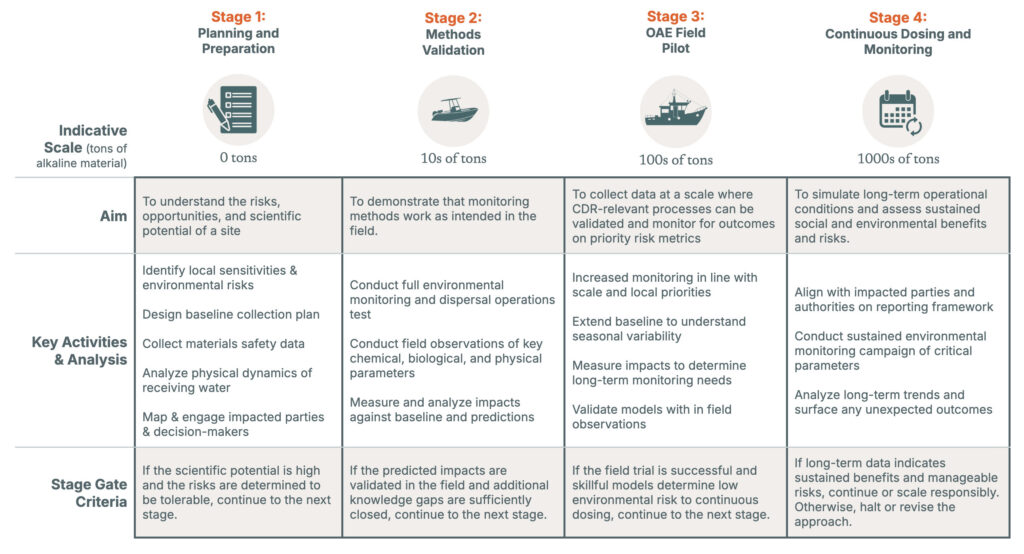
A central theme of this document is that environmental risk remains low and manageable when the scale of activity is matched by proportional gains in scientific understanding. Each stage advances only as the knowledge-base grows, decision gates create deliberate points for critical evaluation, and monitoring is positioned not as a remedy for impacts but as the final layer of a risk-mitigation process that begins with careful planning and dispersal design.
Rather than treating deployment as a binary, “ready or not”, the framework breaks progress into four distinct stages:
- Planning & Preparation: where risks are identified, baseline conditions are established, and community engagement begins;
- Methods Validation: where small-scale tests confirm that dispersal and monitoring approaches behave as expected;
- Field Pilots: where experiments expand to a scale sufficient to observe meaningful biogeochemical and ecological responses; and
- Continuous Dosing & Monitoring: where longer-term deployments are evaluated for sustained benefits and manageable risks.
Each stage forces a check against our expectations: Did the system behave as planned? Are the risks well understood and manageable? If not, the framework calls for a pause and revision. On the surface, this might seem frustrating to teams in the midst of expensive, high stakes projects. But in this early stage of the field, we must go slowly to go far. The pace should be set by what the project is able to demonstrate, and the trust they are able to build along the way.
What It Means to Monitor Responsibly
One of the most consistent points of confusion in this field is what “good monitoring” looks like in practice. The framework addresses this directly by first establishing a process to identify the environmental risks to a specific method, project, and location. Each monitoring strategy should reflect the unique context of the project and are distinguished between three categories:
- Regulatory parameters that are most often called forward by regulators to ensure environmental safety (e.g., pH, temperature, salinity, suspended solids, trace metals)
- Attribution parameters that help explain observed changes (e.g., dissolved oxygen, alkalinity, carbon system dynamics, plankton response)
- Context-specific parameters tailored to local ecosystems, species, and use cases
Just as importantly, the framework makes clear that monitoring is not a substitute for risk mitigation. Good experimental design (including site selection, dilution strategies, dispersal engineering and timing) must do the first and most important work of reducing risk before a monitoring even begins. In other words: we cannot out-monitor poor experimental design.
An invitation to participate
All progress in emerging fields is socially negotiated, and this project was no exception. The topics in this document are rich and the hands that touched it numerous. Debates played out in the hallways of workshops, over long comment threads, and across disciplines that do not always share language or assumptions.
This framework does not remove uncertainty, but offers a way to move forward responsibly in its presence. An aligned network of research and demonstration projects, each contributing its results openly, offers the field its best opportunity to advance quickly, responsibly, and with public confidence intact. The authors hope this framework will encourage additional teams to apply, test, and improve upon these approaches, and together build the knowledge infrastructure for the benefit of the field.
We hope you agree and join us as we launch and promote this resource.
If you would like a printed copy of the OAE Environmental Impact Monitoring Framework, please fill out this form. We will cover the cost of printing and shipping for the first 50 respondents. Please submit your request by October 1, 2026.
To view the full text of the framework, please follow this link.